
Technical Sergeant (TSgt) Professional Development Guide (PDG) Practice Test
$69.00
- Buy to unlock unlimited access to all Quiz questions.
- After purchase you can print a PDF of the whole quiz at any point. The PDF will contain the questions and the correct answers.
About this Exam
The Technical Sergeant (TSgt) Professional Development Guide (PDG) Practice Test is an essential tool for United States Air Force Staff Sergeants (E-5) preparing for promotion to Technical Sergeant (E-6).
This practice test is specifically designed to help Airmen master the material contained in Air Force Handbook 1 (AFH-1), which serves as the Professional Development Guide. It is tailored for ambitious NCOs who want to refine their knowledge of leadership principles, military history, standards, and regulations to succeed in the highly competitive Weighted Airman Promotion System (WAPS) testing cycle.
Ready to test your knowledge?
Buy Now to Access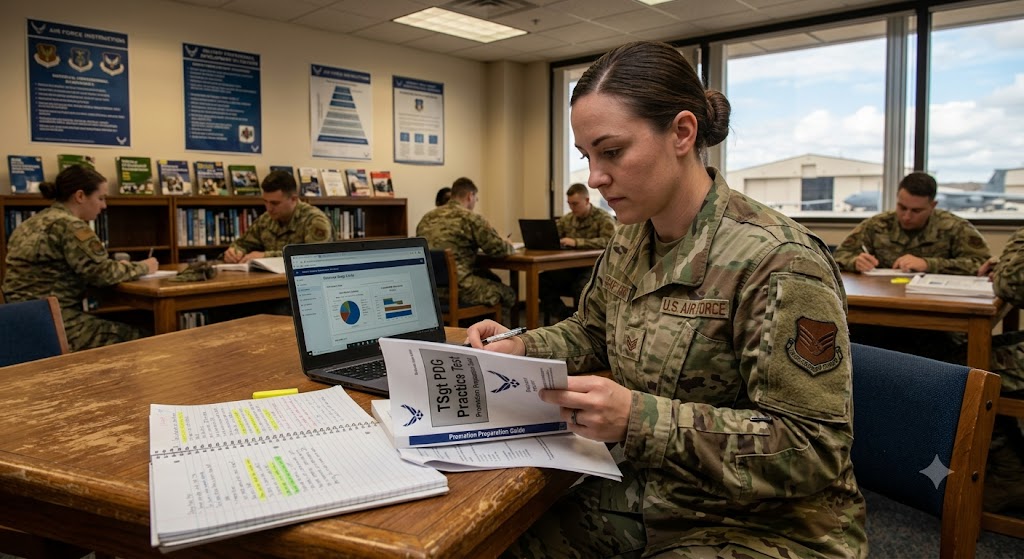
Additional Information
What the Course Entails and Exam Details
The core of the study material covered by this practice test is derived directly from the PDG (AFH-1). The test focuses on critical areas necessary for the transition to supervisory roles.
Key topics included in the preparation course and practice exams are:
Air Force Leadership and Management: Studying effective leadership behaviors, counseling techniques, mentoring, and the responsibilities of a Non-Commissioned Officer (NCO).
Enlisted Force Structure: Understanding the specific roles, responsibilities, and expectations for all enlisted ranks, particularly the distinctions of the Senior NCO tier.
Military History and Heritage: Reviewing significant events, figures, and milestones that have shaped the Air Force.
Standards of Conduct and Professionalism: Mastering ethics, military customs and courtesies, drill and ceremonies, and the Air Force Core Values.
Air Force Doctrine and Organization: Familiarization with the strategic mission of the Air Force, joint operations, and major command structures.
What to Expect in the Final Exam
The actual promotion test administered by the Air Force, which this practice test replicates, is one component of the Weighted Airman Promotion System (WAPS).
While this is a practice guide, the official promotion exam format typically consists of:
Format: 100 multiple-choice questions derived solely from the Professional Development Guide (AFH-1). Note: Airmen also take a separate Specialty Knowledge Test (SKT) specific to their career field.
Time Limit: Airmen are generally allotted approximately 90 minutes to complete the PDG portion of the promotion exam.
Scoring: A minimum score is required to be eligible for promotion consideration. High scores on the PDG and SKT are crucial, as they are heavily weighted alongside other factors like Enlisted Performance Reports (EPRs), decorations, and time in service/grade.
How to Study and Exam Centers
Effective preparation for the TSgt promotion test requires a consistent, multi-faceted study strategy.
Recommended study methods include:
Repeated Practice Tests: Utilizing practice exams like this one to identify knowledge gaps, get comfortable with the multiple-choice format, and practice time management.
Comprehensive Review of AFH-1: Systematically reading and highlighting key information directly from the official Professional Development Guide.
Flashcards and Study Groups: Engaging with peers to test recall of terminology, historical facts, and leadership principles.
Taking the Official Exam: The official WAPS promotion testing is scheduled and administered through your unit’s training office or the base Education Center. Exams are taken in-person at designated, secure military testing facilities, typically located on Air Force installations world-wide.
Job Opportunities from the Course
Successfully mastering the material in the PDG and scoring well on the promotion exam is the primary requirement for promotion to Technical Sergeant (E-6). Achieving the rank of TSgt unlocks significantly increased leadership opportunities and career paths, including:
Flight Chief
Section Chief
Non-Commissioned Officer in Charge (NCOIC)
Additional Duty First Sergeant
Enlisted Professional Military Education (EPME) Instructor
Increased supervisory and mentorship responsibilities within your specific AFSC (career field)
Frequently Asked Questions
Reviews
5.0
Based on 0 reviews
Leave a Review
No reviews yet. Be the first to review!