
Technical Rescue I Rope Rescue Certification Practice Exam
$69.00
- Buy to unlock unlimited access to all Quiz questions.
- After purchase you can print a PDF of the whole quiz at any point. The PDF will contain the questions and the correct answers.
About this Exam
The Technical Rescue I Rope Rescue Certification is a foundational level credential designed for emergency responders, fire service personnel, search and rescue (SAR) team members, and industrial safety professionals.
This certification validates that an individual possesses the essential knowledge and skills required to safely and effectively participate in rope-based rescue operations.
It is often the first step for individuals seeking specialized training in technical rescue disciplines and ensures standard proficiency in using rope systems for life safety.
Ready to test your knowledge?
Buy Now to Access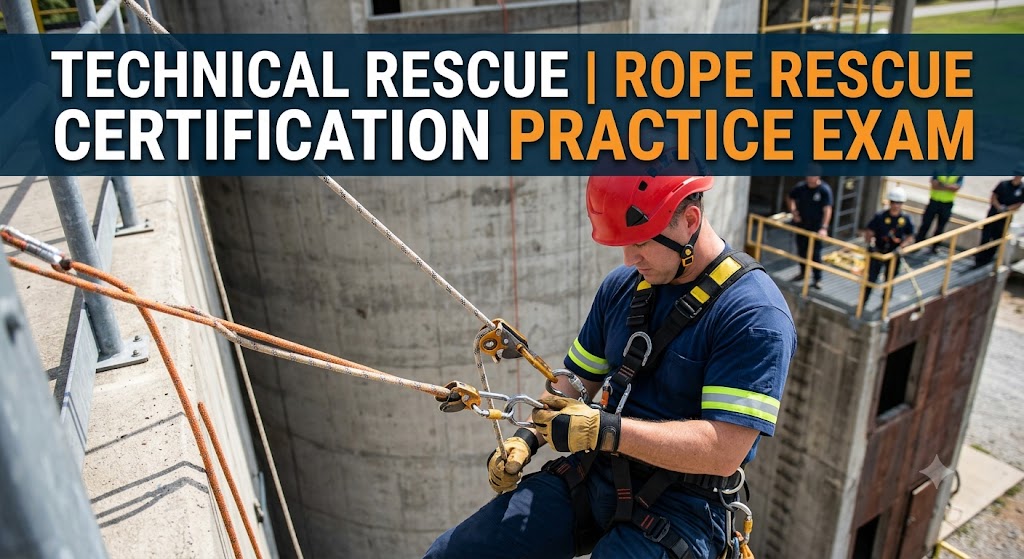
Additional Information
What the Course Entails and Exam Details
The course curriculum covers the fundamental principles of rope rescue as outlined by national standards, such as NFPA 1006.
Core topics typically include:
Rope construction, care, and inspection procedures.
Mastery of essential rescue knots and hitches.
Selection and construction of secure anchor systems.
Understanding and implementation of belay and fall protection systems.
Design and operation of mechanical advantage systems (simple and compound).
Safe rappelling techniques and ascending methods.
Basic patient packaging and litter management in low-angle environments.
The associated exam process typically includes both a written evaluation and a comprehensive practical skills demonstration.
What to Expect in the Final Exam
The final certification exam assesses proficiency in both theory and hands-on application.
Written Exam: Candidates will complete a written test, often formatted as multiple-choice questions, covering rope rescue theory, equipment specifications, safety standards, and operational calculations. A minimum passing score (typically around 70% to 80%) is required.
Practical Skills Evaluation: The core of the exam involves demonstrating mastery of essential practical skills. Candidates will be required to perform specific tasks such as tying essential knots within time limits, constructing anchor systems, setting up and operating mechanical advantage systems, and participating as a team member in a mock rescue scenario. The practical components are often evaluated on a pass/fail basis against established critical skill criteria.
How to Study and Exam Centers
Preparation is crucial for success on both the written and practical portions of the exam.
Study Strategies: Review your course textbook and materials thoroughly, focusing on NFPA standards. Create flashcards for knots, terminology, and system definitions. Utilize online practice quizzes and practice exams to simulate the written test format and identify knowledge gaps. Most importantly, dedicate significant time to hands-on practice. Regularly tie knots until you can do them proficiently and practice building rigging systems with qualified instructors.
Exam Centers: The final certification exam is typically administered by accredited state fire training academies, regional training centers, or private training organizations authorized by the certifying body. In many regions, the certifying authority (such as a state fire marshal's office or an international accreditation service like IFSTA or ProBoard) proctors the evaluations at designated physical locations. You should contact your training provider or state’s fire certification office for specific information on approved testing sites and scheduling.
Job Opportunities from the Course
Earning the Technical Rescue I Rope Rescue certification enhances career prospects in several fields. Common job opportunities include:
Firefighter (specifically within departments with specialized rescue or T-Rex teams)
Urban Search and Rescue (USAR) Task Force Member
Professional Search and Rescue (SAR) Technician
Industrial Rescue Team Member (for confined space or high-angle environments)
Emergency Medical Services (EMS) specialized response personnel
Wind Turbine Maintenance and Rescue Technician
Amusement Park Maintenance and Rescue Staff
Frequently Asked Questions
Reviews
5.0
Based on 0 reviews
Leave a Review
No reviews yet. Be the first to review!