
Technical Communication Practice Exam
$69.00
- Buy to unlock unlimited access to all Quiz questions.
- After purchase you can print a PDF of the whole quiz at any point. The PDF will contain the questions and the correct answers.
About this Exam
The Technical Communication Certification is a professionally recognized credential designed for individuals who specialize in transforming complex technical, scientific, or engineering information into clear, concise, and user-friendly documentation. This certification validates your expertise in analyzing audience needs, designing information architecture, and creating accessible content across various media.
It is ideally suited for aspiring and current technical writers, content strategists, documentation specialists, information designers, editors, and anyone working in technical industries—such as software, engineering, healthcare, or finance—who seeks to prove their competency in professional communication.
Ready to test your knowledge?
Buy Now to Access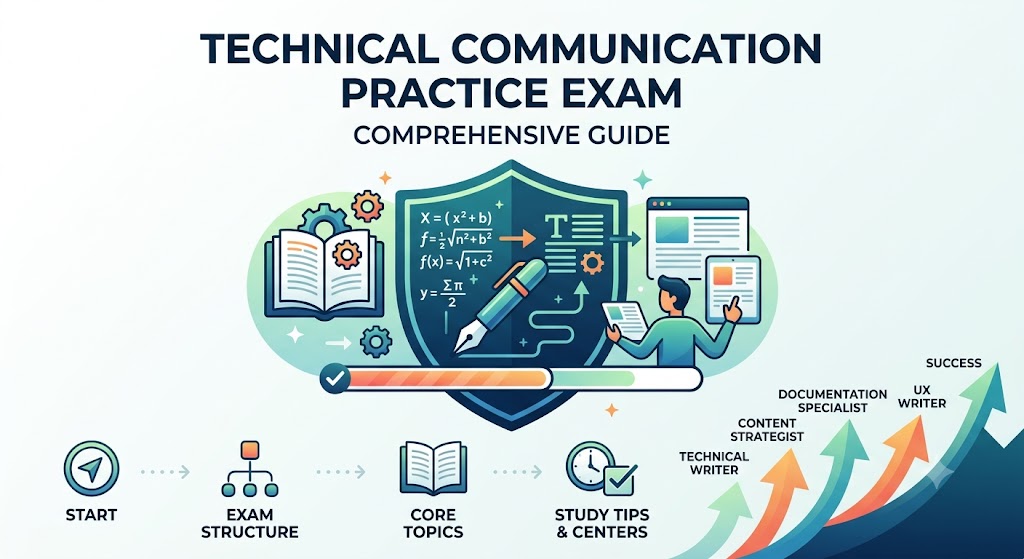
Additional Information
What the Course Entails and Exam Details
The course leading to this certification, and the subsequent exam, focuses on a comprehensive set of skills necessary for success in the field. Core topics typically covered include:
Information Design Principles: Understanding how to structure information logically for maximum user comprehension.
User Experience (UX): Integrating usability and user-centered design into documentation.
Content Strategy: Planning, developing, and managing content throughout its lifecycle.
Technical Writing Styles: Mastering clarity, conciseness, and accuracy in technical communication.
Editing: Applying style guides and editing for grammar, consistency, and tone.
Multi-Channel Publishing: Creating content for print, web, mobile, and online help systems.
Ethical Communication: Understanding intellectual property, copyright, and ethical considerations.
The ultimate exam details, specific to the certifying body, generally involve verifying these competencies through a rigorous testing process.
What to Expect in the Final Exam
The final exam for the Technical Communication Certification is a comprehensive assessment designed to measure your mastery of the curriculum. While specific formats can vary by certifying organization (such as the Society for Technical Communication or similar bodies), you can generally expect the following:
Format: The exam usually consists of a combination of multiple-choice questions, scenario-based problem-solving tasks, and potentially a practical writing or editing component where you must apply your skills to a given technical prompt.
Time Limit: You will typically be given a strict time limit, often ranging from 90 minutes to three hours, depending on the complexity of the practical sections.
Passing Score: The passing score is set by the certifying body and requires a solid understanding of both theoretical concepts and practical applications.
How to Study and Exam Centers
Achieving this certification requires dedicated preparation. Here are effective strategies:
Review Official Materials: Your primary source should be the official study guides, textbooks, and recommended reading lists provided by the certifying organization.
Practice Writing and Editing: Apply your skills by creating documentation for sample projects and having it reviewed by peers or mentors. Focus on clarity and user accessibility.
Take Practice Exams: Utilize official and reputable practice exams to familiarize yourself with the question format and manage your time effectively.
Exam Centers and Delivery:
Most technical communication certification exams are administered globally. You can generally take them in two ways:
Online Portals: Many certifying bodies offer secure, proctored online exams that you can take from your own home or office, provided you meet specific technical and environmental requirements.
Authorized Testing Centers: Alternatively, exams may be delivered through recognized, secure testing center networks such as Pearson VUE or Prometric, which have physical locations worldwide. Some specific schools or institutions may also be authorized centers.
Always check the official website of your chosen certifying body for the most current information on exam registration and delivery options.
Job Opportunities from the Course
Earning this certification opens doors to a wide variety of rewarding career paths across virtually all technical industries. Key job titles and roles include:
Technical Writer: Creating user manuals, installation guides, API documentation, and help systems.
Information Developer: Designing and building comprehensive information architectures.
Content Strategist: Planning content lifecycle and ensuring content meets business and user needs.
Documentation Specialist: Managing and maintaining large-scale product documentation suites.
UX Writer: Crafting clear and concise microcopy for software interfaces and user journeys.
Editor/Proofreader (Technical): Ensuring accuracy, consistency, and clarity in technical content.
Policy and Procedure Writer: Developing clear internal guidelines for organizations.
Medical or Scientific Writer: Translating complex medical or scientific data for broad audiences.
Proposal Writer: Creating compelling and clear technical proposals for business development.
Frequently Asked Questions
Reviews
5.0
Based on 0 reviews
Leave a Review
No reviews yet. Be the first to review!