
Technetium (Tc) Labeled Radiopharmaceuticals Practice Test
$69.00
- Buy to unlock unlimited access to all Quiz questions.
- After purchase you can print a PDF of the whole quiz at any point. The PDF will contain the questions and the correct answers.
About this Exam
This comprehensive practice test is designed for professionals and students in the fields of nuclear medicine technology, radiopharmacy, and medical physics who are preparing for a specialized certification or competency exam focused on Technetium-99m (Tc-99m) labeled radiopharmaceuticals. This exam evaluates the knowledge essential for safely producing, labeling, controlling quality, and visually interpreting the results of Tc-99m compounds, which are used in the majority of all diagnostic nuclear imaging procedures worldwide. If you are aiming to validate your expertise, advance your career as a Nuclear Medicine Technologist, or become a certified Radiopharmacist, this practice test is your critical stepping stone.
Ready to test your knowledge?
Buy Now to Access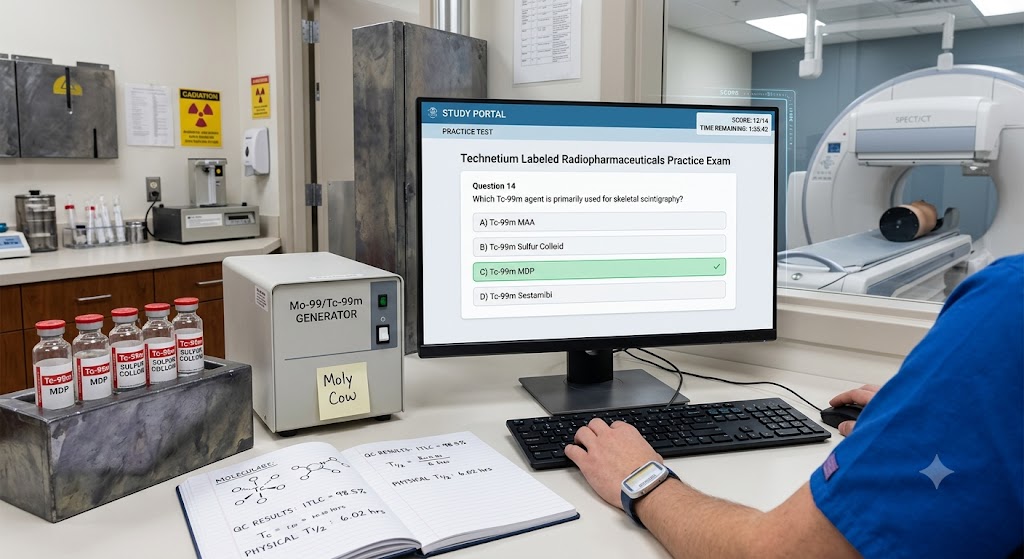
Additional Information
What the Course Entails and Exam Details
This examination covers a multi-disciplinary curriculum, ensuring mastery of both theoretical principles and practical applications of Tc-99m radiopharmaceuticals. The practice test, mirroring official exams, requires in-depth knowledge of the following core areas:
Core Physics and Radioisotope Production: Principles of radioactive decay, the physics of Tc-99m, and the operation, chemistry, and quality control (e.g., Molybdenum-99 breakthrough) of the Mo-99/Tc-99m generator system.
Radiochemistry and Labeling Methods: Technetium chemistry, the pertechnetate ion (TcO₄⁻), reduction states, use of stannous ion (Sn²⁺), and the mechanisms of chelation with various ligands.
Quality Control (QC) Procedures: Performance and analysis of QC tests for radionuclidic, radiochemical (e.g., instant thin-layer chromatography, ITLC), and chemical purity, ensuring product efficacy and safety.
Specific Tc-99m Compounds and Clinical Applications: Mechanism of localization, preparation, dosages, and corresponding diagnostic imaging indications for key compounds, including:
Tc-99m MDP (Bone Scintigraphy)
Tc-99m Sulfur Colloid (Liver, Spleen, Bone Marrow, Lymphoscintigraphy)
Tc-99m MAA (Pulmonary Perfusion)
Tc-99m Sestamibi / Tetrofosmin (Myocardial Perfusion)
Tc-99m DTPA (Renal GFR, Brain Death)
Tc-99m MAG3 (Renal Function)
Tc-99m HIDA (Hepatobiliary Imaging)
Tc-99m Bicisate / Exametazime (Brain Perfusion)
Tc-99m Red Blood Cells (GI Bleed, Hemangioma, Ventriculography)
Instrumentation and Diagnostic Imaging Interpretation: Proper operation of dose calibrators and gamma cameras (SPECT/CT), artifacts, and the visual appearance of normal versus abnormal tracer distribution in planar and tomographic images.
Internal Dos dosimetry and Radiation Safety: Principles of dosimetry (MIRD), radiation units, safe handling of radioactive materials, waste disposal, regulations, and patient care.
What to Expect in the Final Exam
The final certification exam is a computer-based, multiple-choice question (MCQ) assessment.
Format: The test typically consists of approximately 100 to 150 multiple-choice questions. In some cases, examinations may be Computer Adaptive Tests (CAT), meaning the difficulty of questions adjusts based on your performance.
Passing Score: Requirements vary by the certifying body. Often, a scaled score is used (e.g., a minimum scaled score of 700 on a 200-1000 scale, or a general 70-75% unscaled score).
Time Limit: Candidates are typically allotted 2 to 3 hours to complete the examination.
Rules: Exams are proctored. No external resources, calculators, or devices are permitted unless specifically authorized.
How to Study and Exam Centers
Effective preparation requires a structured study plan:
Study Official Specifications: Obtain and meticulously review the detailed content outline or components of preparedness published by the certifying body (e.g., NMTCB, ARRT). Use these as your primary study guide.
Practice with Targeted Mock Exams: This is your most valuable tool. Utilize multiple practice tests to get accustomed to the MCQ format, improve your time management, and identify weak areas for focused review.
Review Accrued Notes and Texts: Go back to your comprehensive lecture notes, reference textbooks, and professional guidelines from organizations like the Society of Nuclear Medicine and Molecular Imaging (SNMMI) or the American Society of Radiologic Technologists (ASRT).
Join Review Courses: Participate in SNMMI or ASRT-endorsed review sessions, often offered during annual meetings or online.
Exam Centers: Official examinations are not administered at physical schools. After your application is approved by the certifying board (such as the Nuclear Medicine Technology Certification Board (NMTCB) or the American Registry of Radiologic Technologists (ARRT)), you will receive an "Eligibility Letter." This letter allows you to schedule your exam at an authorized, secure testing center (e.g., Pearson VUE or Prometric).
Job Opportunities from the Course
A specialty certification in Technetium (Tc) Labeled Radiopharmaceuticals significantly enhances your value in the healthcare market, unlocking specialized roles and leadership positions. Career paths include:
Nuclear Medicine Technologist (NMT), with a designated specialty.
Radiopharmacist, specializing in Tc-99m compounds.
Radiopharmacy Manager.
Hot Lab Supervisor.
Clinical Application Specialist (for radiopharmaceutical or imaging equipment manufacturers).
Health Physics Assistant / Radiation Safety Officer.
Nuclear Medicine Educator / Program Director.
Research Technologist.
Frequently Asked Questions
Reviews
5.0
Based on 0 reviews
Leave a Review
No reviews yet. Be the first to review!