
Teachworthy Practice Test
$69.00
- Buy to unlock unlimited access to all Quiz questions.
- After purchase you can print a PDF of the whole quiz at any point. The PDF will contain the questions and the correct answers.
About this Exam
The CompTIA A+ certification is the industry standard for establishing a career in IT. This performance-based certification validates foundational skills across a variety of devices and operating systems, making it the go-to credential for technical support and IT operational roles. The CompTIA A+ core series requires passing two exams: Core 1 (220-1101) and Core 2 (220-1102).
It is designed for individuals looking to enter the IT workforce, including high school or college students, career changers, or entry-level technicians who want to validate their skills and enhance their employability.
Ready to test your knowledge?
Buy Now to Access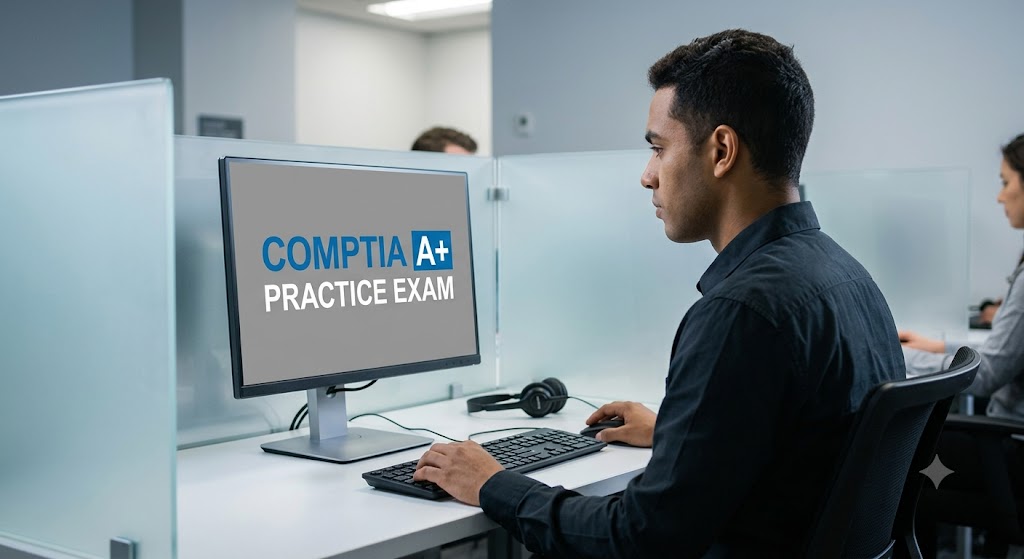
Additional Information
What the Course Entails and Exam Details
This certification covers the essential knowledge needed for entry-level IT roles. The curriculum is split across two domains, corresponding to the two required exams:
CompTIA A+ Core 1 (220-1101) focuses on mobile devices, networking technology, hardware, virtualization, and cloud computing.
Mobile Devices: Installing and configuring laptops and other mobile devices.
Networking: Explaining types of networks and connections (TCP/IP, WIFI, SOHO).
Hardware: Identifying, using, and connecting hardware components and devices, including printing.
Virtualization & Cloud Computing: Comparing and contrasting cloud computing concepts and setting up client-side virtualization.
Hardware & Network Troubleshooting: Troubleshooting device and network issues.
CompTIA A+ Core 2 (220-1102) focuses on operating systems, security, software troubleshooting, and operational procedures.
Operating Systems: Installing and configuring Windows, Mac, Linux, and mobile OS.
Security: Identifying and protecting against security vulnerabilities for devices and their network connections.
Software Troubleshooting: Troubleshooting PC and mobile device issues, including application security support.
Operational Procedures: Following best practices for safety, environmental impacts, communication, and professionalism.
What to Expect in the Final Exam
The CompTIA A+ certification consists of two separate exams (220-1101 and 220-1102). You must pass both to earn the certification.
Exam Format: Each exam features a maximum of 90 questions. The questions are a combination of multiple-choice (single and multiple response), drag-and-drop, and performance-based questions (PBQs). PBQs test your ability to solve problems in a simulated environment.
Time Limit: You have 90 minutes to complete each exam.
Passing Score: The passing scores are different for each exam:
CompTIA A+ 220-1101 (Core 1): 675 (on a scale of 100-900)
CompTIA A+ 220-1102 (Core 2): 700 (on a scale of 100-900)
How to Study and Exam Centers
Successfully passing the CompTIA A+ exams requires a combination of conceptual knowledge and hands-on experience.
Study Strategies:
Official Study Guides: Start with official CompTIA CertMaster Learn materials or reputable third-party study guides (like those by Mike Meyers or Professor Messer).
Practice Tests: Taking practice exams is crucial. They help you get used to the question format, manage your time, and identify areas where you need more review.
Hands-on Labs: Use virtual lab environments or set up your own practice lab with old computers to gain practical experience with hardware and software configuration.
Exam Centers: CompTIA exams are administered by Pearson VUE. You can take the exams in two ways:
In-Person Testing: You can schedule your exam at one of the thousands of Pearson VUE authorized testing centers worldwide. This offers a traditional, proctored environment.
Online Testing (OnVUE): You can take the exam from the comfort of your home or office. This option requires a reliable internet connection, a webcam, and a private space, and it is proctored remotely.
Job Opportunities from the Course
Earning your CompTIA A+ certification significantly boosts your resume for entry-level IT positions. The certification is highly recognized by employers and unlocks several career paths, including:
Help Desk Technician
IT Support Specialist
Field Service Technician
Technical Support Analyst
Desktop Support Administrator
Junior Systems Administrator
Associate Network Engineer
Frequently Asked Questions
Reviews
5.0
Based on 0 reviews
Leave a Review
No reviews yet. Be the first to review!