
Teacher Licensure Practice Test & Exam Prep | Sierra Leone
$69.00
- Buy to unlock unlimited access to all Quiz questions.
- After purchase you can print a PDF of the whole quiz at any point. The PDF will contain the questions and the correct answers.
About this Exam
The Sierra Leone Teacher Licensure Exam is a standardized professional certification assessment administered by the Teaching Service Commission (TSC). It is designed exclusively for individuals who have completed their teacher training education (such as HTC, TC, or B.Ed.) and wish to be officially licensed to practice as professional teachers in government and government-assisted schools. The primary purpose of this licensure exam is to uphold and elevate the educational standards within Sierra Leone. By rigorously testing a candidate's readiness, the TSC ensures that only qualified, competent, and ethical individuals are entrusted with shaping the minds of the nation's future generations. Passing this exam is not just a legal requirement; it is a professional declaration of your commitment to educational excellence.
Ready to test your knowledge?
Buy Now to Access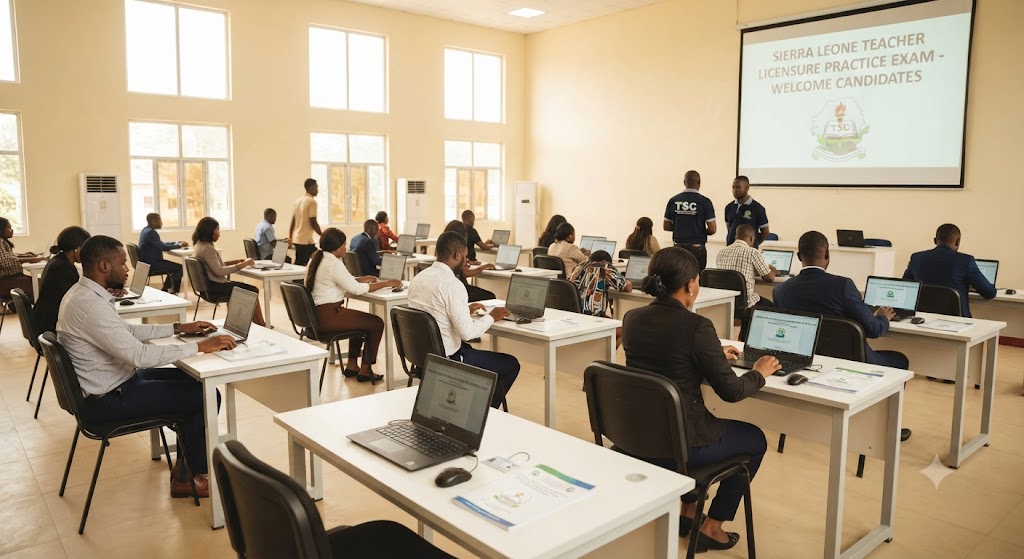
Additional Information
What the Course
Entails and Exam Details
The SLTLE is comprehensive, covering both the academic depth
of your subject specialization and the essential principles of professional
teaching. The curriculum and exam are structured around several core domains
designed to assess a holistic teaching capability.
Candidates must demonstrate proficiency in the following key
areas:
- General
Professional Knowledge: This section evaluates your understanding of
the fundamental theories of education, educational psychology, child
development, and classroom management techniques.
- Pedagogical
Content Knowledge (Methodology): This critical area tests your ability
to effectively teach the specific subjects you are licensed in. It covers
lesson planning, instructional strategies, curriculum implementation, and
assessment methods suitable for different grade levels.
- Subject
Matter Specialization: You will be examined on the depth and breadth
of your chosen subject areas (e.g., Mathematics, English Language,
Integrated Science, Social Studies, etc.) based on the national curriculum
you intend to teach.
- Professional
Ethics, Law, and Policies: This section ensures you are familiar with
the Sierra Leone Teachers' Code of Conduct, relevant education policies,
child protection laws, and the legal framework governing the education
sector.
- General
Studies and Communication Skills: This often includes tests of general
knowledge, logical reasoning, and proficiency in the English language
(both written and spoken) to ensure effective communication within the
school environment.
The exam is designed to confirm that you are not only
knowledgeable but also capable of applying that knowledge practically in a
dynamic classroom setting.
What to Expect in
the Final Exam
The Sierra Leone Teacher Licensure Exam is structured as a
multi-part assessment, primarily utilizing objective testing methods to ensure
fair and standardized evaluation. While the exact format may be updated by the
TSC, the typical structure includes:
- Format:
The exam is predominantly administered as a Computer-Based Test (CBT). It
consists largely of multiple-choice questions (MCQs) designed to cover a
wide range of topics quickly and objectively. There may also be sections
requiring constructed responses or essay-type answers, particularly for
assessing lesson planning and pedagogical application.
- Passing
Score: The Teaching Service Commission sets a specific passing score
(often a percentage threshold, such as 50% or 60% overall, with minimum
requirements in key sections). To pass, candidates must meet or exceed
this predetermined benchmark across all papers or sections of the exam.
- Time
Limits: Each paper or subject area of the exam is strictly timed.
Candidates must manage their time effectively during the CBT to ensure
they answer all questions within the allotted period.
- Exam
Rules and Regulations: Strict examination ethics are enforced.
Candidates are typically prohibited from bringing unauthorized materials,
such as mobile phones, smartwatches, or personal notes, into the
examination hall. Valid photo identification (like a National ID or Voter
Card) and your exam registration slip are mandatory for entry. Any form of
examination malpractice, including cheating or collusion, is severely
penalized and can result in disqualification and a permanent ban from the
teaching profession.
Preparation should therefore focus not only on what
to study but also on how to efficiently navigate the digital testing
interface under time constraints.
How to Study and
Exam Centers
Success in the SLTLE requires a disciplined and strategic
approach to studying. Start by obtaining the official syllabus and recommended
reading list provided by the Teaching Service Commission or the relevant
tertiary institutions.
Actionable Study Strategies:
- Create
a Structured Study Plan: Allocate specific time slots each day to
cover different subjects from the syllabus. Be realistic and consistent.
- Utilize
Past Questions: This is one of the most effective preparation methods.
Obtain official past questions and answers for the SLTLE. Practicing these
will familiarize you with the question patterns, the depth of knowledge
required, and the phrasing used in the exam.
- Join
Study Groups: Collaborating with peers can help clarify difficult
concepts and keep you motivated. Discussing pedagogical scenarios with
others can deepen your understanding.
- Focus
on Methodology: Don't just memorize facts; understand how to
teach them. Practice creating lesson plans and analyzing case studies
related to classroom challenges.
- Take
Mock Exams: Simulate the exam environment by taking timed practice
tests, especially using the online portal if available. This helps build
stamina and improves time management.
Exam Registration and Centers:
- Registration:
All candidates must register officially through the designated Teaching
Service Commission (TSC) online portal. Ensure all personal details and
qualifications are accurately uploaded during registration. You will be
required to pay the prescribed examination fee.
- Exam
Centers: The SLTLE is administered nationwide at designated centers
approved by the TSC. These centers are usually located in major towns and
cities across all districts of Sierra Leone (e.g., Freetown, Bo, Kenema,
Makeni, Port Loko). When registering, candidates will be able to select a
preferred center from the available options, typically on a first-come,
first-served basis. Be sure to confirm your assigned center and seat
number well in advance of the exam date.
Job Opportunities
from the Course
Successfully passing the Sierra Leone Teacher Licensure Exam
and obtaining your professional license unlocks a wide array of career
opportunities within the educational sector. This certification is your gateway
to secure, respected, and fulfilling roles.
Licensed professional teachers in Sierra Leone are qualified
for the following roles and career paths:
- Subject
Specialist Teacher: Teach your specific subject area (e.g.,
Mathematics, Physics, Literature) at the Junior Secondary School (JSS) or
Senior Secondary School (SSS) level in both public and private
institutions.
- Primary
School Teacher: Serve as a qualified educator for various subjects at
the primary school level, laying the foundational knowledge for young
learners.
- Early
Childhood Educator: Utilize specialized training to teach and nurture
children in pre-school and nursery settings (if your licensure covers this
specialization).
- Head
Teacher / Principal: With experience and further professional
development, licensed teachers can advance into leadership roles, managing
schools and guiding educational policy implementation at the school level.
- Educational
Administrator / Supervisor: Work within the Ministry of Basic and
Senior Secondary Education (MBSSE) or the Teaching Service Commission in
administrative, supervisory, or quality assurance roles.
- Curriculum
Developer: Contribute to the development and improvement of national
educational curricula and instructional materials.
- NGO
Education Officer: Many non-governmental organizations focused on
education in Sierra Leone require licensed teachers to manage projects,
train other educators, and implement community-based learning initiatives.
- Private
Tutor / Academic Coach: Offer specialized, high-quality private
tutoring services, commanding higher fees due to your certified
professional status.
Your teaching license is a valuable asset that provides job
security, opportunities for career advancement, and the personal satisfaction
of contributing directly to the development of Sierra Leone.
Frequently Asked Questions
Reviews
5.0
Based on 0 reviews
Leave a Review
No reviews yet. Be the first to review!