
TDLR Class A Barber Practice Exam
$69.00
- Buy to unlock unlimited access to all Quiz questions.
- After purchase you can print a PDF of the whole quiz at any point. The PDF will contain the questions and the correct answers.
About this Exam
The TDLR Class A Barber License is the premier certification required to practice professional barbering legally in the state of Texas.
This license is designed for individuals who aspire to perform comprehensive barbering services, including cutting, styling, highlighting, and shaving.
This certification ensures that practitioners possess the essential knowledge and practical skills required to maintain high standards of safety, sanitation, and technical proficiency in the barbering industry.
Earning this license is a mandatory requirement for anyone wishing to launch a successful career as a barber within Texas.
Ready to test your knowledge?
Buy Now to Access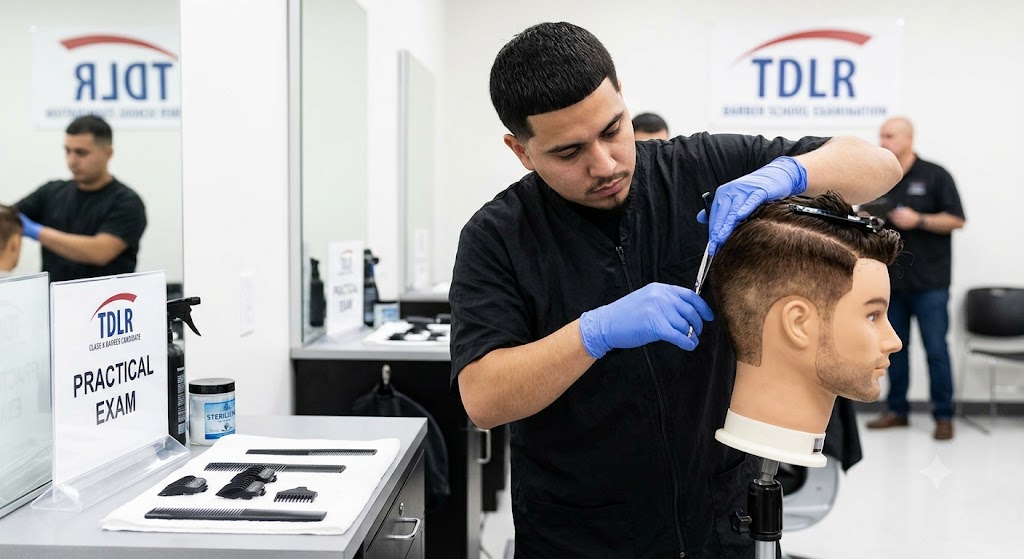
Additional Information
What the Course Entails and Exam Details
To qualify for the TDLR Class A Barber exam, candidates must first complete 1,000 hours of instruction at a licensed barber school.
The comprehensive curriculum is designed to cover both theoretical knowledge and practical application, ensuring well-rounded proficiency.
The course entails a rigorous syllabus that includes:
Sanitation, Sterilization, and Bacteriology: Crucial health and safety protocols for a professional environment.
Anatomy and Physiology: Understanding the structure and function of the skin, hair, and scalp.
Barbering History and Ethics: The foundations and professional conduct of the trade.
Hair Cutting and Styling: Advanced techniques in tapering, fading, and classic cuts.
Shaving and Beard Design: The art of the straight razor shave and facial hair grooming.
Chemical Services: Permanent waving, chemical hair relaxing, and coloring/highlighting.
Skin and Scalp Treatments: Facials and therapeutic massage techniques.
What to Expect in the Final Exam
The TDLR Class A Barber examination is a two-part process consisting of a written theory exam and a practical skills exam.
1. The Written (Theory) Exam:
This is a computer-based, multiple-choice test.
It covers topics like sanitation, licensing rules, hair analysis, and chemical services.
You are typically allotted about 100 minutes to complete approximately 100 questions.
A passing score of 70 is required to move forward to the practical section.
2. The Practical Exam:
This hands-on portion requires you to perform specific barbering services in front of a live proctor/examiner.
You must bring your own supplies and, depending on the exam site, potentially a mannequin or a live model.
Services evaluated include: Professional setup and sanitation, shaving, hair cutting (e.g., a taper cut), and potentially a chemical service application.
You are graded on technique, safety, infection control, and final appearance.
A passing score of 70 is also required for the practical portion.
How to Study and Exam Centers
Preparation is key to succeeding on both portions of the exam. Here are the best ways to prepare:
Study Strategies:
Utilize a Practice Exam: Engaging with a comprehensive TDLR Class A Barber Practice Exam is the single most effective way to become familiar with the written exam structure, timing, and question types. This builds confidence and identifies knowledge gaps.
Review the Candidate Information Bulletin (CIB): TDLR provides a free CIB that explicitly lists the content areas, reading lists, and practical exam criteria. This should be your study bible.
Hands-on Drill: Practice every practical service repeatedly under timed conditions. Focus on efficient setup and strict sanitation protocols—these are pass/fail criteria.
Review School Theory Material: Re-read your Milady or Pivot Point textbooks, focusing on anatomy, chemistry, and state regulations.
Exam Centers:
The written exam is administered through a third-party testing service, primarily PSI Services. They operate numerous testing centers throughout Texas (e.g., Austin, Dallas, Houston, El Paso, etc.). You must schedule your appointment through PSI once TDLR confirms your eligibility.
The practical exam is also scheduled through PSI and is held at specific, authorized physical locations often associated with barber colleges or dedicated testing centers capable of hosting practical examinations.
Job Opportunities from the Course
Upon successfully passing both portions of the TDLR Class A Barber exam and receiving your license, you have a direct pathway to numerous career opportunities in a growing industry.
This license unlocks potential roles such as:
Professional Licensed Barber
Master Barber
Barbershop Manager or Owner
Platform Artist and Educator
Grooming Consultant
Barber School Instructor (requires additional licensing)
Product Representative and Brand Ambassador for barbering lines
Frequently Asked Questions
Reviews
5.0
Based on 0 reviews
Leave a Review
No reviews yet. Be the first to review!