
TDLR Boiler Commission Practice Exam
$69.00
- Buy to unlock unlimited access to all Quiz questions.
- After purchase you can print a PDF of the whole quiz at any point. The PDF will contain the questions and the correct answers.
About this Exam
The TDLR Boiler Commission exam, overseen by the Texas Department of Licensing and Regulation (TDLR), is a critical certification process for individuals who seek to become commissioned boiler inspectors in the state of Texas. This certification validates that an individual possesses the necessary technical knowledge and regulatory understanding to safely inspect and certify the operation of various boiler systems, ranging from low-pressure heating units to high-pressure power boilers. The exam is primarily designed for experienced individuals in the boiler industry, such as operators, mechanics, or engineers, who want to advance their careers into regulatory compliance and safety inspection. It ensures that all public and commercial boilers operate under strict safety standards to prevent accidents and protect the public.
Ready to test your knowledge?
Buy Now to Access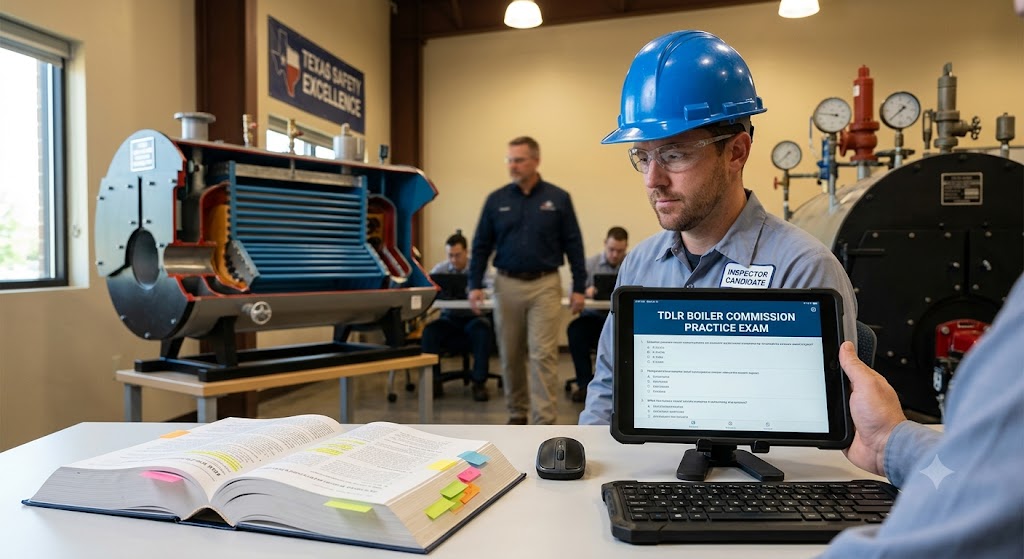
Additional Information
What the Course Entails and Exam Details
Preparing for the TDLR Boiler Commission exam requires a deep understanding of multiple engineering, regulatory, and safety disciplines. The core topics covered within a comprehensive study course, and subsequently on the exam, are meticulously designed to ensure a robust foundation in boiler technology.
A standard study path will entail mastery of the following:
ASME Boiler and Pressure Vessel Codes: In-depth knowledge of Section I (Power Boilers), Section IV (Heating Boilers), and Section VIII (Pressure Vessels) is fundamental.
Texas Boiler Law and Rules: Specific knowledge of the Texas Health and Safety Code, Chapter 755, and associated administrative rules (Title 16, Texas Administrative Code, Chapter 65).
Boiler Theory and Design: Understanding different boiler types (firetube, watertube), their operational principles, circulation systems, and combustion processes.
Fuel and Combustion Systems: Comprehensive knowledge of different fuel types (gas, oil, solid fuel), burner operation, and combustion safety controls.
Boiler Piping and Accessories: Understanding the function and code requirements for safety valves, water columns, gauge glasses, feed pumps, and blowdown systems.
Water Treatment: Knowledge of water chemistry, internal and external treatment methods to prevent scale and corrosion.
Inspection Procedures and Non-Destructive Examination (NDE): Learning how to conduct both internal and external inspections, and understanding NDE methods like ultrasonic and radiographic testing.
Safety Controls and Instrumentation: Mastering the installation, testing, and maintenance of all critical safety devices, including low-water cutoffs and pressure controls.
What to Expect in the Final Exam
The final TDLR Boiler Commission examination is a rigorous assessment of your ability to apply code requirements and safety principles in real-world scenarios. It is not merely a test of memorization but an evaluation of your analytical and problem-solving skills in the field.
The exam format and key details include:
Format: The exam is typically composed of multiple-choice and true/false questions.
Time Limit: Candidates are generally allocated a fixed time window, such as four hours, to complete the examination.
Passing Score: A minimum passing score of 70% is usually required to be eligible for the Texas commission.
Reference Material: While much of the test relies on ingrained knowledge, candidates are often permitted to use specific code books, such as approved editions of the ASME Code, as reference materials during the exam, reflecting the real-world need to look up precise engineering standards.
Structure: The exam is segmented to cover different areas of knowledge, including Code-specific sections and Texas-specific regulatory and safety sections.
How to Study and Exam Centers
Preparation is the key to success. Because of the vast amount of technical detail involved, structure is essential in your study plan.
Here are actionable study strategies:
Engage in a Practice Exam: A robust TDLR Boiler Commission Practice Exam is your single best tool. Use it not just for practice but to identify your weakest areas of knowledge.
Focus on the Code: Dedicate substantial time to reading and, more importantly, understanding how to navigate the ASME Code books. Practice looking up specific material specifications, design calculations, and inspection frequencies.
Master the Math: The exam often includes problems involving maximum allowable working pressure (MAWP) calculations, safety valve capacity requirements, and other formulas found in the Code.
Know Texas Regulations: Read the Texas Boiler Law and Rules thoroughly. Understand the state-specific definitions, inspection frequencies, and the exact roles and responsibilities of a commissioned inspector.
Join Study Groups: Interacting with others who are preparing can provide new perspectives on difficult code interpretations.
Exam Centers and Scheduling:
The TDLR has authorized PSI Exams, a leading global provider of assessment services, to administer the boiler commission examination. Candidates cannot schedule their exam until they have applied to TDLR and received an eligibility notification. Once approved, you can register through the PSI website (psiexams.com) and select a testing option.
You will have two convenient options:
Online Proctoring: Take the exam from your own computer at a quiet, secure location, monitored remotely by a live proctor.
Physical Testing Centers: Choose from a wide network of PSI Premier PLUS computer-based testing centers located throughout Texas and the United States.
Job Opportunities from the Course
Earning your commission from the Texas Department of Licensing and Regulation unlocks prestigious career paths focused on industrial safety and compliance. This certification is a public acknowledgment of your expertise.
Upon success, the core job titles and opportunities available to you include:
Texas Deputy Boiler Inspector: Employment directly with the state of Texas, performing regulatory inspections and investigations.
Authorized Boiler Inspector (AIA): Employment with an Authorized Inspection Agency, which are often insurance companies or specialized inspection firms, to conduct inspections on behalf of clients.
Boiler Inspection Manager: Leading a team of inspectors within a large industrial organization or a governmental body.
Quality Control (QC) Manager: Overseeing boiler repair and manufacture shops to ensure adherence to ASME and National Board requirements.
Loss Control Specialist: Working for insurance companies to assess risk in facilities with high-pressure equipment.
Chief Engineer: Assuming leadership in plant operations where deep compliance knowledge is paramount.
Regulatory Compliance Officer: Ensuring an entire organization meets all local, state, and federal safety codes.
Frequently Asked Questions
Reviews
5.0
Based on 0 reviews
Leave a Review
No reviews yet. Be the first to review!