
TDCJ Region 1 Training Academy Practice Test
$69.00
- Buy to unlock unlimited access to all Quiz questions.
- After purchase you can print a PDF of the whole quiz at any point. The PDF will contain the questions and the correct answers.
About this Exam
Launching a career within the Texas Department of Criminal Justice (TDCJ) is a path chosen by dedicated individuals. The TDCJ Region 1 Training Academy serves as a critical entry point for new recruits, providing the foundational knowledge and physical training necessary for success. This practice test is designed specifically for aspiring correctional officers and staff preparing for the challenging academic and practical evaluations they will encounter during the academy program. By simulating the exam experience, this comprehensive tool helps candidates build confidence, identify knowledge gaps, and master the complex topics required for official certification and a rewarding future in corrections.
Ready to test your knowledge?
Buy Now to Access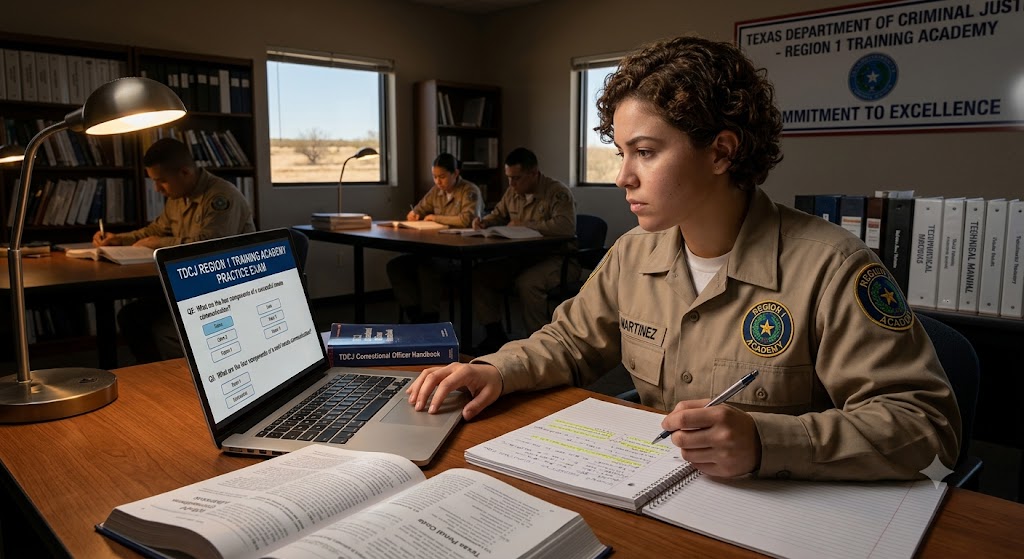
Additional Information
What the Course Entails and Exam Details
The TDCJ Region 1 Training Academy course encompasses a demanding curriculum that merges theoretical learning with practical skill application. Students dive deep into a wide array of crucial subjects. These include correctional procedures, safety protocols, and emergency response strategies. Ethical conduct, inmate supervision techniques, and communication skills are paramount, and recruits are trained extensively in these areas. The syllabus covers the Texas Penal Code, security management principles, report writing, and fundamental self-defense techniques. While this practice test focuses on the academic component, the actual academy process evaluates candidates through multiple formats. Recruits face multiple-choice examinations, practical skills assessments like cell searches and inmate interactions, and rigorous physical fitness tests throughout their training journey.
What to Expect in the Final Exam
Upon completion of the training academy, recruits undergo a comprehensive final assessment, which is not just one test but a serious evaluation across several domains. The primary component is a detailed, multiple-choice final exam that rigorously tests your grasp of the extensive correctional knowledge gained during the course. Candidates can anticipate scenario-based questions requiring critical thinking and the correct application of TDCJ policies and Texas laws. Strict time limits are enforced for each exam section. Maintaining a high level of academic excellence is required, with passing scores generally set at 70-80% or higher, reflecting the immense responsibility of the role. Additionally, practical evaluations will test your ability to perform tasks like physical restraints, defensive maneuvers, and procedural security checks in real-time scenarios, adding to the rigorous standards.
How to Study and Exam Centers
Preparation for the rigorous academy assessments requires a dedicated and multifaceted approach. Creating condensed study guides and detailed flashcards for core concepts is a highly effective strategy. Actively using this TDCJ Region 1 Training Academy Practice Test is one of the most powerful tools available, offering a realistic simulation that highlights weak areas and boosts memory retention. Form study groups with peers to review difficult material and practice practical skills together. Engage in consistent physical fitness training, focusing on strength, endurance, and agility. While this practice test can be accessed online for independent study, the official end-of-course examinations are conducted on-site at the designated TDCJ Region 1 Training Academy facility itself. There are no external testing centers, and all evaluations occur under official proctors as an integral part of the training program.
Job Opportunities from the Course
Successfully navigating the TDCJ Region 1 Training Academy unlocks numerous rewarding and challenging career paths within the Texas corrections system. Your official certification proves you have the skills and knowledge to maintain safety and order. Below are some of the potential job opportunities this training opens up:
Correctional Officer I: The fundamental role, managing inmate populations and ensuring facility security.
Specialized Units Officer: Opportunities in high-security, behavioral modification, or educational units.
Correctional Sergeant: A supervisory position over entry-level officers, coordinating unit activities.
Gang Investigator/Intelligence Officer: Focused on identifying and managing gang-related activities within the prison system.
Field Training Officer: Helping to mentor and evaluate the next generation of academy recruits in real-world scenarios.
Potential for promotion to administrative and leadership roles, including positions in policy development, program management, and facility operations.
Frequently Asked Questions
Reviews
5.0
Based on 0 reviews
Leave a Review
No reviews yet. Be the first to review!