
TCOLE Rules and Regulations Practice Test
$69.00
- Buy to unlock unlimited access to all Quiz questions.
- After purchase you can print a PDF of the whole quiz at any point. The PDF will contain the questions and the correct answers.
About this Exam
The TCOLE Rules and Regulations exam is a critical step for individuals seeking licensure as law enforcement officers in the state of Texas. Administered by the Texas Commission on Law Enforcement (TCOLE), this examination evaluates a candidate's comprehensive understanding of the state statutes, commission rules, and ethical standards that govern peace officers, county jailers, and telecommunicators.
This certification is designed specifically for aspiring law enforcement professionals who have completed their basic licensure training and are ready to demonstrate their readiness to uphold the laws and administrative codes of Texas. Passing this exam is a mandatory prerequisite for state licensure.
Ready to test your knowledge?
Buy Now to Access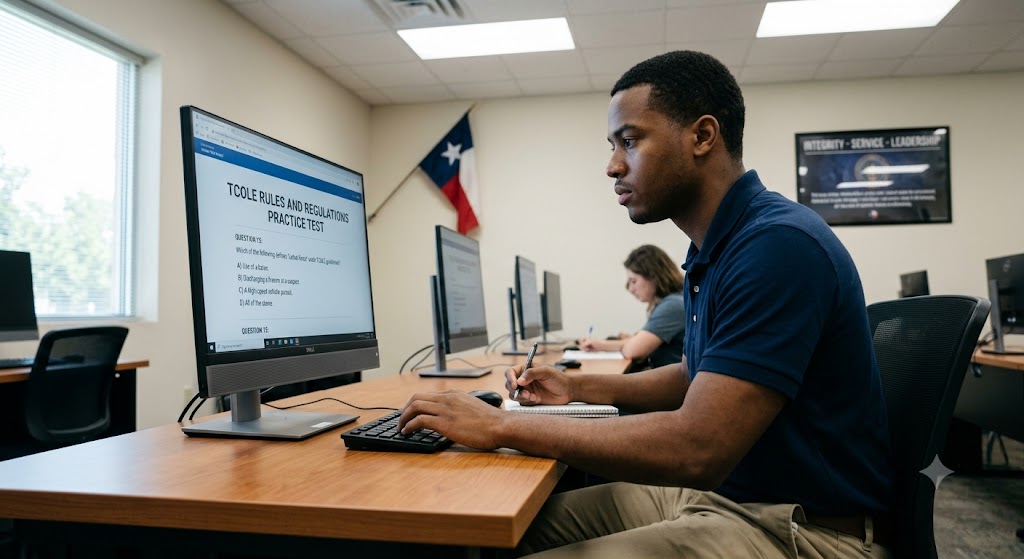
Additional Information
What the Course Entails and Exam Details
This exam does not have a standalone "course," but rather serves as the cumulative assessment for the legal and administrative sections covered during basic licensure training academies. The exam focuses heavily on the Texas Administrative Code (TAC), specifically Title 37, Part 7, which contains the TCOLE rules.
Core topics covered in the TCOLE Rules and Regulations matrix include:
Commission Rules: In-depth knowledge of TCOLE’s structure, responsibility, and the administrative process for licensure.
Licensure Requirements: Specific criteria for acquiring and maintaining peace officer, jailer, and telecommunicator licenses.
Enforcement: Procedures regarding disciplinary actions, license suspension, and revocation.
Texas State Statutes: Relevant sections of the Texas Occupations Code and the Texas Penal Code that define officer conduct and authority.
Professional Ethics: Standards of conduct, ethical decision-making, and the consequences of official misconduct.
What to Expect in the Final Exam
The final TCOLE Rules and Regulations examination is a rigorous assessment administered in a secure environment. Here are the specific details of what you should expect on exam day:
Format: The exam is strictly multiple-choice. Candidates must select the best answer from four possible options.
Number of Questions: The test typically consists of 100 to 150 questions (the exact number can vary slightly by administration).
Time Limit: Candidates are generally allocated three (3) hours to complete the examination.
Passing Score: A minimum score of 70% is required to pass and qualify for licensure.
Exam Rules: The exam is closed-book. No outside materials, study guides, or electronic devices are permitted in the testing area. Strict identification verification is required.
How to Study and Exam Centers
Preparation is the absolute key to success on the TCOLE Rules and Regulations exam. It requires dedicated memorization of administrative codes rather than just general legal concepts.
Effective Study Strategies:
Master the TAC: Your primary study resource should be the Texas Administrative Code (Title 37, Part 7). You can access these rules directly on the TCOLE website.
Use Practice Tests: Engaging with a TCOLE Rules and Regulations Practice Exam is highly recommended. These practice sessions help familiarize you with the wording and structure of the actual test questions.
Flashcards: Utilize flashcards (digital or physical) to memorize specific rule numbers, licensing timelines, and definitions.
Study Groups: Discussing scenario-based questions with fellow academy cadets can clarify how specific rules apply in real-world situations.
Exam Centers and Registration:
The TCOLE exam is taken through secure, computer-based testing (CBT) portals. You cannot simply register for this exam independently; you must be sponsored by a law enforcement agency or a TCOLE-approved training coordinator.
Exams are administered at:
Contract TCOLE Test Sites: These are specific, authorized locations throughout Texas, often located within regional police academies, universities, or councils of government.
Agency Testing: Large law enforcement agencies may have the infrastructure to administer the CBT directly to their recruits.
Job Opportunities from the Course
Successfully passing the TCOLE Rules and Regulations exam and obtaining state licensure opens the door to a wide range of career paths within the Texas criminal justice system. While this is not an exhaustive list, successful candidates often secure positions as:
Texas Peace Officer (Police Officer)
Sheriff's Deputy
County Jailer
Texas Ranger (Requires additional experience)
Department of Public Safety (DPS) Trooper
Municipal Court Bailiff
Constable Deputy
Investigator for State Agencies
University Police Officer
Public Safety Telecommunicator (Dispatcher)
The tone is intended to be professional, encouraging, and highly informative, guiding students through the complexity of the requirements with clarity.
Frequently Asked Questions
Reviews
5.0
Based on 0 reviews
Leave a Review
No reviews yet. Be the first to review!