
TCOLE Criminal Investigations Practice Exam
$69.00
- Buy to unlock unlimited access to all Quiz questions.
- After purchase you can print a PDF of the whole quiz at any point. The PDF will contain the questions and the correct answers.
About this Exam
The Texas Commission on Law Enforcement (TCOLE) Criminal Investigations designation is a specialized certification for licensed Texas peace officers. This comprehensive course is designed for officers looking to advance their careers and move into investigative roles. It equips participants with the essential knowledge, investigative techniques, and legal framework required to conduct thorough, effective, and lawful criminal investigations within the state of Texas.
Whether you are a patrol officer seeking to transition to a detective role or a seasoned professional looking to sharpen your investigative skills, this certification validates your proficiency in managing crime scenes and building strong criminal cases.
Ready to test your knowledge?
Buy Now to Access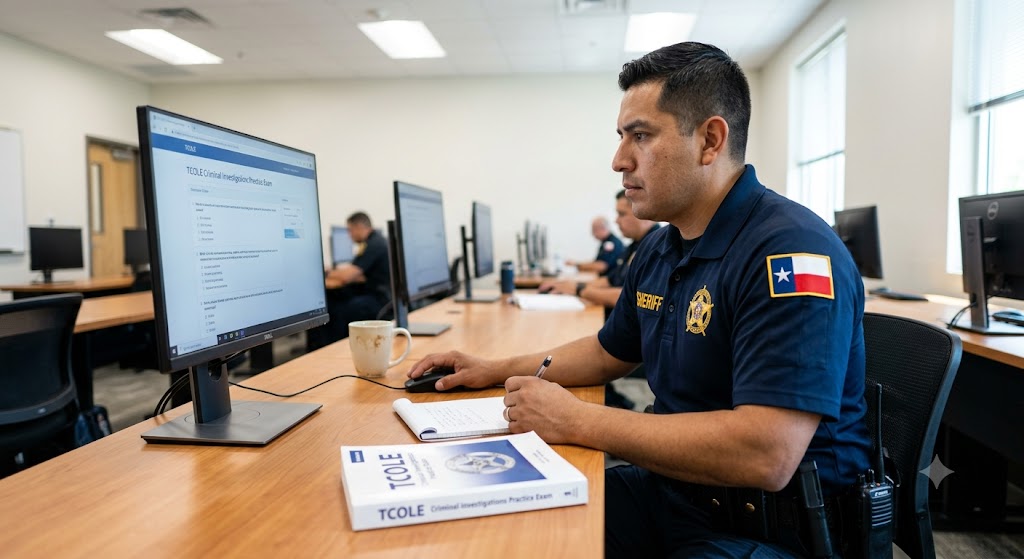
Additional Information
What the Course Entails and Exam Details
The TCOLE Criminal Investigations course (#3232) typically spans 40 hours of intensive training. The curriculum covers a broad range of critical topics essential for successful investigations, focusing heavily on Texas specific laws and procedures. Key areas of focus include:
Legal Aspects and Liability: Deep dives into search and seizure laws (4th Amendment), laws of arrest, and Texas Penal Code and Code of Criminal Procedure updates.
Crime Scene Management: Procedures for securing, processing, sketching, and photographing crime scenes, and identifying and preserving evidence.
Interviewing and Interrogation: Effective techniques for questioning witnesses, victims, and suspects, adhering to legal requirements and ethical standards.
Specific Investigation Types: Strategies for investigating various offenses, including crimes against persons (assault, homicide), property crimes (burglary, theft), and specialized areas like white-collar crime and narcotics.
Case File Management: Best practices for documentation, report writing, and preparing comprehensive case files for prosecution.
Courtroom Testimony: Principles of effective communication and professional demeanor when testifying in criminal proceedings.
The final exam assesses understanding and application of these principles, ensuring officers possess the requisite skills before they are certified as investigators.
What to Expect in the Final Exam
The TCOLE Criminal Investigations final exam is a comprehensive assessment administered at the conclusion of the 40-hour course. It is designed to evaluate mastery of the course objectives. Candidates can expect the following:
Format: The exam typically consists of multiple-choice and/or true/false questions derived directly from the course curriculum and objectives. The number of questions can vary by training provider, but usually ranges between 50 and 100 questions.
Content: Questions will test knowledge of legal statutes, investigative protocols, evidence handling, and practical scenarios.
Time Limit: A reasonable time limit (often 2–3 hours) is provided, allowing sufficient time to review and answer all questions thoroughly.
Passing Score: Most training providers require a passing score of at least 80% to successfully complete the course and receive TCOLE credit.
Rules: The exam is usually closed-book, and integrity standards are strictly enforced.
How to Study and Exam Centers
The key to success on the TCOLE Criminal Investigations exam lies in thorough preparation and active engagement during the training course. Here are effective study strategies:
Active Course Participation: Pay close attention during class, take detailed notes, and ask questions. The information provided in the lectures is the primary source for exam material.
Review Course Materials: Regularly study the participant manual, handouts, and legal updates provided by the instructor. Focus on key legal definitions, elements of offenses, and proper investigative procedures.
Utilize Practice Exams: Incorporating a reliable TCOLE Criminal Investigations practice exam into your study routine is invaluable. These practice tests help you familiarize yourself with the question format, identify areas where you need further study, and build confidence before the actual exam.
Focus on Texas Law: Pay specific attention to Texas Penal Code articles and Code of Criminal Procedure provisions relevant to investigations, as this is a significant component of the exam.
Group Study: Reviewing material with classmates can help reinforce learning and provide different perspectives on investigative scenarios.
Where to Take the Exam: The final exam for TCOLE course #3232 is not administered at commercial testing centers (like Pearson VUE). Instead, it is conducted in-person by the licensed TCOLE training provider (e.g., police academy, regional council of governments, or law enforcement agency) offering the course immediately upon its completion.
Job Opportunities from the Course
Successfully completing the TCOLE Criminal Investigations course and exam unlocks diverse career paths and specialized roles within Texas law enforcement agencies. These opportunities often come with increased responsibility, autonomy, and specialized focus. Career opportunities include:
Detective / Criminal Investigator
Crime Scene Investigator (CSI)
Specialized Unit Investigator (e.g., Narcotics, Gangs, Special Victims Unit (SVU), or Homicide)
Background Investigator
Property and Evidence Technician (Advanced roles)
Task Force Officer (assigned to state or federal task forces)
Internal Affairs Investigator
Frequently Asked Questions
Reviews
5.0
Based on 0 reviews
Leave a Review
No reviews yet. Be the first to review!