
TCOLE Arrest, Search and Seizure Practice Test
$69.00
- Buy to unlock unlimited access to all Quiz questions.
- After purchase you can print a PDF of the whole quiz at any point. The PDF will contain the questions and the correct answers.
About this Exam
The TCOLE Arrest, Search, and Seizure component is a critical pillar of law enforcement training in Texas. Managed by the Texas Commission on Law Enforcement, it ensures that every aspiring peace officer possesses a profound understanding of the legal frameworks governing how they interact with citizens and handle evidence. Mastering this topic is not a choice; it is a foundational requirement for anyone seeking a license to serve as a peace officer in the State of Texas. Beyond initial licensing, it is also a vital intermediate-level course (TCOLE 3111) for current officers seeking to deepen their legal expertise and advance their careers. This comprehensive practice test is designed for recruits currently in a law enforcement academy, as well as seasoned officers preparing to move to an intermediate certification level, ensuring they can apply complex constitutional principles in high-pressure, real-world scenarios.
Ready to test your knowledge?
Buy Now to Access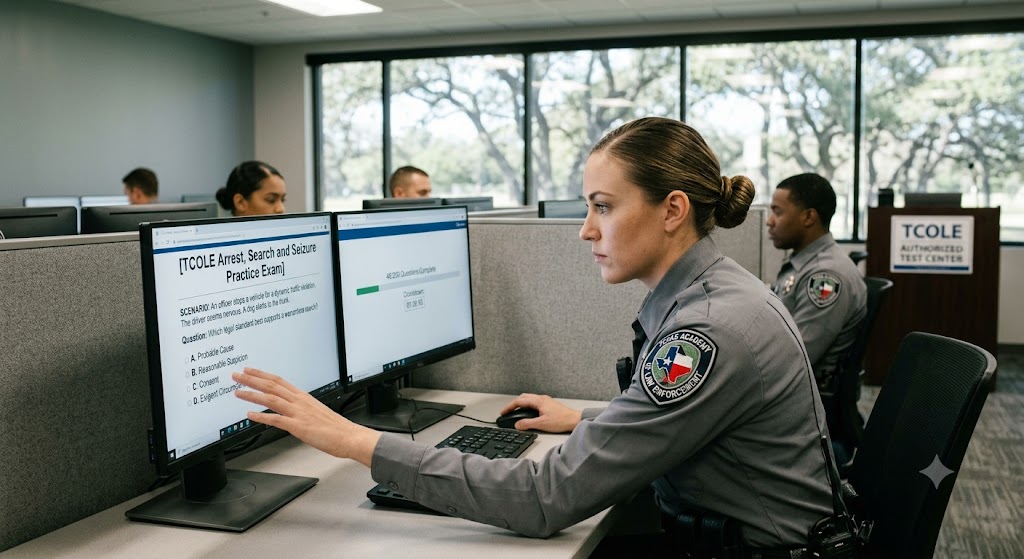
Additional Information
What the Course Entails and Exam Details
The TCOLE Arrest, Search, and Seizure curriculum is exhaustive, diving deep into the 4th Amendment of the U.S. Constitution, Article I, Section 9 of the Texas Constitution, and the Texas Code of Criminal Procedure. The course doesn't just ask students to memorize definitions; it demands the ability to apply them. Key areas of focus include:
Probable Cause: Mastering the definition and recognizing its application as the legal threshold for arrests and searches.
Warrant Requirements: Understanding the procedural steps and legal justification required to obtain a valid search or arrest warrant in Texas.
Exceptions to Warrantless Searches: Navigating the complex legal labyrinth of situations where a warrant is not required, such as exigent circumstances, plain view, consent, search incident to arrest, and the automobile exception.
Stop and Frisk: Analyzing the legal standards set by Terry v. Ohio for temporary investigative detentions and limited pat-downs.
The Exclusionary Rule: Understanding the legal consequences of gathering evidence in violation of the Constitution.
Case Law Analysis: Deconstructing landmark Supreme Court and Texas Court of Criminal Appeals decisions that shape current law enforcement procedures.
The comprehensive practice test mirrors these core areas, presenting detailed scenarios that require you to make instantaneous, legally sound decisions just as you would in the field.
What to Expect in the Final Exam
For those preparing for the main Texas Peace Officer Licensing Exam, the Arrest, Search, and Seizure topic makes up a significant portion of the total questions. The full state licensing exam is a formidable test, typically consisting of 250 multiple-choice questions that must be completed within a strict three-hour time limit. To pass, candidates must achieve a minimum score of 70%. The exam is proctored, strictly timed, and closed-book. For students taking a standalone Intermediate Arrest, Search, and Seizure (3111) Course, the final assessment format will vary by the specific academy or training provider, but it always requires a demonstrated mastery of the legal principles with a minimum passing grade of 70%. All TCOLE final exams are rigorous assessments that measure your ability to apply complex law under pressure.
How to Study and Exam Centers
Effective study for this TCOLE exam requires a strategic, active learning approach. Simply reading the material is not enough. You must prioritize the highest-yield topics, particularly probable cause and warrantless exceptions, as these form the bulk of the scenario-based questions. The most effective study method is to take multiple high-quality practice tests, such as this TCOLE Arrest, Search, and Seizure Practice Test, to diagnose your weak areas and gain experience with the exam's unique question formatting. After every practice session, spend significant time reviewing not just the questions you missed, but also those you found difficult. Analyze the legal reasoning for the correct answer. You must understand why a particular search was valid or an arrest was illegal.
TCOLE exams are administered through several authorized channels. You can register for the state licensing exam through the official TCOLE "myTEEX" student portal. Testing takes place at regional law enforcement academies, selected community colleges, and authorized physical testing centers across Texas, including dedicated facilities like Laredo College and Vernon College. Your academy coordinator can provide specific guidance on your final licensing test location.
Job Opportunities from the Course
A profound mastery of Arrest, Search, and Seizure is a prerequisite for many specialized, impactful, and higher-paying careers in Texas law enforcement. Achieving TCOLE licensing as a Peace Officer is the first step, and advanced competency in this area unlocks the following career paths:
Texas Peace Officer (Municipal Police, County Sheriff's Deputy, State Trooper)
Detective / Criminal Investigator
K-9 Officer
Narcotics Investigator
Tactical (SWAT) Operator
Internal Affairs Investigator
Special Agent (with state-level agencies)
Frequently Asked Questions
Reviews
5.0
Based on 0 reviews
Leave a Review
No reviews yet. Be the first to review!