
TCIC/LETS Full Access With CCH/CCQ Recertification Practice Test
$69.00
- Buy to unlock unlimited access to all Quiz questions.
- After purchase you can print a PDF of the whole quiz at any point. The PDF will contain the questions and the correct answers.
About this Exam
This comprehensive practice test is a critical study tool for Texas law enforcement professionals who are due to recertify their "Full Access" capabilities for the Texas Crime Information Center (TCIC) and the Law Enforcement Telecommunications System (LETS). It is specifically designed for terminal operators, dispatchers, and other personnel who have the highest level of access to these sensitive criminal justice databases.
This recertification ensures that individuals can correctly and legally query specialized files, most notably the Computerized Criminal History (CCH) and the Continuity of Care Query (CCQ). The CCQ is vital for identifying and assisting special needs offenders, streamlining communication between jail and local mental health authorities.
By using this practice exam, students will reinforce their understanding of system protocols, data entry standards, and the strict dissemination rules that govern the use of TCIC/LETS and NCIC information, ensuring they maintain the high level of competency required for their role.
Ready to test your knowledge?
Buy Now to Access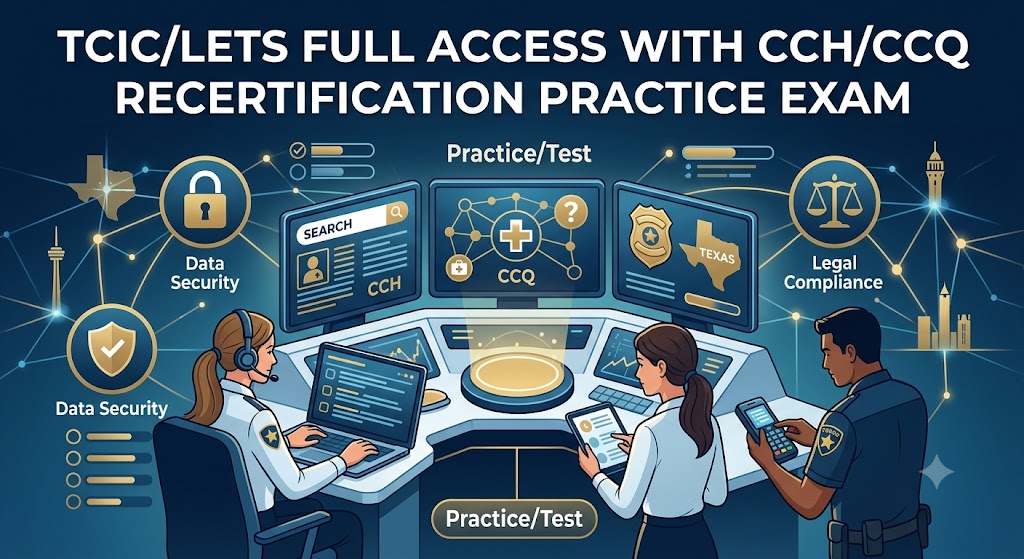
Additional Information
What the Course Entails and Exam Details
This practice exam covers the essential knowledge areas and skill sets required to maintain TCIC/LETS Full Access certification in Texas. The curriculum and the practice questions focus on the correct use of the system to ensure both public safety and the protection of individual civil liberties.
The core topics included in this practice exam are:
TCIC and NCIC Database Familiarity: Detailed procedures for inquiring into specialized files, such as the Wanted Person, Missing Person, Protection Order, Vehicle, and Article Files.
Continuity of Care Query (CCQ): The exact process, data elements, and implications of performing a CCQ, which is critical for identifying special needs offenders in the criminal justice system and coordinating care with local mental health authorities.
Computerized Criminal History (CCH): Specific protocols and transaction codes for requesting and interpreting CCH information, including understanding criminal history record dissemination and the function of the Interstate Identification Index (III).
System Security and Access: Strict adherence to data security policies, including password management, terminal physical security, and the determination of authorized personnel.
Rules of Dissemination: Comprehensive understanding of who is authorized to receive CJI (Criminal Justice Information) and the legal ramifications of unauthorized requests, receipts, or releases of data.
Recent Legislative and Procedural Updates: Questions reflecting current Texas law and Senate Bills, such as automated communication initiatives and changes to the manual identification process for special needs offenders.
What to Expect in the Final Exam
The actual TCIC/LETS Full Access with CCH/CCQ Recertification exam is a mandatory, timed evaluation designed to verify an operator's continued proficiency. While the exact details can be specific to each agency's protocol as guided by the Texas Department of Public Safety (DPS), the common format involves:
Multiple-Choice and True/False Questions: Similar to the format of this practice test, the final exam will use a series of structured questions to assess your knowledge and decision-making abilities.
Focus on Applied Scenarios: The exam will place you in common operator scenarios, asking you to identify correct transaction codes, interpret complex system responses (like serious error messages or specific status returns), and apply policy decisions.
High Passing Score: Law enforcement systems demand precision. Students should expect a high required passing score, often 80% or higher, reflecting the low tolerance for error in handling criminal justice information.
System and Policy Changes: This being a recertification, a significant portion of the test will focus on updates to the TCIC/LETS system and relevant state or federal policy that has changed since your last certification cycle.
How to Study and Exam Centers
Preparation is key to maintaining your certification. For maximum effectiveness, students should employ a multi-faceted study strategy:
Leverage Practice Exams: Utilize this comprehensive practice test to familiarize yourself with the question format, identify areas of weakness, and build confidence.
Review Official Texas DPS Materials: Dive into the official TCIC/LETS user manuals, training guides, and any "hot sheets" or informational bulletins provided by the Texas Department of Public Safety. These are the primary source for the exam questions.
Focus on Key Transactions and Codes: Create study aids for critical transaction codes, especially for CCH, CCQ, and complex NCIC inquiries.
Clarify Dissemination Rules: Make sure you have an ironclad understanding of the CJIS (Criminal Justice Information Services) Security Policy and Texas-specific dissemination rules. When in doubt, ask your agency's Terminal Agency Coordinator (TAC).
The final TCIC/LETS recertification exam is not typically taken at public test centers like Pearson VUE. Instead, it is administered through specific channels authorized by the Texas DPS:
Authorized Online Portals: Most agencies use an online, secure proctored portal provided by or approved by the Texas DPS for employee certification.
In-Agency Testing: The exam is frequently administered by your agency's certified instructors or TAC within a secure area at your place of employment.
Job Opportunities from the Course
Maintaining your TCIC/LETS Full Access CCH/CCQ Certification is not just a regulatory requirement; it is a critical skill set that unlocks and maintains your ability to work in key roles within Texas law enforcement and public safety:
Law Enforcement Telecommunicator (Dispatcher): The backbone of first response, responsible for real-time information exchange between officers and databases.
TCIC/LETS Terminal Operator: A specialized role focused on managing data entry, quality control, and inquiry processing for a law enforcement agency.
Criminal Justice Records Clerk: Essential for the accurate maintenance and legally compliant dissemination of criminal records.
Police or Sheriff's Officer: Necessary for all active-duty officers who require direct or mobile system access to perform their duties safely and effectively.
Court Clerk or Administrative Personnel: Often required for staff who process warrants, protection orders, or maintain court records linked to the state and federal databases.
Frequently Asked Questions
Reviews
5.0
Based on 0 reviews
Leave a Review
No reviews yet. Be the first to review!