
TCFP Hazmat Practice Exam
$69.00
- Buy to unlock unlimited access to all Quiz questions.
- After purchase you can print a PDF of the whole quiz at any point. The PDF will contain the questions and the correct answers.
About this Exam
The Texas Commission on Fire Protection (TCFP) Hazardous Materials (Hazmat) designation is a critical certification for fire service personnel in Texas. This exam verifies that emergency responders possess the essential knowledge and skills to effectively identify, analyze, and mitigate incidents involving hazardous materials.
Designed primarily for firefighters, rescue personnel, and other emergency first responders, this certification is a prerequisite for advancing into specialized roles within the fire service, including Hazardous Materials Technician. It ensures that personnel can operate safely and efficiently under high-pressure conditions involving dangerous substances.
Ready to test your knowledge?
Buy Now to Access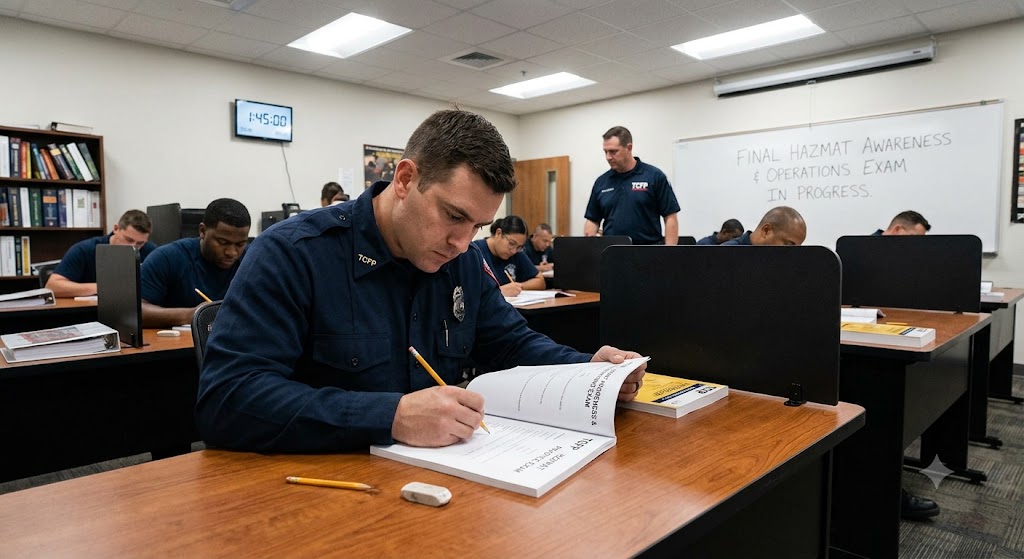
Additional Information
What the Course Entails and Exam Details
The preparatory course leading to the TCFP Hazmat exam covers a wide array of competencies based on NFPA 1072 standards (standard for Hazardous Materials/Weapons of Mass Destruction Emergency Response Personnel Professional Qualifications).
Core topics and syllabus components typically include:
Analyzing the Incident: Learning to detect the presence of hazardous materials, identifying specific chemicals using the Emergency Response Guidebook (ERG), and predicting potential behavior.
Planning the Response: Understanding operational objectives, selecting appropriate personal protective equipment (PPE), and developing a safe defensive action plan.
Implementing the Response: Performing basic control and confinement operations, establishing scene control, and executing emergency decontamination.
Evaluation: Reviewing the effectiveness of the actions taken.
The curriculum is split between classroom learning and hands-on practical skills application.
What to Expect in the Final Exam
The final TCFP Hazmat examination consists of two main components: a written cognitive exam and a manipulative skills performance evaluation.
Cognitive (Written) Exam
Format: Typically administered via computer-based testing, consisting of multiple-choice questions.
Question Count: Varies, but usually around 100 questions covering the entire scope of the training.
Time Limit: You are generally allotted approximately two to three hours to complete the written portion.
Passing Score: Candidates must achieve a minimum score of 70% to pass the written exam.
Manipulative Skills Evaluation
Format: This is a physical demonstration of mandatory skills, where you must perform specific tasks observed by TCFP-certified examiners.
Skills Covered: Tasks often include properly donning/doffing PPE, decontaminating personnel, and performing absorption, adsorption, or damming operations.
Passing Requirement: Candidates must successfully complete all designated skills tasks. This is typically graded on a pass/fail basis.
How to Study and Exam Centers
Preparation is paramount. Here are actionable strategies for success:
Study Strategies
Master the ERG: The Emergency Response Guidebook is your primary tool. You must be able to navigate it instantly. Dedicate significant time to practice finding chemical ID numbers and corresponding response guides.
Use Official TCFP Materials: The TCFP provides detailed curriculum manuals and skills matrices. Base your study plan around these official documents.
Take Practice Exams: Utilize high-quality TCFP Hazmat practice exams. These simulate the actual test environment, helping you improve your speed, accuracy, and confidence.
Hands-on Practice: Attend all practical skills training sessions. Repeated physical practice of skills like decontamination is essential for muscle memory and confidence during the evaluation.
Exam Centers
The TCFP manages the testing process throughout Texas.
Where to Test: Written exams are typically scheduled through authorized regional testing centers, which may include major fire academies (like TEEX - Texas A&M Engineering Extension Service) and community college fire technology programs.
How to Register: Testing must be scheduled through the TCFP's online portal. Candidates generally need to be sponsored by a fire department or have completed an approved training program to register for the certification exam.
Job Opportunities from the Course
Earning your TCFP Hazmat certification is a prerequisite for numerous career paths within the Texas fire and emergency services sector. This certification is usually mandatory for employment as a structural firefighter in Texas.
The specific job opportunities and career paths this certification unlocks include:
Career Firefighter (Municipal/Structural)
Industrial Firefighter (Refineries, Chemical Plants)
Hazardous Materials Technician (Hazmat Team Member)
Airport Firefighter (ARFF)
Fire Inspector / Prevention Specialist
Emergency Management Coordinator
Safety Specialist (Industrial and Environmental Compliance)
Good luck with your preparation for the TCFP Hazmat Practice Exam! Your commitment to this training enhances the safety of your community and your team.
Frequently Asked Questions
Reviews
5.0
Based on 0 reviews
Leave a Review
No reviews yet. Be the first to review!