
TCFP Driver/Operator Practice Exam
$69.00
- Buy to unlock unlimited access to all Quiz questions.
- After purchase you can print a PDF of the whole quiz at any point. The PDF will contain the questions and the correct answers.
About this Exam
The TCFP Driver/Operator-Pumper certification, overseen by the Texas Commission on Fire Protection (TCFP), is a critical step for fire service personnel aiming to safely and effectively operate fire apparatus. This certification is specifically designed for individuals already holding a basic structural fire suppression certification, Aircraft Rescue Fire Fighting, or Marine Fire Protection certification, who wish to specialize in the complex responsibilities of a fire engine driver and pump operator. It verifies that a candidate has the requisite knowledge and performance skills to inspect, maintain, and operate a fire pumper in accordance with NFPA 1002, Standard for Fire Apparatus Driver/Operator Professional Qualifications.
Ready to test your knowledge?
Buy Now to Access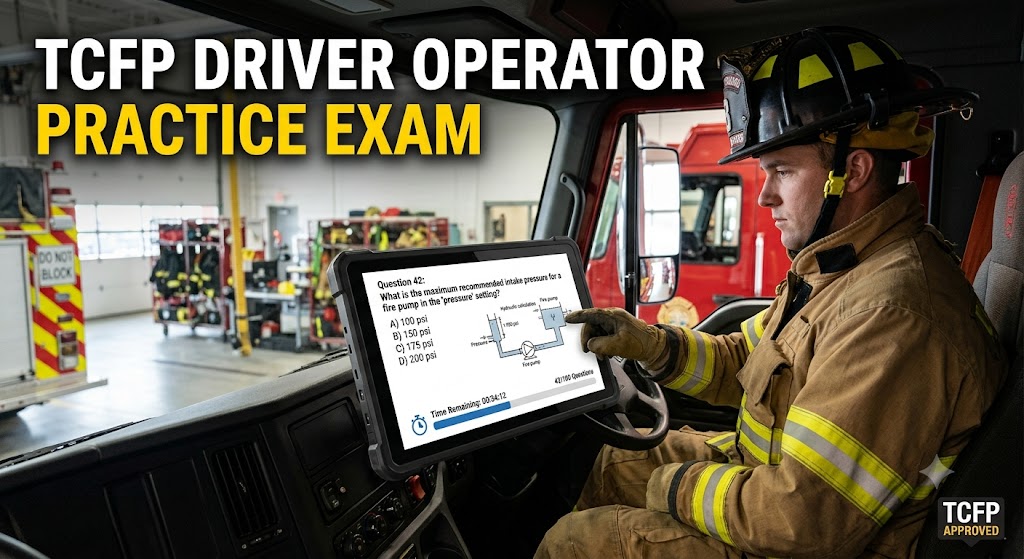
Additional Information
What the Course Entails and Exam Details
To be eligible for the TCFP Driver/Operator-Pumper exam, candidates must first complete a commission-approved training program. These courses are comprehensive and typically utilize the IFSTA Pumping and Aerial Apparatus Driver/Operator Handbook as the core textbook. The curriculum covers a wide array of topics, ensuring a deep understanding of both vehicle mechanics and operational tactics.
Key course topics include:
Preventive Maintenance: Routine inspection, testing, and servicing of all apparatus systems, including the engine, brakes, electrical systems, tires, and the fire pump itself.
Safe Driving Operations: Techniques for maneuvering large vehicles under emergency and non-emergency conditions, including proper positioning, braking, and backing. The course also integrates the National Traffic Incident Management Responder Training.
Apparatus Systems and Construction: Detailed study of various apparatus types, their components, and design standards, such as those in NFPA 1901.
Water Supply and Pumping Operations: This is a major section covering fluid mechanics, hydraulic calculations (determining nozzle pressure, friction loss, and appliance loss), static water supply sources (drafting), and the mechanics of centrifugal fire pumps.
Foam Systems: Understanding the types of foam, application methods, and proportioning equipment.
Advanced Vehicle Technology: Recent updates include training on modern apparatus safety systems and electric vehicle (EV) fire protocols.
What to Expect in the Final Exam
The TCFP certification process consists of two primary components: a comprehensive knowledge exam and a practical skills evaluation. Students must pass both to be eligible for certification.
The Knowledge Exam: The final knowledge exam is a proctored, computer-based test, typically administered at authorized testing sites like community colleges or regional training centers. Candidates must have an approved application and a valid score on file through their TCFP FIDO account. The exam is comprehensive, covering all material from the course, and often consists of multiple-choice questions.
Format: Multiple choice (e.g., approximately 100 questions)
Passing Score: 70% or higher
Time Limit: Usually 1 hour
The Skills Evaluation: The performance skills evaluation is a separate but equally important component, frequently scheduled for the same day as the final exam or during the last week of the training course. Candidates must demonstrate proficiency in all required skills to pass. For some skills, the scoring is a simple Pass/Fail; for others, it may involve a combination of "Satisfactory" or "Unsatisfactory" steps, with all steps requiring a "Satisfactory" score to pass the skill section. An overall "Pass" on the skills sheet requires passing all individual skill sections.
Key skills evaluated include:
Pre-Trip/Preventive Maintenance Inspection: A full "360-degree walk-around" and internal inspection to verify the apparatus's operational status.
Driving Skills: Demonstration of safe driving in scenarios, such as backing into tight spaces, making serpentine turns, and proper positioning at an incident scene.
Pumping Operations: Specific practical tasks such as producing an effective fire stream, setting up a drafting operation from a static source, and performing hydraulic calculations in real time.
How to Study and Exam Centers
Effective preparation for the TCFP Driver/Operator-Pumper exam requires a combination of self-study, practical application, and targeted practice.
Study Strategies:
Utilize Practice Exams: Use realistic practice exams designed for the current TCFP Driver/Operator-Pumper curriculum, including updates for NFPA 1901 standards. Look for guides that offer detailed answer explanations for every question, allowing you to "understand the why" behind each concept.
Master Hydraulics: Focus heavily on the "Water Supply and Pumping Operations" section. Develop a strong grasp of hydraulic formulas and create a personal formula sheet for quick review.
Simulate the Exam: Take practice tests under timed conditions to get a feel for the 1-hour limit and identify areas where you need to improve your speed.
Review Official Textbooks: Your training course textbook, likely the IFSTA manual, is your primary knowledge source. Study each chapter thoroughly and review the chapter-end questions.
Hands-on Practice: During your training, maximize your time with the apparatus. Perform pre-trip inspections and practice pumping operations as often as possible to build muscle memory and confidence for the skills evaluation.
Exam Centers:Exams are administered at a variety of physical locations throughout Texas, typically computer labs at educational institutions. For example, Texas State University offers computer-based testing at its main campus in San Marcos and at its Round Rock campus. Paris Junior College also provides TCFP online certification exams at its Paris and Greenville testing centers. You must register for your exam and schedule an appointment through your TCFP FIDO account, which will provide a list of current testing sites and schedules.
Job Opportunities from the Course
Earning the TCFP Driver/Operator-Pumper certification significantly enhances a firefighter's value to their department and opens up advanced career opportunities within the fire service.
Unlocking this certification leads directly to positions such as:
Firefighter/Apparatus Operator (often a dedicated, higher-paying role)
Fire Engineer
Driver/Operator - Pumper
Specialized Driver/Operator for Mobile Water Supply or Aerial Apparatus
Promotional paths toward Lieutenant, Captain, and other leadership roles, which frequently require this specialized technical knowledge
Frequently Asked Questions
Reviews
5.0
Based on 0 reviews
Leave a Review
No reviews yet. Be the first to review!