
TCCC Combat Lifesaver (CLS) Train-the-Trainer (T3) Practice Exam
$69.00
- Buy to unlock unlimited access to all Quiz questions.
- After purchase you can print a PDF of the whole quiz at any point. The PDF will contain the questions and the correct answers.
About this Exam
Welcome to your essential resource for preparing for the TCCC Combat Lifesaver (CLS) Train-the-Trainer (T3) certification. This advanced program is designed exclusively for experienced military medical personnel who are ready to step into a vital leadership and instructional role. The T3 certification validates your expertise not only in performing critical, life-saving Tactical Combat Casualty Care (TCCC) interventions under pressure but also in your ability to effectively teach these skills to others in your unit. By passing this exam, you demonstrate your proficiency in the latest, evidence-based protocols that save lives on the battlefield. This is a crucial step for service members with medical backgrounds who wish to become force multipliers, ensuring their entire team is equipped with the knowledge and confidence to handle preventable causes of death in a tactical environment.
Ready to test your knowledge?
Buy Now to Access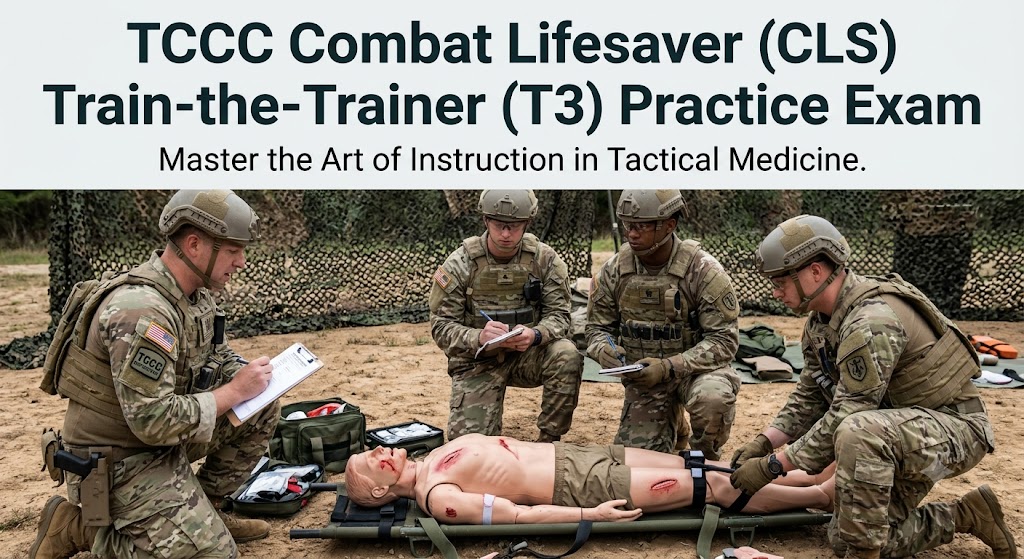
Additional Information
What the Course Entails and Exam Details
The TCCC CLS T3 course goes far beyond the initial CLS curriculum. While it reinforces all core medical skills, its primary focus is on instructional techniques and ensuring a standard application of the Joint Trauma System (JTS) developed TCCC guidelines. The comprehensive curriculum prepares you to:
Master Advanced Medical Techniques: Gain expert proficiency in Care Under Fire (CUF), Tactical Field Care (TFC), and Tactical Trauma Assessment (TTA) using the MARCH-PAWS sequence. This includes high-level mastery of junctional hemorrhage control, wound packing, advanced airway management, and chest decompressions.
Learn Educational Methodologies: Understand how to teach diverse learners effectively using the Whole-Part-Whole (WPW) instructional strategy.
Facilitate Scenario-Based Training: Create, manage, and evaluate realistic tactical medical scenarios that challenge students to apply their knowledge.
Validate Skills Proficiency: Master the official TCCC skills checklists, learning how to objectively assess student performance and provide constructive, critical feedback.
Utilize JTS Materials: Gain in-depth familiarity with the official educational resources available via DeployedMedicine.com and the Committee on Tactical Combat Casualty Care (CoTCCC).
What to Expect in the Final Exam
The final T3 certification exam is rigorous, evaluating both your knowledge and your instructional aptitude. Candidates must demonstrate proficiency in two distinct parts:
The Didactic (Written) Exam: This section typically consists of a comprehensive, multiple-choice assessment that can be administered online. You must achieve a minimal passing score of 70% to move forward. The questions cover the latest TCCC protocols, medical theory, and instructional theory.
The Practical instructional Evaluation: This is the core of the T3 exam. You will be placed in a simulated training environment and must effectively instruct and evaluate a student (or peer role-playing a student) through a full Tactical Trauma Assessment scenario. An authorized Course Manager or Medical Director will observe and grade you using the official TCCC Instructor Skills Checklist. You must achieve a "Pass" on all critical instructional tasks, demonstrating clear communication, standard application of procedures, and effective evaluation of the trainee.
How to Study and Exam Centers
Preparation is paramount for the T3 exam. To succeed, integrate these study strategies:
Utilize Official Resources: Your primary study materials must be the most current CoTCCC guidelines and instructor-specific resources found on DeployedMedicine.com. Review the instructor guides, teaching plans, and video-based skill instructions.
Practice instructional Delivery: Do not just practice the medical skills; practice teaching them. Grab a peer or use a training mannequin and go through the steps of instruction out loud. Focus on explaining the "why" behind each action according to the JTS curriculum.
Master the Skills Checklists: Obtain and memorize the criteria on the official TCCC Skills Assessment Checklists. Use them to self-evaluate and evaluate others.
Complete this Practice Exam: Use this resource to build familiarity with the types of written questions you will face, testing your understanding of protocols and instructional nuances.
Exam Centers: The TCCC T3 course and final certification are typically administered within your military unit, a training center (like an Army Medical Department school), or at a contracted, JTS-authorized training facility. Coordination for scheduling the course is done through your unit’s training NCO or Medical Officer. You will need to check with them to identify the specific designated location and testing portal (e.g., in-house system or specific online test proctoring) used for your T3 validation.
Job Opportunities from the Course
A TCCC CLS T3 certification unlocks several specialized and rewarding career paths, both within the military and in the civilian contracted sector. This certification is highly sought after as it represents a validated level of expertise and instructional ability in tactical medicine. Key opportunities include:
Unit-Level TCCC CLS Instructor: Serve as the primary point of contact for tactical medical training within your unit, ensuring all service members maintain currency.
TCCC Training Manager: Oversee and coordinate tactical medical training programs at the battalion or brigade level.
Military Contracted Instructor: Provide TCCC and other operational medicine training for civilian companies that support military pre-deployment and sustainment training.
Tactical Medicine Subject Matter Expert (SME): Advise leadership on medical training standards and protocols.
Role in Medical Simulation Centers: Work as an instructor or developer in advanced medical simulation facilities, helping create new and effective training scenarios.
Tactical Paramedic/Specialist: Integrate into specialized units (military or law enforcement tactical teams) as a medical provider and internal instructor.
Frequently Asked Questions
Reviews
5.0
Based on 0 reviews
Leave a Review
No reviews yet. Be the first to review!