
TBS Communications Equipment I and II Practice Test
$69.00
- Buy to unlock unlimited access to all Quiz questions.
- After purchase you can print a PDF of the whole quiz at any point. The PDF will contain the questions and the correct answers.
About this Exam
The TBS Communications Equipment I and II certification is a comprehensive, two-tiered program designed for individuals aiming to become expert technicians and operators of mission-critical communication systems.
This curriculum is meticulously crafted to bridge the gap between theoretical knowledge and the practical application of high-reliability communications, specifically focusing on advanced tactical, public safety, and critical industrial systems.
Whether you are an aspiring communication specialist in the emergency services, a technician for critical infrastructure, or preparing for a specialized military role, this program ensures you possess the skills to deploy, maintain, and troubleshoot complex, multi-layered communication networks under pressure.
Ready to test your knowledge?
Buy Now to Access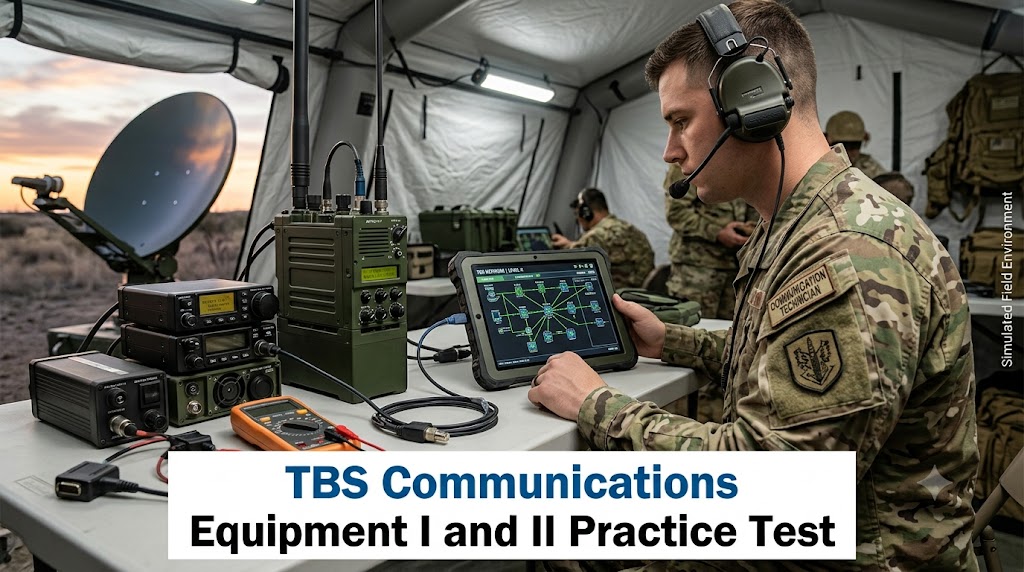
Additional Information
What the Course Entails and Exam Details
This certification is structured into two distinct levels, building from fundamental principles to masterful system-level integration.
Level I focuses on core competencies, ensuring a robust understanding of individual equipment operation and basic radio frequency (RF) theory.
Level II elevates the operator to a systems expert, capable of complex networking, data integration, and managing communications in challenged environments.
RF Fundamentals: Principles of propagation, modulation, antenna theory, and spectrum management.
Tactical Radio Systems: Operation and configuration of multi-band handheld and man-pack transceivers (e.g., VHF, UHF, and L-Band).
Satellite Communications (SATCOM): Deployment and troubleshooting of ground-based satellite terminals, link budgets, and network access.
IP Networking: Advanced configuration of voice over IP (VoIP), data integration, and secure mesh networking.
Cryptographic & Security Systems: Implementation of encryption standards, key management, and transmission security (TRANSEC).
Electronic Warfare (EW) & Countermeasures: Understanding signal denial, anti-jamming techniques, and low probability of intercept (LPI) operations.
System Integration & Design: Creating resilient, scalable communication architectures to support multiple users and agencies.
What to Expect in the Final Exam
The comprehensive final exam for TBS Communications Equipment I and II is a rigorous evaluation of both your technical knowledge and practical proficiency, combining a multiple-choice component with a high-fidelity practical evaluation.
The test is structured to mirror real-world operational challenges.
Format: The exam is split into two parts: a timed, computer-based testing (CBT) written section (100 questions) and a hands-on, scenario-based practical evaluation (PE).
Written Exam (60%): Evaluates knowledge of RF theory, networking, equipment specs, and security protocols.
Practical Evaluation (40%): Candidates must successfully configure, deploy, and troubleshoot a complex integrated communications system (tactical radio, SATCOM link, and data network) based on a given scenario within a set timeframe.
Time Limits: 2 hours for the written exam; 4 hours for the practical evaluation.
Passing Score: An overall score of 80% is required, with a mandatory passing grade on both individual sections.
Rules: Valid government-issued photo ID is required for all components. Practical evaluations are "open book," allowing access to specific technical manuals provided by the examiner.
How to Study and Exam Centers
Preparation for the TBS Communications Equipment I and II requires a dedication to both technical documentation and hands-on laboratory time.
We recommend a structured approach to master the curriculum.
Study Strategies: Create a rigid study schedule, dedicating equal time to RF theory, data networking, and each major equipment system. Do not skip fundamental Level I concepts, as Level II is entirely dependent on them.
Practice Methods: Maximize hands-on equipment time. The most successful candidates are those who have repeatedly configured, torn down, and "troubleschooled" systems. Utilize simulation software and authorized training labs. Our provided online portal includes extensive practice question banks and interactive system diagrams.
Exam Centers: The written portion can be taken at any Pearson VUE authorized testing center globally. However, due to the requirement for specialized high-value equipment, the Practical Evaluation must be taken at designated authorized schools, specific military/government communication centers, or certified industrial testing facilities. Consult your student portal for a list of authorized locations and their availability.
Job Opportunities from the Course
Graduates with the TBS Communications Equipment I and II certification are in high demand across multiple sectors, filling critical roles that keep infrastructure and teams connected.
Here are the specific job titles and career paths this certification unlocks.
Job Titles:
Tactical Communications Technician
Public Safety Communications Specialist
Satellite Communications Operator-Maintainer
Network Engineer, Mission-Critical Systems
Emergency Operations Center (EOC) Comms Manager
Industrial Communications System Integrator (e.g., Mining, Oil & Gas)
Aviation/Aeronautical Band Transceiver Specialist
Government/Defense Contractor Communications Lead
Frequently Asked Questions
Reviews
5.0
Based on 0 reviews
Leave a Review
No reviews yet. Be the first to review!