
Tax Knowledge Assessment (TKA) HR Block Practice Test
$69.00
- Buy to unlock unlimited access to all Quiz questions.
- After purchase you can print a PDF of the whole quiz at any point. The PDF will contain the questions and the correct answers.
About this Exam
The Tax Knowledge Assessment (TKA) serves as a critical gateway for individuals aspiring to launch their careers in professional tax preparation, particularly within the HR Block network.
This comprehensive exam is meticulously designed to evaluate a candidate's fundamental understanding of individual income tax law, regulations, and standard filing procedures.
It is the primary screening tool used to identify prospective tax professionals who possess the requisite knowledge base to excel in the rigorous and ever-changing field of taxation.
Successfully navigating the TKA is often the first, essential step toward securing a position as a tax preparer, opening doors to seasonal opportunities, advanced roles, and long-term career growth in financial services.
Ready to test your knowledge?
Buy Now to Access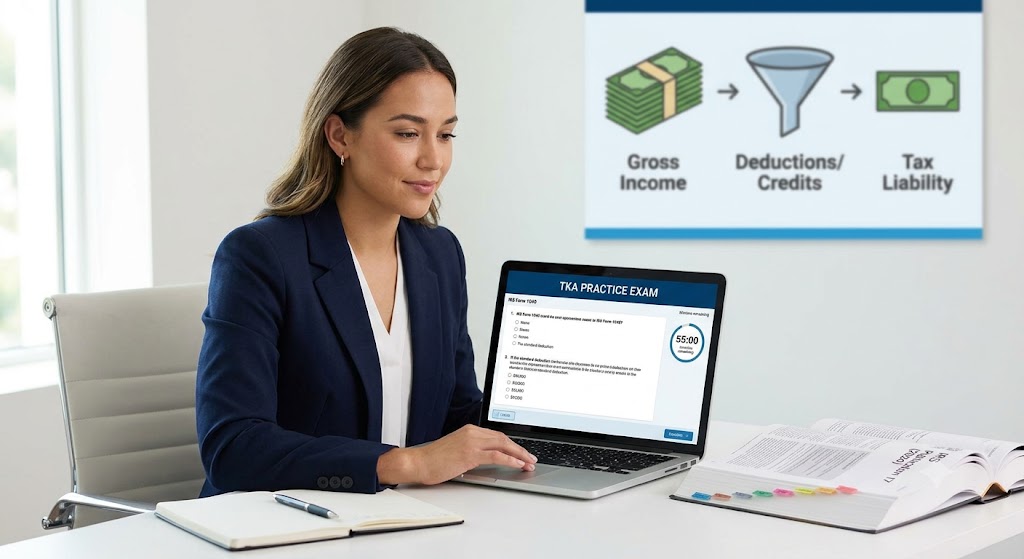
Additional Information
What the Course Entails and Exam Details
The TKA is built around core tax competencies essential for any successful tax professional.
It rigorously tests your command over essential concepts, beginning with the structure of the individual income tax return, primarily focusing on Form 1040 and its supporting schedules.
Candidates must demonstrate proficiency in accurately determining filing status, identifying dependencies, and calculating various components of gross income, including wages, interest, dividends, and simple business income.
The assessment delves deeply into crucial topics like the distinction between standard and itemized deductions, common adjustments to income (above-the-line deductions), and the calculation of the correct tax liability.
Furthermore, a significant portion of the TKA focuses on refundable and non-refundable tax credits, such as the Earned Income Tax Credit (EITC), the Child Tax Credit, and education credits, which are vital for understanding client eligibility and optimizing returns.
It ensures that test-takers can handle fundamental mathematical calculations inherent in tax preparation while applying IRS regulations correctly.
What to Expect in the Final Exam
While specific details can evolve, the Tax Knowledge Assessment (TKA) consistently follows a structured format that prioritizes accuracy and speed.
The final examination is typically composed entirely of multiple-choice questions, challenging candidates to select the single correct answer from several plausible options.
This format efficiency assesses a broad range of tax knowledge within a limited timeframe.
The TKA is a timed assessment, usually lasting between 60 to 90 minutes, depending on the specific version and administration.
Precision is paramount, as the exam requires a high passing score—often around 70% to 80%—to demonstrate mastery of the fundamental tax principles necessary to advise clients responsibly.
The test is strictly proctored, ensuring the integrity of the results.
How to Study and Exam Centers
A dedicated study regimen is the key to conquering the TKA.
Begin by immersing yourself in the IRS materials, especially Publication 17, Your Federal Income Tax, which covers nearly all the topics relevant to individual filers.
Create comprehensive flashcards for important terms, filing deadlines, and eligibility criteria for major credits and deductions.
However, theoretical knowledge is best cemented through practical application. This is where this comprehensive TKA Practice Exam becomes invaluable.
Simulating the real test environment with a series of practice exams will build your confidence, improve your time management, and identify specific knowledge gaps that require further review.
The official TKA is administered through two main channels: directly at local HR Block offices during hiring cycles, or increasingly, via authorized online testing portals, such as HR Block's internal learning management systems (often called HR Block Link) when proctored remotely.
Job Opportunities from the Course
Successfully passing the Tax Knowledge Assessment and subsequently engaging with the HR Block training programs unlocks a rewarding career trajectory in tax services.
Here are specific job opportunities and career paths this certification facilitates:
Tax Preparer (Seasonal): A foundational role preparing basic individual tax returns for clients during the peak tax season.
Senior Tax Preparer: With experience, this role involves handling complex returns, advising clients on tax strategies, and potentially reviewing junior preparers' work.
Tax Professional Associate: Often a transitional role leading toward permanent employment, focusing on client services and complex filings.
Tax Office Manager: An administrative and leadership position responsible for managing daily operations, overseeing a team of preparers, and ensuring quality control within an HR Block location.
Enrolled Agent (EA) Candidate: Passing the TKA provides the perfect knowledge base to pursue the prestigious EA credential, a federally licensed tax advisor title awarded by the IRS.
Frequently Asked Questions
Reviews
5.0
Based on 0 reviews
Leave a Review
No reviews yet. Be the first to review!