
Tankers Class Marker Practice Test
$69.00
- Buy to unlock unlimited access to all Quiz questions.
- After purchase you can print a PDF of the whole quiz at any point. The PDF will contain the questions and the correct answers.
About this Exam
The Tankers Class Marker Practice Test is an essential mock exam designed for seafarers who are preparing to earn their official international maritime endorsements for working aboard tankers. This comprehensive practice tool is tailored for a wide range of personnel, from entry-level crew members seeking basic familiarization to senior deck and engineering officers aiming for advanced cargo operations certifications. Earning these endorsements is a mandatory requirement under the International Convention on Standards of Training, Certification and Watchkeeping for Seafarers (STCW), ensuring that anyone with responsibilities on oil, chemical, or liquefied gas tankers possesses the critical knowledge to operate these complex vessels safely and protect the marine environment.
Ready to test your knowledge?
Buy Now to Access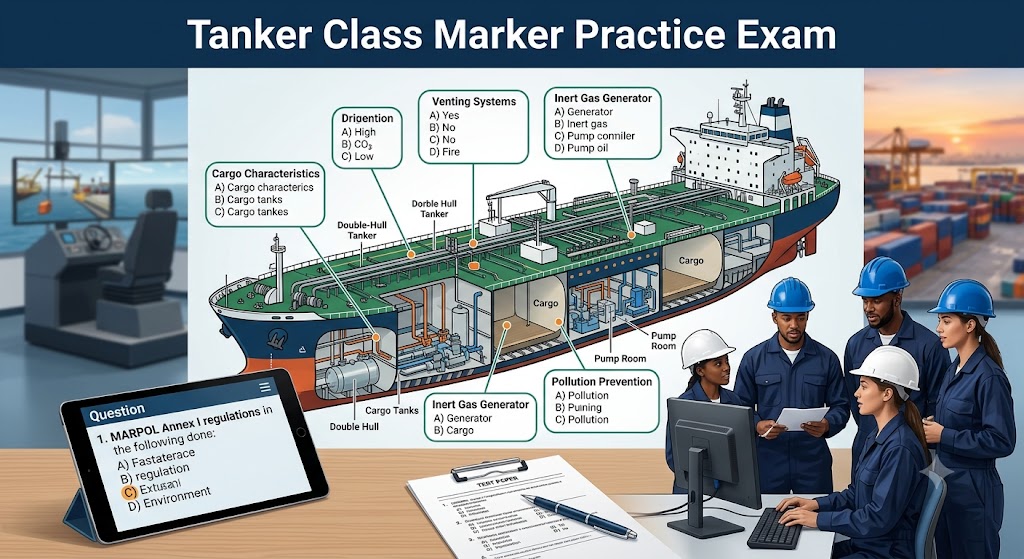
Additional Information
What the Course Entails and Exam Details
This practice test is an invaluable resource that covers the core syllabus required for various levels of official STCW tanker training. Users can expect a rigorous review of topics across three main categories of vessels: oil tankers, chemical tankers, and liquefied gas tankers.
The official training courses themselves, which this test aims to simulate, can range from basic 2-5 day familiarization programs to more intensive 5-10 day advanced courses.
The Tankers Class Marker Practice Test focuses heavily on the written examination portion of these certifications, challenging your understanding of:
Cargo Properties and Hazards: Understanding the physical and chemical properties of crude oil, refined products, chemical substances, and liquefied gases (LNG/LPG), including their density, volatility, toxicity (e.g., H2S), and flammability.
Tanker Design and Systems: Mastery of vessel construction features like double-hulls, tank arrangements, and the function of crucial systems, such as cargo pumps, piping networks, venting, inert gas generators, and tank cleaning equipment.
Safe Cargo Operations: Procedures for loading, discharging, ballasting, deballasting, tank cleaning, purging, and gas-freeing.
Emergency Procedures: How to respond to critical situations, including cargo spills, fires, explosions, equipment failure, and confined space rescue.
Pollution Prevention: Deep knowledge of international regulations, specifically MARPOL (International Convention for the Prevention of Pollution from Ships), and practical methods to prevent operational and accidental pollution.
What to Expect in the Final Exam
For the written portion, which this practice exam mirrors, candidates can typically expect a computer-based or paper-based test consisting primarily of multiple-choice questions.
These questions will assess your ability to recall and apply the technical details and safety protocols covered in your training. While the exact number of questions and passing scores are determined by your national maritime administration (e.g., USCG, MCA) and the authorized training provider, a passing score is often between 70% and 80%. Time limits are also standard, encouraging efficient decision-making.
For advanced certifications, the official final exam may not stop at the written paper; it frequently includes a mandatory practical assessment. This might involve demonstrating proficiency in a hi-fidelity cargo handling simulator, conducting firefighting exercises, or successfully executing a confined space entry drill. Your overall competency will be evaluated based on both your theoretical knowledge and your ability to apply it effectively in realistic scenarios.
How to Study and Exam Centers
Preparation is paramount for success, and this practice test should be a central component of your study plan. Integrate it with traditional learning methods:
Official Training Courses: Enrolling in an STCW-approved training program is the first and most critical step. These provide the structured, in-depth knowledge and hands-on experience you need.
Study IMO Model Courses: The International Maritime Organization (IMO) publishes detailed model courses (e.g., Model Course 1.01 for Tanker Familiarization) which form the basis for most official curricula. Studying these is highly recommended.
Active Practice: Take this marker practice test multiple times. Use the feedback to identify weak areas and return to your course materials for focused revision. Simulating the exam environment with time limits can help build confidence and speed.
Authorized Exam Centers: Official STCW tanker exams are not typically taken at commercial general testing centers like Pearson VUE. Instead, they are administered directly by the authorized maritime training academies and centers that deliver the courses. These centers must be formally approved by your country's maritime administration to issue official certifications on their behalf. You will book your training and final examination as a bundled package through these specialized institutions.
Job Opportunities from the Course
A Tankers Class Marker Practice Test prepares you for the certifications that unlock a range of specialized, well-compensated career paths within the vital maritime energy and chemical transport sectors. Securing these endorsements is a critical prerequisite for many roles, including:
Tanker Master (Captain)
Tanker Chief Officer and Deck Officer
Tanker Chief Engineer and Engineer Officer
Cargo Officer / Pumpman (specialized in cargo operations)
Tanker Rating / Able Seaman (assigned to cargo duties)
Gas Engineer
Cargo Surveyor
Marine Superintendent (Tanker Fleet Operations)
Oil Major Vetting Inspector
Maritime Training Instructor (Tanker Specialization)
Frequently Asked Questions
Reviews
5.0
Based on 0 reviews
Leave a Review
No reviews yet. Be the first to review!