
TAHOMA Boarding Officer Practice Exam
$69.00
- Buy to unlock unlimited access to all Quiz questions.
- After purchase you can print a PDF of the whole quiz at any point. The PDF will contain the questions and the correct answers.
About this Exam
The TAHOMA Boarding Officer Practice Exam is an essential stepping stone for dedicated individuals aspiring to become Certified Boarding Officers within the United States Coast Guard (USCG). This prestigious role places you at the forefront of maritime law enforcement, safety, and security. Boarding Officers are the lead authority during maritime boardings, responsible for enforcing federal laws and treaties on the high seas and waters under U.S. jurisdiction. This comprehensive practice exam is specifically designed to assess and reinforce the critical knowledge and decision-making skills required to lead a boarding team, ensuring that you are fully prepared for the rigors of the official qualification process.
Ready to test your knowledge?
Buy Now to Access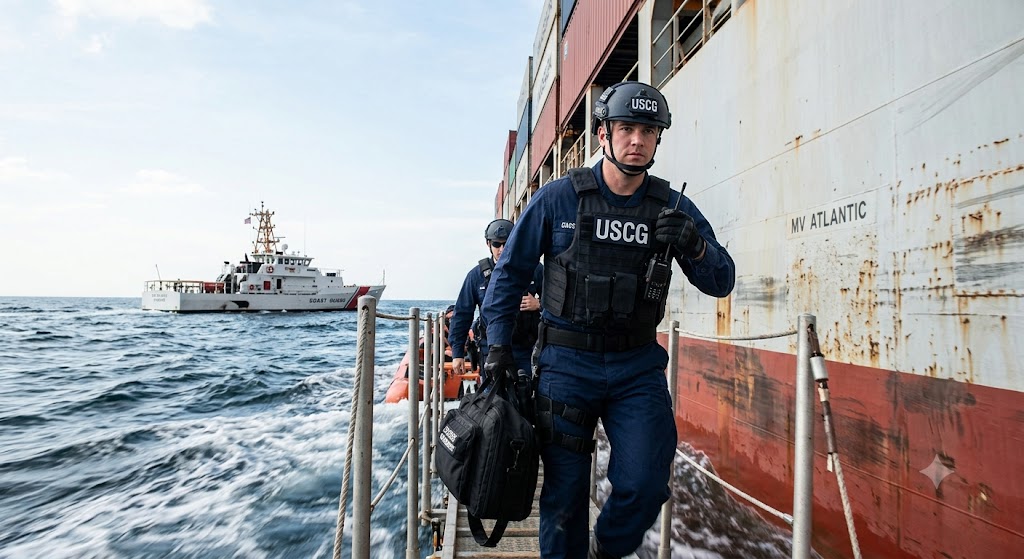
Additional Information
What the Course Entails and Exam Details
Preparing for the TAHOMA Boarding Officer qualification involves mastering a diverse and challenging syllabus. The core material is centered on the Basic Boarding Officer Course (BBOC), a rigorous training program that covers the following essential pillars of maritime law enforcement:
Authority and Jurisdiction: Understanding the legal basis for USCG actions, including international law and domestic statutes.
Maritime Law Enforcement (MLE) Operations: Procedural aspects of conducting boardings, from pre-boarding planning to post-boarding documentation.
Use of Force Policy: Comprehensive training on the USCG Use of Force continuum, including judgmental applications.
Tactical Procedures: Skills for safe movement, vessel control, and personnel management during a boarding.
Criminal Law and Evidence: Recognition of violations and proper evidence handling procedures.
Boating Safety Regulations: Enforcing recreational and commercial vessel safety standards.
Specialized Areas: Including fisheries enforcement, drug interdiction, immigration law, and environmental protection.
The TAHOMA Boarding Officer Practice Exam mirrors this curriculum, providing targeted questions and scenario-based problems that require you to apply these principles under time pressure. The final certification exam is a cumulative assessment of these subjects, typically taken upon completion of the BBOC.
What to Expect in the Final Exam
The actual USCG Boarding Officer certification is not just a single test, but a comprehensive evaluation that includes several components:
Written Examination: A rigorous, multiple-choice exam that tests detailed knowledge of MLE manuals, regulations, use of force policy, and legal frameworks. Expect questions that require recall of specific facts as well as application to complex scenarios.
Practical Evolutions: Candidates are evaluated on their ability to perform tactical procedures, lead a team, and manage judgmental use of force situations in a realistic environment.
Oral Board: A panel interview where you must defend your decisions and demonstrate a command of the required knowledge.
While the TAHOMA Boarding Officer Practice Exam focuses on the written component, it is designed to build the confidence and deep understanding needed for all phases of the final qualification.
How to Study and Exam Centers
Success on the TAHOMA Boarding Officer exam requires a disciplined and multi-faceted study strategy. Focus your efforts on the following:
Official USCG Manuals: Your primary source material should be the official USCG Maritime Law Enforcement Manual (MLEM) and related Commandant Instructions.
Utilize This Practice Exam: Take the TAHOMA Boarding Officer Practice Exam multiple times. Use it not just to score yourself, but to identify weak areas that require further study in the primary sources.
Create Flashcards: Master definitions, specific legal citations, and use of force steps through active recall.
Scenario-Based Discussions: Practice applying the Use of Force Policy and tactical procedures with peers to build decision-making speed.
For USCG personnel, the official Basic Boarding Officer Course and its final examinations are conducted at the USCG Maritime Law Enforcement Academy (MLEA) in Charleston, South Carolina, and at designated regional training centers.
Job Opportunities from the Course
Earning the designation of a USCG Certified Boarding Officer is a significant achievement that opens up a distinct and challenging career path within the Coast Guard. This qualification is a prerequisite for numerous leadership roles in maritime law enforcement, including:
Boarding Officer: Leading boarding teams on a wide variety of vessels.
Boarding Team Leader: Supervising multiple boarding teams during larger operations.
Maritime Law Enforcement Specialist (ME): A dedicated rating focused on law enforcement duties, port security, and counter-terrorism.
MLE Instructor: Training the next generation of Coast Guard boarding personnel.
Operations Officer (Combatant/Cutter): Planning and overseeing MLE missions at sea.
Positions in Port Security Units (PSUs) and Tactical Law Enforcement Teams (TACLETs).
This certification demonstrates a high level of responsibility, leadership, and expertise, making it a critical asset for any Coast Guard member dedicated to protecting our nation's maritime interests.
Frequently Asked Questions
Reviews
5.0
Based on 0 reviews
Leave a Review
No reviews yet. Be the first to review!