
Tactical Strength and Conditioning Practice Exam
$69.00
- Buy to unlock unlimited access to all Quiz questions.
- After purchase you can print a PDF of the whole quiz at any point. The PDF will contain the questions and the correct answers.
About this Exam
The Tactical Strength and Conditioning (TSAC) certification is designed for professionals who train specialized, demanding populations like military personnel, law enforcement officers, firefighters, and emergency responders.
This certification verifies an individual's expertise in applying strength and conditioning principles to improve performance, enhance readiness, and reduce injury risk for these tactical athletes.
Aspiring facilitators learn how to build effective programs tailored to the unique physical and environmental challenges these individuals face daily.
Ready to test your knowledge?
Buy Now to Access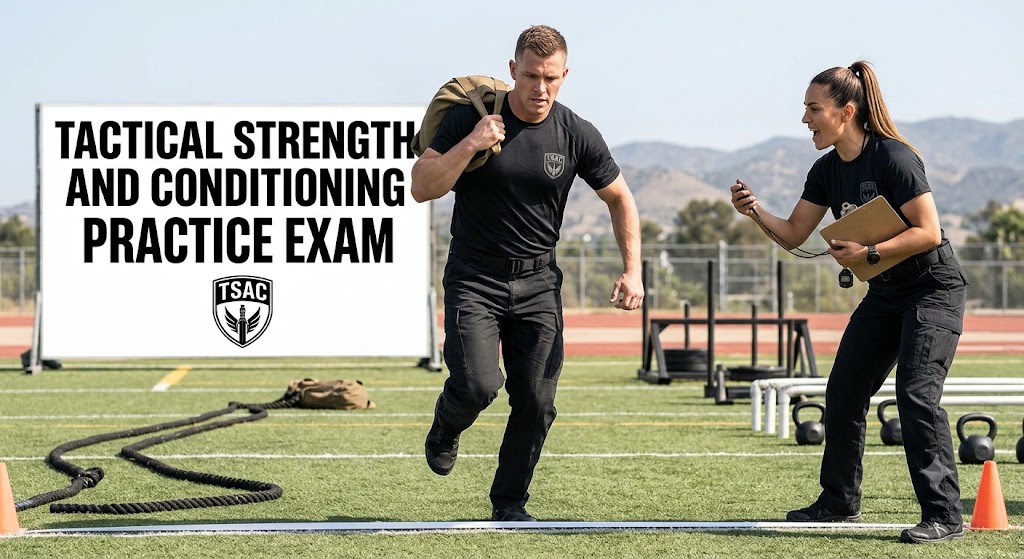
Additional Information
What the Course Entails and Exam Details
The underlying coursework typically covers a broad range of scientific and practical applications necessary for tactical readiness.
Students delve into key subjects such as advanced exercise physiology, biomechanics, and nutrition tailored for high-demand individuals.
The curriculum includes developing specialized program designs that improve anaerobic and aerobic capacity, power, and agility for tactical operators.
Facilitators also learn crucial skills in injury prevention, risk management, the physiology of stress, and specific considerations for a diverse force.
Testing, evaluation, and data analysis to track performance progress are also core components.
What to Expect in the Final Exam
The official certification exam is typically a proctored, computer-based multiple-choice test.
Candidates can expect approximately 155 questions, including both scored items and potential unscored pre-test questions designed to ensure the quality of future exams.
The content usually focuses on two primary areas: Scientific Foundations (e.g., Exercise Science, Nutrition, Psychophysiology) and Practical Application (e.g., Exercise Technique, Program Design, Organization/Administration).
The exam often has a time limit of around three hours, and a scaled score (usually 70 or above) is required to pass and earn the certification.
How to Study and Exam Centers
Thorough preparation is essential for success. We recommend starting with a comprehensive review of the primary textbooks, such as "Essentials of Tactical Strength and Conditioning."
Utilize detailed study guides and create flashcards for key concepts and terminology. Multiple practice exams are crucial to familiarize yourself with the question style and identify weak areas for focused study.
Ensure you carefully review the official Exam Content Outline provided by the certifying organization.
The final exam is typically administered through a professional testing service like Pearson VUE. Candidates can register and schedule their exam at authorized physical testing centers conveniently located globally.
Some organizations may offer a live remote proctoring option.
Job Opportunities from the Course
Achieving this certification opens doors to specialized roles within unique populations and organizations. Common job titles and career paths include:
Tactical Strength and Conditioning Facilitator (TSAC-F) for military units (Army, Navy, Air Force, Marines, etc.)
Fitness and Wellness Instructor for local, state, or federal Law Enforcement Agencies
Physical Training Coordinator for Fire Departments and Emergency Medical Services (EMS)
Performance Coach for Special Operations commands or tactical teams
Strength and Conditioning Specialist for government contractors providing readiness programs
Program Director for agency-wide health and fitness initiatives.
Frequently Asked Questions
Reviews
5.0
Based on 0 reviews
Leave a Review
No reviews yet. Be the first to review!