
Tactical Session Controller (TSC) Practice Exam
$69.00
- Buy to unlock unlimited access to all Quiz questions.
- After purchase you can print a PDF of the whole quiz at any point. The PDF will contain the questions and the correct answers.
About this Exam
The Tactical Session Controller (TSC) certification is a premier credential for professionals operating within the high-stakes environment of unmanned system command and control. Designed primarily for defense contractors, military personnel, and specialized public safety officers, this certification validates the critical skills needed to manage, coordinate, and control real-time tactical sessions of Unmanned Aerial Systems (UAS), Unmanned Ground Vehicles (UGV), and other autonomous assets. A certified TSC is the linchpin of a tactical operation, ensuring seamless communication, data integration, and mission execution in complex, dynamic scenarios. This practice exam is your essential tool to master the required knowledge and approach the final certification with confidence.
Ready to test your knowledge?
Buy Now to Access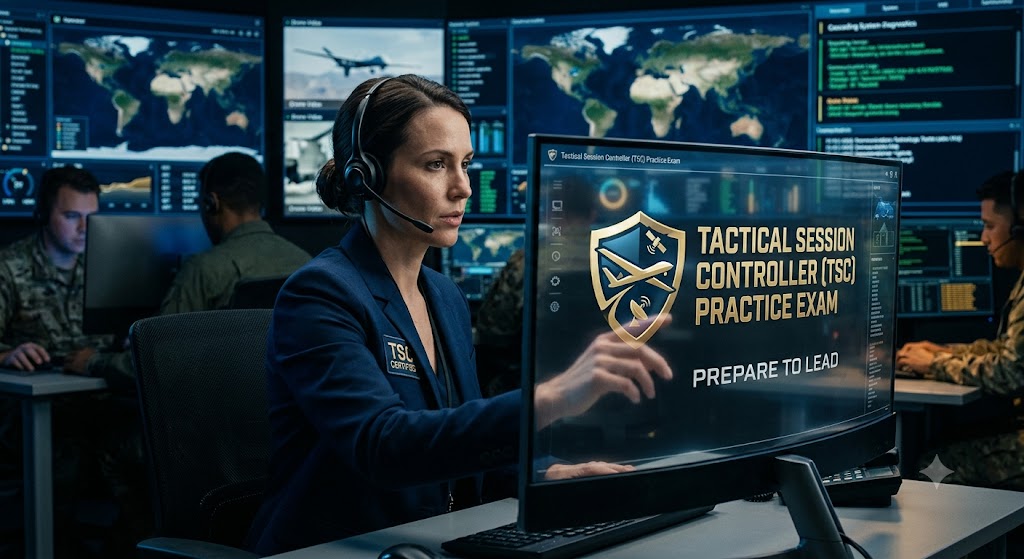
Additional Information
What the Course Entails and Exam Details
Preparing for the TSC exam requires a comprehensive understanding of multi-domain operations. The core syllabus covers a spectrum of technical and operational competencies. Students must demonstrate proficiency in:
Unmanned Systems Operations: Principles of flight, vehicle dynamics, payload management, and mission planning for various unmanned platforms.
Command and Control (C2) Architectures: Understanding the hardware, software, and communication protocols (such as NATO STANAG 4586) that enable remote control and data link management.
Tactical Data Links and Communication: Managing line-of-sight and beyond-visual-line-of-sight (BVLOS) links, ensuring bandwidth optimization, and maintaining secure communications.
Situational Awareness and Intelligence Fusion: Integrating real-time video feeds, sensor data, and geospatial information to create a comprehensive tactical picture for decision-makers.
Rules of Engagement (ROE) and Safety Protocols: Applying operational legal frameworks, airspace deconfliction methods, and emergency procedure management.
Session Coordination and Leadership: Leading a mission team, delegating tasks, and maintaining clear, concise communication under pressure.
What to Expect in the Final Exam
The final TSC Certification Exam is a rigorous assessment designed to simulate the pressures of a live operational environment. It is typically divided into two primary components:
Written Knowledge Assessment: A multiple-choice and multi-select exam consisting of approximately 100 to 120 questions. This section evaluates your theoretical understanding of systems, regulations, and protocols. The time limit is generally 2 to 3 hours, and a passing score of 75% or higher is required.
Practical Simulation Exam: This is the core of the TSC certification. Candidates are placed in a high-fidelity simulator that replicates a command and control station. You will be required to manage a complex, multi-vehicle tactical "session." This includes responding to dynamic threats, asset failures, and changing mission objectives in real-time. Your performance is evaluated on technical precision, adherence to protocols, and leadership under pressure.
How to Study and Exam Centers
Success on the TSC exam demands a blended approach of theoretical study and practical application.
Actionable Study Strategies:
Utilize Official TSC Courseware: Begin with the authorized training materials, which provide the foundational knowledge for all exam domains.
Take Multiple Practice Exams: Our [Tactical Session Controller (TSC) Practice Exam] is designed to mirror the style and difficulty of the written assessment, helping you identify knowledge gaps.
Hands-on Simulator Time: This is non-negotiable. Spend significant hours in an authorized command and control simulator to build muscle memory and decisive decision-making skills.
Form Study Groups: Collaborate with peers to discuss complex tactical scenarios and critique each other’s mission planning.
Exam Centers:
The written exam can typically be taken at authorized physical testing centers, such as Pearson VUE, which offer proctored environments globally.
The practical simulation exam must be taken at designated Tactical Center of Excellence (TCOE) facilities or authorized training command locations, as they require specialized, certified simulation hardware.
Job Opportunities from the Course
A TSC certification opens doors to specialized, high-demand roles within the defense and aerospace sectors. Here are specific job titles and career paths this credential unlocks:
Unmanned Systems (UAS/UGV) Mission Commander
Tactical Operations Center (TOC) Controller
Unmanned Systems Command and Control (C2) Operator
Defense Contractor – UAS Operations Specialist
ISR (Intelligence, Surveillance, Reconnaissance) Session Manager
Public Safety / Border Patrol UAV Coordinator
Advanced Unmanned Systems Instructor
Test and Evaluation (T&E) Specialist for Autonomous Systems
Frequently Asked Questions
Reviews
5.0
Based on 0 reviews
Leave a Review
No reviews yet. Be the first to review!