
Tactical Paramedic Certification (TP-C) Practice Exam
$69.00
- Buy to unlock unlimited access to all Quiz questions.
- After purchase you can print a PDF of the whole quiz at any point. The PDF will contain the questions and the correct answers.
About this Exam
The Tactical Paramedic Certification (TP-C) is a high-level credential for experienced paramedics working in law enforcement and other tactical environments. It validates the critical-thinking skills and specialized medical knowledge required to provide care in high-threat, complex, and austere situations, often within the "warm zone" of an active scene. This exam is designed for individuals serving on SWAT teams, federal agency medical units, high-risk operational teams, and international protective details, aiming to set the standard for tactical medicine across the industry. It emphasizes pre-hospital trauma care and dynamic decision-making under intense pressure.
Ready to test your knowledge?
Buy Now to Access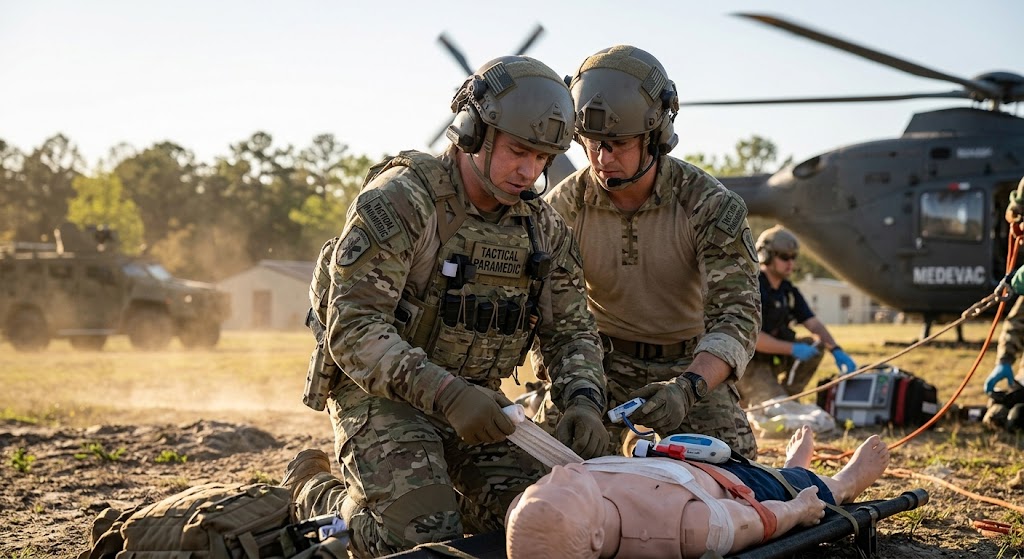
Additional Information
What the Course Entails and Exam Details
The TP-C exam covers an extensive range of topics critical to operational and tactical medicine. The core content follows the curriculum recommendations of the Board of Certification for Emergency Nursing (BCEN) and the IBSC/BCCTPC. Candidates are tested on their knowledge of Tactical Combat Casualty Care (TCCC) and Tactical Emergency Casualty Care (TECC) guidelines, operational medicine logistics, care in unconventional environments, force health protection, and extended care scenarios. Key domains include hemorrhage control, airway management in tactical settings, managing chest trauma, environmental emergencies, pediatric and K9 tactical care, and operational planning. The actual TP-C exam is a computer-based test consisting of 125 multiple-choice questions, with 100 scored and 25 unscored pre-test questions, delivered via a secure testing facility.
What to Expect in the Final Exam
When you sit for the actual TP-C final exam administered by the International Board of Specialty Certifications (IBSC), you should expect a challenging assessment designed to measure advanced competency. The total time allowed for the exam is 2.5 hours. To pass, you must achieve a predetermined cut score, which is set using a criterion-referenced method to ensure psychometric validity. The questions often present scenarios requiring candidates to apply clinical knowledge while simultaneously considering operational security and scene safety principles. It is a closed-book exam, and strict identification and security protocols are enforced at all certified testing centers. There is no practical component required for the TP-C written exam itself, although many preparatory courses include hands-on training to reinforce these concepts.
How to Study and Exam Centers
Preparation for the TP-C requires a combination of clinical experience and focused study on tactical medicine principles. Utilizing a detailed TP-C Practice Exam is one of the most effective strategies to familiarize yourself with the question style and identify knowledge gaps.
Start by thoroughly reviewing current TCCC and TECC guidelines, which are fundamental to the exam's content.
Studying standard tactical medicine textbooks and resources, such as "PHTLS: Military Edition" or similar curriculum, is essential.
Consistently take practice exams to improve your time management skills and your ability to apply complex algorithms in a high-stress, scenario-based format.
Focus on challenging domains: dynamic assessment of the "warm zone" versus "cold zone," advanced hemorrhage control beyond tourniquets, and prolonged field care in operational settings.
For the actual final exam, you cannot take it just anywhere. The IBSC administers the computer-based testing through specialized professional centers. These include Pearson VUE testing centers globally and specific military or government installation testing sites, depending on the candidate's affiliation. Registration and scheduling must be completed through the IBSC website. The practice exam you are taking here is an excellent preparatory simulation tool accessible online to help you succeed before arriving at the official center.
Job Opportunities from the Course
Earning your Tactical Paramedic Certification significantly enhances your career trajectory and opens doors to elite positions within specialized teams. The TP-C is increasingly recognized, and sometimes required, by agencies looking for the highest standard of tactical medical integration. Successful individuals move into specialized career paths such as:
SWAT Team Paramedic
Federal Law Enforcement Medic (e.g., FBI, DEA, Secret Service)
State and Local Tactical EMS Coordinator
Contract Tactical Medic (supporting international operations)
High-Risk Protective Detail Medical Specialist
Flight Paramedic with tactical integration capabilities
Special Operations Medic (within military or government organizations)
Tactical Medicine Instructor/Educator
Frequently Asked Questions
Reviews
5.0
Based on 0 reviews
Leave a Review
No reviews yet. Be the first to review!