
Tactical Combat Casualty Care (TCCC) Tier 3 Practice Exam
$69.00
- Buy to unlock unlimited access to all Quiz questions.
- After purchase you can print a PDF of the whole quiz at any point. The PDF will contain the questions and the correct answers.
About this Exam
Tactical Combat Casualty Care (TCCC) is the standard of care for pre-hospital battlefield trauma, developed by the Defense Health Agency (DHA). The Tier 3 level, often known as the Combat Lifesaver (CLS) course, is designed to bridge the gap between basic all-service-member life support and the advanced care provided by combat medics or corpsmen. This critical training equips non-medical military personnel—and certain law enforcement or first responder units—with the essential skills needed to treat and stabilize casualties under fire and during transport. Earning this certification proves your ability to perform life-saving interventions in high-stress, tactical environments.
Ready to test your knowledge?
Buy Now to Access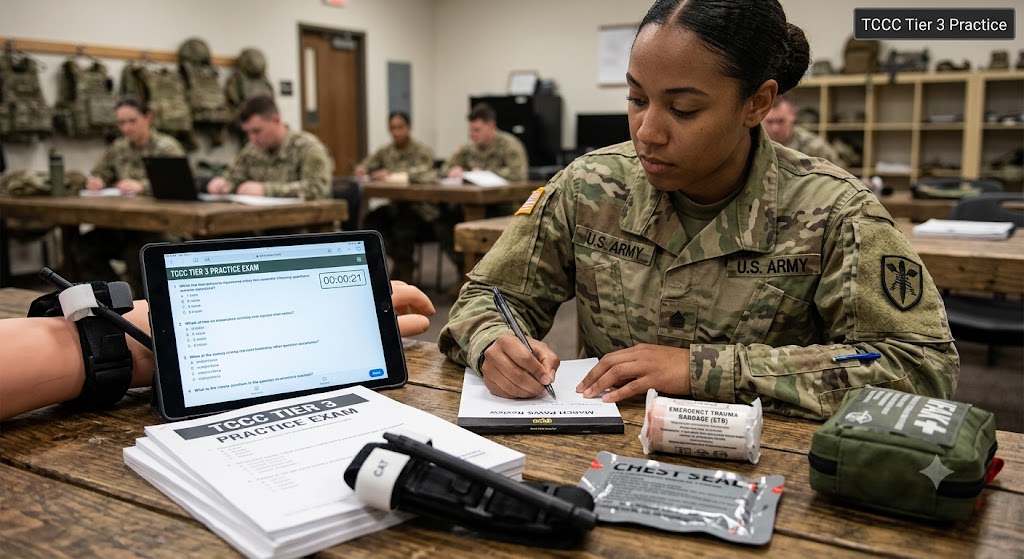
Additional Information
What the Course Entails and Exam Details
The TCCC Tier 3 course is a rigorous program, combining a deep theoretical understanding with high-intensity practical application. The curriculum centers on the evidence-based guidelines developed by the Committee on Tactical Combat Casualty Care (CoTCCC). Students are trained in advanced procedures far beyond the standard service member or combat lifesaver. Key areas covered include:
The MARCHE Assessment Algorithm: Mastering the priority of care for trauma casualties: Massive Hemorrhage, Airway, Respiration, Circulation, Hypothermia, and Head injury.
Hemorrhage Control: Advanced techniques for limb and junctional tourniquet application, hemostatic dressings, and wound packing.
Airway Management: Skills for managing difficult airways, including surgical cricothyroidotomy and the use of extraglottic airways.
Respiration and Chest Trauma: Diagnosis and management of tension pneumothorax, using chest seals and needle decompression.
Circulation and Shock: Establishing IV/IO access, fluid resuscitation strategies, and the use of tranexamic acid (TXA).
Hypothermia Prevention: Techniques to prevent and manage the lethal triad of trauma.
Analgesia and Antibiotics: Appropriate battlefield pharmacology for pain management and infection control.
Tactical Phases of Care: Understanding and applying procedures within the distinct phases: Care Under Fire (CUF), Tactical Field Care (TFC), and Tactical Evacuation Care (TACEVAC).
Casualty Movement and Evacuation: Techniques for moving casualties while maintaining care and calling for medical evacuation (9-Line MEDEVAC).
The course often culminates in a comprehensive assessment that includes both a written written exam to test knowledge and a series of dynamic practical skill stations.
What to Expect in the Final Exam
Preparation is key, and knowing what to expect can help you succeed. The final evaluation for TCCC Tier 3 is not just about recall; it tests your ability to make critical decisions under stress. You can typically expect a two-part assessment:
Written Examination: This component evaluates your understanding of the theoretical concepts, guidelines, and protocols. Expect multiple-choice questions covering topics such as the phases of care, specific medical interventions, pharmacological dosages, and the MARCHE algorithm. You must demonstrate a high level of competency, often requiring a passing score of 80% or higher.
Practical Skills and Scenarios: This is the heart of the assessment. Candidates will be required to perform a wide range of hands-on skills in a simulated, high-stress tactical environment. Evaluators will watch for correct technique, speed, and adherence to the CoTCCC guidelines. Expect multiple scenarios where you must assess and treat simulated casualties, often with distractions and limited resources. Failure in key skills, such as tourniquet application or airway management, may result in failure of the entire course.
Specific rules, time limits, and scenarios will be briefed by the instructing body, ensuring all candidates understand the rigorous expectations of this elite-level certification.
How to Study and Exam Centers
Successfully passing the TCCC Tier 3 exam requires a multi-faceted study approach.
Study the Guidelines: The official CoTCCC guidelines and the NAEMT TCCC-CMC curriculum are your primary resources. Review them thoroughly.
Use Practical Practice: "Train as you fight." Practice your skills relentlessly. Use training manikins, simulated bleeding kits, and practice the MARCHE algorithm out loud until it is second nature. Find a study partner to run scenarios.
Online and Mobile Resources: Utilize official tools like the "Deployed Medicine" app for up-to-date guidelines, videos, and modules. Look for accredited practice exam questions from reputable sources to familiarize yourself with the written format.
Practice Under Stress: Incorporate physical exertion, noise, and distractions into your skill practice to simulate the pressure of a real deployment or the final exam.
Finding Exam Centers: TCCC Tier 3 courses and exams are not taken at commercial testing centers like Pearson VUE. Instead, they are delivered by authorized training centers, military units, and accredited medical schools. For military personnel, training is usually coordinated within your unit or through service-specific medical training commands. For civilian tactical medical professionals, search for "NAEMT TCCC-CMC" or "TCCC-MP" (Medical Personnel) courses offered by certified training organizations or local Emergency Medical Services (EMS) authorities. Ensure the course provider is officially recognized by the Defense Health Agency (DHA) and NAEMT to issue a valid certification.
Job Opportunities from the Course
A TCCC Tier 3 certification is a powerful and respected credential in both military and specialized civilian sectors. It opens doors to career paths where advanced prehospital trauma care is paramount. Key opportunities include:
Combat Medic Specialist (U.S. Army MOS 68W)
Hospital Corpsman (U.S. Navy HM)
Aerospace Medical Service Technician (U.S. Air Force 4N0X1)
Special Operations Combat Medic (SOCM)
Tactical Paramedic / Tactical EMS Provider
SWAT Medic / Law Enforcement Medical Support
Government or Private Security Medical Contractor
Remote or Austere Medicine Practitioner
Medical Instructor for Tactical and Operational Medicine
Flight Medic / Aeromedical Evacuation Crew
Frequently Asked Questions
Reviews
5.0
Based on 0 reviews
Leave a Review
No reviews yet. Be the first to review!