
Tactical Combat Casualty Care (TCCC) Practice Test
$69.00
- Buy to unlock unlimited access to all Quiz questions.
- After purchase you can print a PDF of the whole quiz at any point. The PDF will contain the questions and the correct answers.
About this Exam
The Tactical Combat Casualty Care (TCCC) certification represents the gold standard in battlefield and high-threat medical response, designed specifically to reduce preventable deaths in tactical situations.
This course is aimed at military personnel, first responders, and medical professionals operating in austere environments, focusing on life-saving interventions when immediate evacuation is impossible.
If you aim to provide immediate, life-sustaining medical attention under duress, TCCC certification is your essential credential.
Ready to test your knowledge?
Buy Now to Access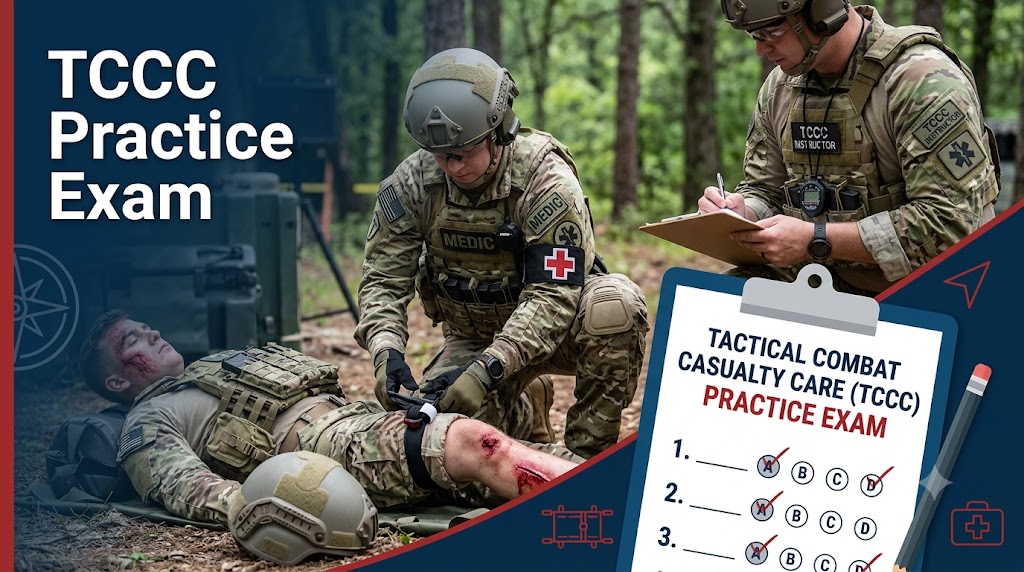
Additional Information
What the Course Entails and Exam Details
TCCC training is divided into clear phases of care, each with its unique priorities and limitations.
The curriculum explicitly covers: Care Under Fire (CUF), where the primary goal is suppression and movement to cover; Tactical Field Care (TFC), where medical treatment can begin in relative safety; and Tactical Evacuation Care (TACEVAC), focusing on care during transport to higher levels of facility.
Core skills center on the MARCH algorithm: Massive Hemorrhage control (e.g., tourniquet application), Airway management, Respiration assessment (treating tension pneumothorax), Circulation (fluid resuscitation and bleeding control), and Hypothermia prevention/Head injury management.
What to Expect in the Final Exam
The final assessment typically involves both a comprehensive written examination and a practical skills evaluation.
The written test is frequently a multiple-choice exam assessing theoretical knowledge of protocols, pharmacology (relevant to battlefield trauma), and triage decision-making.
The critical practical evaluation requires candidates to demonstrate hands-on proficiency in TCCC skills, such as tourniquet placement, wound packing, and airway interventions, often within a realistic, simulated scenario under time constraints and artificial pressure.
A high passing score (typically 80% or higher for the written, and flawless execution for critical skills) is mandatory to receive certification, which is valid for four years (e.g., NAEMT TCCC).
How to Study and Exam Centers
Effective preparation demands a blend of rigorous theoretical review and extensive hands-on practice.
Study strategies must include reviewing the primary TCCC guidelines, participating in scenario-based drills, and practicing with training aids like tourniquets and practice mannequins until the procedures become instinctive.
To take the TCCC course and exam, individuals must register through NAEMT-authorized training centers or specific military and law enforcement training academies. These courses are typically multi-day, intensive sessions held at physical training facilities that have the necessary equipment for realistic simulations.
Job Opportunities from the Course
TCCC certification directly translates into expanded roles and responsibilities in challenging environments, unlocking several career paths.
It is either required or strongly preferred for specific professions, such as:
Special Operations Forces Personnel (e.g., Navy SEAL, Green Beret)
Combat Medics / Corpsmen
Tactical EMS Providers (supporting law enforcement SWAT or HRT)
Tactical Law Enforcement Officers
Contract Medical Personnel in High-Threat Zones
Flight Paramedics in Austere or Combat Roles
Private Security Contractors (Executive Protection in dangerous locales)
Frequently Asked Questions
Reviews
5.0
Based on 0 reviews
Leave a Review
No reviews yet. Be the first to review!