
Tactical Combat Casualty Care (TCCC) – Hospital Corpsman Basic (HCB) Practice Test
$69.00
- Buy to unlock unlimited access to all Quiz questions.
- After purchase you can print a PDF of the whole quiz at any point. The PDF will contain the questions and the correct answers.
About this Exam
The Tactical Combat Casualty Care (TCCC) – Hospital Corpsman Basic (HCB) curriculum represents the United States Navy’s foundational medical training for battlefield survival and casualty care. This course is specifically designed for United States Navy Hospital Corpsmen, equipping them with the life-saving skills necessary to provide immediate medical attention in a tactical or pre-hospital environment. It forms the bedrock of their operational readiness and ability to support combat forces globally. The TCCC HCB practice test is an essential tool for Corpsmen preparing for their final assessment, helping to reinforce knowledge of life-saving protocols and critical decision-making under pressure.
Ready to test your knowledge?
Buy Now to Access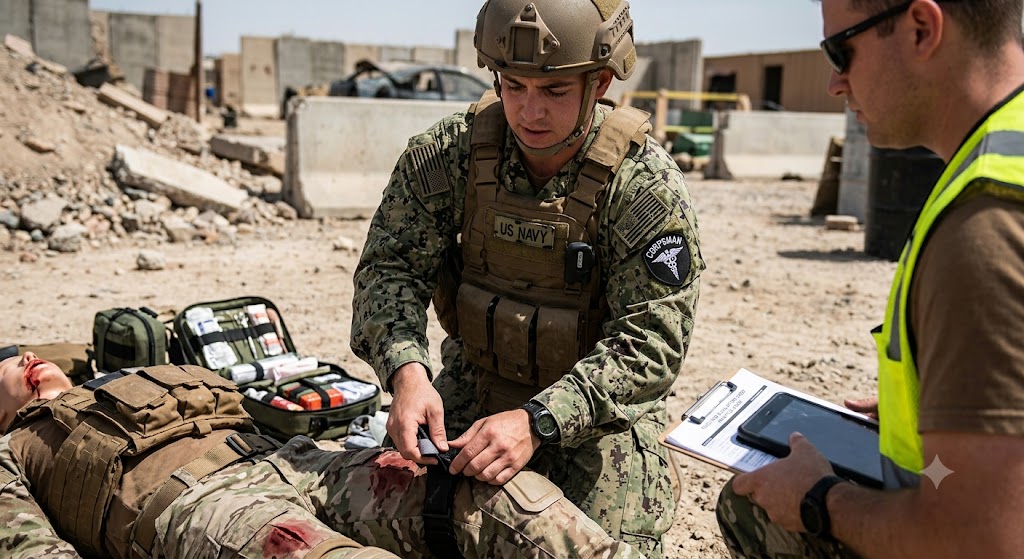
Additional Information
What the Course Entails and Exam Details
The TCCC HCB course focuses on the three phases of tactical combat casualty care: Care Under Fire (CUF), Tactical Field Care (TFC), and Tactical Evacuation Care (TACEVAC). The curriculum covers crucial topics including massive hemorrhage control using tourniquets and hemostatic dressings, airway management, breathing assessment for tension pneumothorax, circulation stabilization with IVs and fluids, and prevention of hypothermia. Students must master the TCCC guidelines and protocols to prioritize treatments based on the severity of the situation and the threat. The course combines classroom instruction, simulation, and extensive hands-on practice in various realistic battlefield scenarios to ensure comprehensive competency.
What to Expect in the Final Exam
The final TCCC HCB examination is a rigorous multi-part assessment designed to test both theoretical knowledge and practical application under stress. It typically includes a written, multiple-choice test that covers all areas of the TCCC protocols, medical procedures, and operational concepts. Following the written portion, candidates must successfully complete a series of physical skills-based stations. In these scenarios, examiners evaluate the candidate’s ability to correctly and rapidly perform critical life-saving techniques, such as tourniquet application, advanced airway maneuvers, and wound packing, often while wearing tactical gear in a dynamic environment. A high passing score is required for both the written exam and a perfect execution of all critical life-saving steps in the practical assessments.
How to Study and Exam Centers
Effective study strategies for the TCCC HCB test include a deep review of the official TCCC guidelines provided by the Joint Trauma System, utilizing Navy training materials and courses (such as those offered on official online platforms), and, most importantly, repeated hands-on practice. It is highly recommended that students practice techniques like tourniquet application and wound care until they become second nature. Form a study group with fellow Corpsmen to simulate battlefield scenarios and run through TCCC algorithms together. The TCCC HCB examination is typically administered at dedicated US Navy training commands, medical centers, and other authorized military training facilities.
Job Opportunities from the Course
Successful completion of the TCCC HCB course and final examination is mandatory for Hospital Corpsmen to advance in their military careers and is a foundational requirement for all deployment roles. This qualification unlocks various professional opportunities within the United States Navy and the wider military medical community. A Hospital Corpsman with TCCC HCB certification is qualified for and can pursue the following specific roles:
Fleet Marine Force (FMF) Corpsman (combat medic with Marine Corps units)
Operational Medical Support in Naval Special Warfare (SEAL Teams, etc.)
Independent Duty Corpsman (IDC) training pathways
Medical support on Navy ships and submarines
Aviation Medicine Technician
Dive Medical Technician
Search and Rescue Medical Technician (SAR MED TECH)
Medical simulation instructor or TCCC curriculum developer
Deployment readiness with various operational and expeditionary medical units
A solid foundation for advanced certifications and pathways to becoming a Physician Assistant or entering other highly skilled healthcare fields.
Frequently Asked Questions
Reviews
5.0
Based on 0 reviews
Leave a Review
No reviews yet. Be the first to review!