
Tactical Combat Casualty Care (TCCC) – Deployed Medic (Tier 1) Practice Test
$69.00
- Buy to unlock unlimited access to all Quiz questions.
- After purchase you can print a PDF of the whole quiz at any point. The PDF will contain the questions and the correct answers.
About this Exam
The Tactical Combat Casualty Care (TCCC) – Deployed Medic (Tier 1) certification is a specialized qualification designed for non-medical military personnel and government contractors deploying to potentially hostile or austere environments.
Its primary focus is to empower individuals to provide immediate, life-saving trauma care on the battlefield, Bridging the critical gap until specialized combat medics or definitive medical care can assume responsibility.
This course teaches a standardized, evidence-based approach to trauma care, maximizing casualty survival rates by addressing the most common causes of preventable death.
Ready to test your knowledge?
Buy Now to Access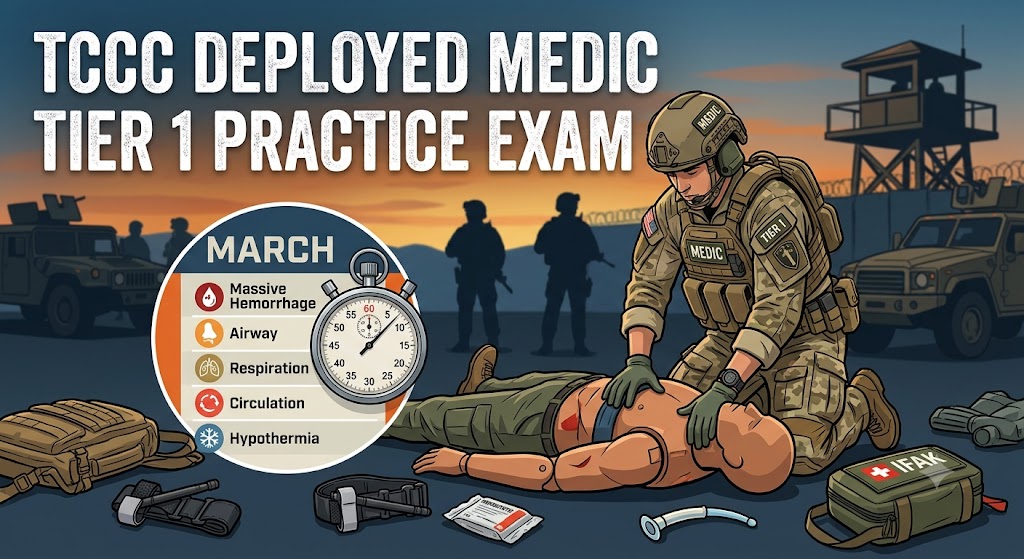
Additional Information
What the Course Entails and Exam Details
The TCCC Deployed Medic (Tier 1) course and its final exam cover a comprehensive, standardized syllabus.
The core of the curriculum is centered around the three phases of TCCC care:
Care Under Fire (CUF): Providing medical aid while under effective hostile fire, focusing only on the most critical, immediate life-saving intervention: life-threatening hemorrhage control.
Tactical Field Care (TFC): Providing care once the casualty and provider are no longer under effective hostile fire, allowing for a more detailed assessment and treatment.
Tactical Evacuation Care (TACEVAC): Providing care while the casualty is being transported to a higher level of medical care.
The skills covered within these phases follow the crucial M.A.R.C.H. algorithm:
M — Massive Hemorrhage: Control of life-threatening bleeding using tourniquets, hemostatic dressings, and pressure bandages.
A — Airway: Establishing and maintaining a patent airway using maneuvers, adjuncts (like the nasopharyngeal airway), and recovery positioning.
R — Respiration: Assessment for and treatment of life-threatening chest injuries, such as a tension pneumothorax, using occlusive dressings and needle decompression (where authorized and trained).
C — Circulation: Further shock assessment and management, including consideration for IV/IO access (as per scope) and continued hemorrhage control reassessment.
H — Hypothermia Prevention: Proactive measures to prevent the "lethal triad" by keeping the casualty warm and dry.
Additionally, candidates are trained and tested on proper casualty movement, communication, and medical documentation using the DD Form 1380 (TCCC Card).
What to Expect in the Final Exam
The final examination to earn the TCCC Deployed Medic (Tier 1) certification is a rigorous, two-part assessment designed to verify both knowledge and practical proficiency.
1. Written (Cognitive) Exam This part of the exam typically consists of multiple-choice questions administered online through a designated portal, such as deployedmedicine.com or a specific authorized educational platform. Candidates must demonstrate a firm grasp of all TCCC principles, the MARCH algorithm, and critical decision-making in each phase of care. A common minimum passing score is 70%. The time limit is determined by the specific administering body but is usually sufficient to thoroughly consider each scenario-based question.
2. Practical (Skills) Assessment This is a critical, hands-on evaluation where candidates are put into a simulated tactical scenario. They must physically perform the required TCCC skills while being observed and graded by a certified instructor using a standardized Tactical Trauma Assessment Checklist. Candidates must successfully perform all critical, life-saving steps of the M.A.R.C.H. algorithm within the appropriate phase of care to pass. Failure to correctly apply a tourniquet to control massive hemorrhage, for example, is typically grounds for immediate failure of the entire practical component.
How to Study and Exam Centers
Preparation for the TCCC Deployed Medic (Tier 1) exam requires a dedicated combination of academic study and physical skill repetition.
How to Study
Master the MARCH Algorithm: This is the absolute foundation. Understand, memorize, and be able to vocalize and perform every step in order, without hesitation.
Review Current TCCC Guidelines: The only official source for TCCC information is the Committee on Tactical Combat Casualty Care (CoTCCC). Always study from the most up-to-date guidelines and instructional materials, which are readily available on platforms like deployedmedicine.com.
Practice with Real Equipment: It is not enough to read about a tourniquet; you must repeatedly practice applying one on yourself and others, under various simulated conditions, until it is a reflex. This also applies to other skills like wound packing and inserting adjunct airways.
Utilize Official Resources: Use all official teaching materials provided, including Skill Instructions, Skill Cards, and video demonstrations.
Take Reputable Practice Tests: Simulating the written exam with realistic practice questions will help you identify knowledge gaps and get comfortable with the exam format and style.
Exam Centers
You cannot take the TCCC Deployed Medic (Tier 1) certification exam independently at a public computer. It must be administered through an authorized training center or a certified school. This includes:
Authorized NAEMT Training Centers: Many organizations are certified through the National Association of Emergency Medical Technicians (NAEMT) to deliver TCCC courses and conduct the required testing.
Military and Government Training Facilities: Authorized schools within the military or government offer these courses to deploying personnel.
Private Tactical and Medical Training Schools: A wide network of private schools is authorized to train and test civilians and contractors.
When registering, confirm that the school is a current, official provider of the CoTCCC curriculum to ensure your certification is valid.
Job Opportunities from the Course
Earning the TCCC Deployed Medic (Tier 1) certification unlocks critical roles in the operational, government, and private sectors, especially for those deploying in support of national security missions.
Common job titles and career paths enabled by this certification include:
TCCC Instructor / Medical Instructor
Tactical Combat Casualty Care (TCCC) Trainer
Contractor – Security and Protection Details
Contractor – Austere Environment Logistics and Support
Government Agency Field Operative / Support Staff
Non-Governmental Organization (NGO) Relief Worker
Private Military Contractor (PMC) Operator
Wilderness/Expedition Medical Support Staff
Frequently Asked Questions
Reviews
5.0
Based on 0 reviews
Leave a Review
No reviews yet. Be the first to review!