
Tactical Combat Casualty Care – Combat Medic/Corpsman (TCCC‑CMC) Practice Test
$69.00
- Buy to unlock unlimited access to all Quiz questions.
- After purchase you can print a PDF of the whole quiz at any point. The PDF will contain the questions and the correct answers.
About this Exam
Tactical Combat Casualty Care – Combat Medic/Corpsman (TCCC-CMC), also known as TCCC Tier 3, is the gold standard of care for military medical personnel. It is specifically designed for combat medics, corpsmen, pararescue, and other medical providers deploying in support of combat operations. This course builds upon the basic life-saving skills of TCCC, empowering medical professionals with advanced, evidence-based trauma care techniques to manage casualties in the most austere and hostile environments.
Ready to test your knowledge?
Buy Now to Access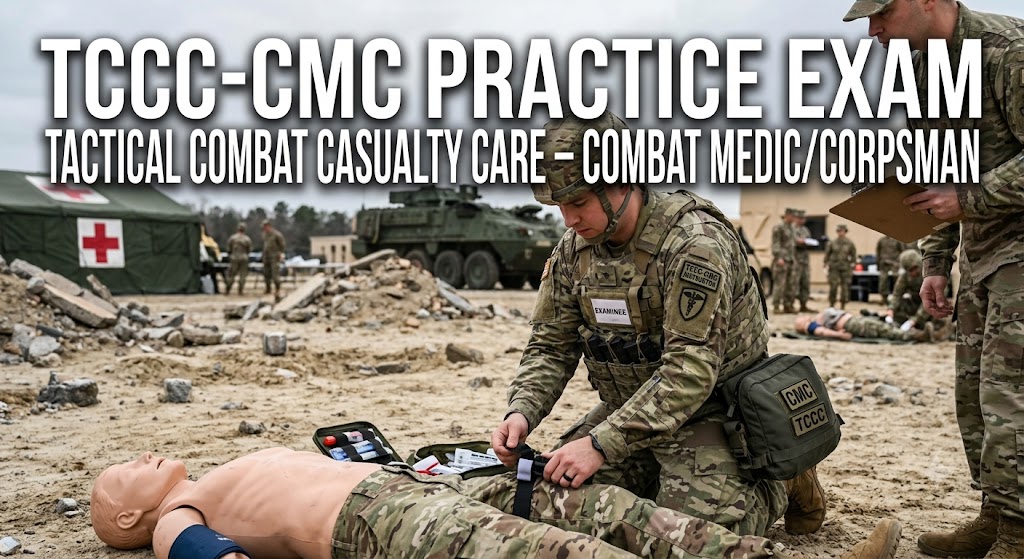
Additional Information
What the Course Entails and Exam Details
The TCCC-CMC is a rigorous and comprehensive program, typically spanning 64 hours. It provides an in-depth education on managing life-threatening injuries commonly encountered on the tactical battlefield. Students will delve into advanced topics, mastering skills essential for the entire continuum of care. The course curriculum is based on the Department of Defense Committee on TCCC (Co-TCCC) guidelines.
Core areas covered include:
Advanced principles of airway and respiratory management.
Comprehensive trauma shock assessment and management.
Strategies for burn injury treatment in a tactical setting.
Techniques for advanced pain and sedation management.
Setting up and managing Casualty Collection Points (CCPs).
Advanced extrication techniques and casualty movement.
Communication strategies and detailed documentation.
Operational planning, execution, and preparing casualties for evacuation.
What to Expect in the Final Exam
The final examination process for TCCC-CMC is a comprehensive assessment designed to ensure medical providers are ready for real-world combat scenarios. It consists of two main components: a written test and a practical assessment.
The written examination is typically a multiple-choice test that covers the theoretical knowledge of the entire course. It includes scenarios, TCCC principles, and protocols. Expect questions on the three phases of care: Care Under Fire, Tactical Field Care, and Tactical Evacuation Care, with a significant emphasis on the MARCH-PAWS algorithm (Massive hemorrhage, Airway, Respiration, Circulation, Hypothermia/Head injury - Pain, Antibiotics, Wounds, Splinting). While exact question counts can vary by training site, a high degree of proficiency (often requiring an 80% passing score, similar to the prerequisite pre-test) is required to pass.
The practical assessment is equally critical. During this portion, students must demonstrate their mastery of hands-on skills in a simulated, high-stress field environment. You will be evaluated on your ability to apply life-saving interventions correctly and efficiently, such as tourniquet application under fire, advanced airway management, surgical cricothyroidotomy, needle decompression, and intraosseous access, all while maintaining tactical situational awareness.
How to Study and Exam Centers
Effective study for the TCCC-CMC exam requires a blend of academic review and practical skill repetition. Your primary resource should be the most up-to-date Committee on Tactical Combat Casualty Care (Co-TCCC) guidelines, which are readily available on DeployedMedicine.com. Complement your study with the Prehospital Trauma Life Support (PHTLS) Military textbook, which is often the official curriculum text.
Create scenarios to practice applying the MARCH-PAWS algorithm mentally. Revisit the "Phases of Care" and understand how treatment priorities change. For the practical exam, repetitive hands-on practice is non-negotiable. If you can, drill with standard TCCC equipment, focusing on muscle memory for critical tasks like applying a tourniquet in under one minute.
The TCCC-CMC course and final certification are offered at NAEMT-authorized training centers worldwide. These centers include dedicated military training commands, such as the Field Medical Training Battalions (FMTB), as well as private specialized tactical medical training organizations. When scheduling your exam, ensure the center is fully accredited to issue the official TCCC certification recognized by the Joint Trauma System and the American College of Surgeons.
Job Opportunities from the Course
Earning your TCCC-CMC certification is a pivotal achievement for military medical providers and is often a mandatory requirement for deployment in combat roles. This credential unlocks numerous advanced career paths within and outside the uniformed services.
Career opportunities unlocked by this certification include:
Deployable Combat Medic / Corpsman (Tier 3 Provider)
Special Operations Combat Medic (SOCM) and Pararescue (PJ) roles
TCCC Instructor / Trainer (Military or Contract)
Tactical Paramedic (with further state/national licensure)
Tactical Medical Provider for government agencies and private security contractors
Flight Medic / Flight Nurse (in tactical or austere environments)
Advanced positions in Military Medical Logistics and Operational Planning
Frequently Asked Questions
Reviews
5.0
Based on 0 reviews
Leave a Review
No reviews yet. Be the first to review!