
Tactical Combat Casualty Care – Combat Lifesaver (TCCC-CLS) Tier 2 Practice Exam
$69.00
- Buy to unlock unlimited access to all Quiz questions.
- After purchase you can print a PDF of the whole quiz at any point. The PDF will contain the questions and the correct answers.
About this Exam
Welcome to your definitive guide for mastering the Tactical Combat Casualty Care – Combat Lifesaver (TCCC-CLS) Tier 2 qualification. This intensive program is the cornerstone of non-medical lifesaving on the battlefield. It is explicitly designed for non-medical military personnel, such as infantry, engineers, and support troops, who are deploying to combat or high-risk environments. This course bridges the gap between basic self-aid and the advanced care provided by medical providers. It equips you with the essential skills to save lives under duress, specifically focusing on the leading causes of preventable death in tactical situations. By mastering this practice exam, you are one step closer to becoming a critical asset to your team, capable of providing intermediate care at the point of injury when every second counts.
Ready to test your knowledge?
Buy Now to Access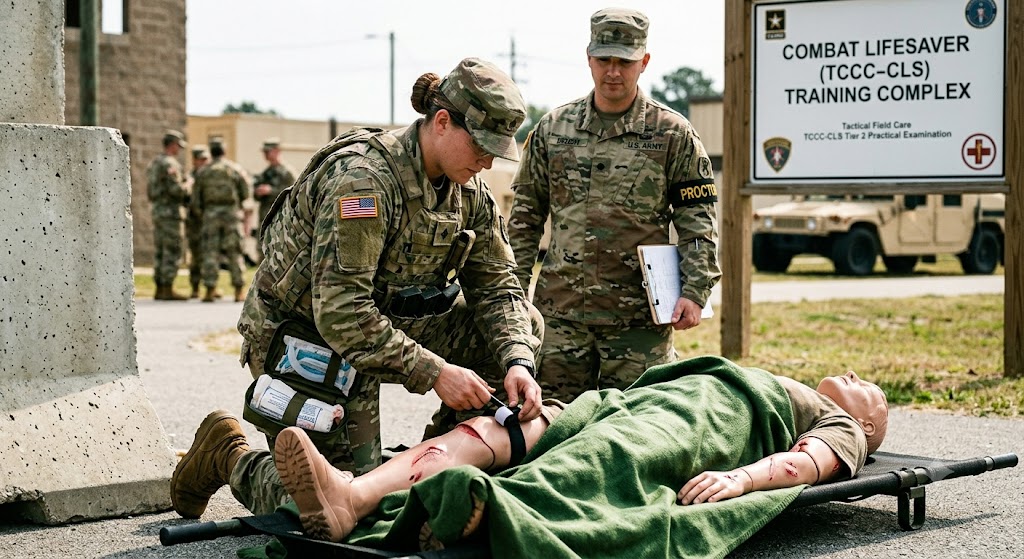
Additional Information
What the Course Entails and Exam Details
The TCCC-CLS Tier 2 course is a rigorous, 40-hour program that integrates classroom instruction with extensive hands-on practical skills training. It is structured around the Committee on TCCC (CoTCCC) guidelines, which are the evidence-based standard for battlefield trauma care. The core curriculum is built on the systematic M.A.R.C.H. P.A.W.S. treatment algorithm, ensuring a prioritized response to the most lethal injuries. The skills you will master include:
Massive Hemorrhage Control: Master the rapid application of limb tourniquets (both self and buddy), junctional tourniquets, and hemostatic dressings (like Combat Gauze) with wound packing.
Airway Management: Learn to identify and treat airway obstructions, including the insertion of Nasopharyngeal Airways (NPAs) and understanding postural airway management.
Respiration/Breathing: Recognize and manage tension pneumothorax with needle decompression and application of vented chest seals.
Circulation: Identify and treat shock, apply principles of hypothermia prevention, and manage casualties for tactical evacuation.
Head Injury & Hypothermia: Perform a basic assessment for traumatic brain injury (TBI) and initiate critical hypothermia prevention measures.
P.A.W.S. Management: Apply the principles of Pain management, Antibiotics (understanding the combat wound pill pack), Wounds (basic care and dressings), and Splinting for fractures.
Tactical Trauma Assessment (TTA): Learn a rapid, prioritized head-to-toe assessment of trauma casualties in three phases: Care Under Fire (CUF), Tactical Field Care (TFC), and Tactical Evacuation Care (TACEVAC).
Medical Documentation: Correct and complete the DD Form 1380 (TCCC Casualty Card).
What to Expect in the Final Exam
To earn your TCCC-CLS Tier 2 certification, you must successfully pass a comprehensive evaluation process. The exam is divided into two distinct parts, and failure to meet the standard in either component will result in failing the course.
Multiple-Choice Exam: You will complete a written (often online, via Deployed Medicine) exam, typically consisting of 50 questions. These cover cognitive knowledge of the TCCC guidelines, M.A.R.C.H. P.A.W.S. protocol, medication usage, and tactical decision-making. The minimum passing score is 70%.
Practical Skills Evaluation: This is a dynamic, scenario-based assessment where you will be graded on your ability to perform critical skills correctly and in the proper sequence, based on a Tactical Trauma Assessment Skills Checklist. You will be evaluated on your skill in:
Care Under Fire: Performing rapid tourniquet application while under simulated stress.
Tactical Field Care: Executing the full M.A.R.C.H. algorithm on a simulated casualty (manikin or peer).
Skill Stations: Demonstrating mastery of individual tasks like NPA insertion, chest seal application, wound packing, and DD Form 1380 documentation.
A 'Critical Failure' on any essential life-saving step in the checklist will result in automatic failure of the practical portion.
How to Study and Exam Centers
Preparation is paramount. Here are actionable strategies to prepare for success on your TCCC-CLS Tier 2 exam:
Practical, Hands-on Practice: The exam is heavily performance-based. Spend significant time practicing every skill. Do not just watch others; apply tourniquets on yourself and buddies (repeatedly, aiming for under 30 seconds), practice wound packing on trainers, and practice posturing the airway. Use the Official TCCC-CLS Skills Checklists to ensure you do not miss steps.
Study the Material: The primary source is the current TCCC Guidelines, available on deployedmedicine.com and through the Deployed Medicine mobile app. Read the CLS Student Manual, watch the official skill videos, and use the provided study guides.
Utilize This Practice Exam: Use this comprehensive practice exam to test your knowledge. Focus on why an answer is correct, not just which one it is.
Where to Take the Exam: TCCC-CLS Tier 2 training is typically provided in-house by your military unit’s medical or training departments. authorized training centers. Courses are also offered through designated Defense Health Agency (DHA) sites, NAEMT training centers, and military-affiliated civilian schools. The written exam is often administered through the Deployed Medicine online platform upon course completion.
Job Opportunities from the Course
While TCCC-CLS Tier 2 is first and foremost a military qualification designed to create a "secondary mission" capability for non-medical warfighters, the certification and the underlying, high-level tactical medical skills are in demand for numerous career paths. This qualification unlocks opportunities including:
Combat Lifesaver (CLS) - Non-medical Military Personnel
Private Security Contractor (PSC) / High-Risk Security Detail
Tactical Law Enforcement Officer / SWAT Team Member
Disaster Response Team Member
Tactical EMT or Paramedic (with further civilian certification)
Medical Skills Instructor / Trainer
Hostile Environment Consultant
Frequently Asked Questions
Reviews
5.0
Based on 0 reviews
Leave a Review
No reviews yet. Be the first to review!