
Tableau Data Analyst Certification Practice Test
$69.00
- Buy to unlock unlimited access to all Quiz questions.
- After purchase you can print a PDF of the whole quiz at any point. The PDF will contain the questions and the correct answers.
About this Exam
Are you looking to solidify your career as a leading data analyst? The Tableau Certified Data Analyst certification is an elite credential designed for individuals who possess a comprehensive understanding of Tableau for business intelligence. It validates your ability to enable stakeholders to make informed, data-driven decisions. By proving your proficiency, you demonstrate that you can effectively understand business problems, identify and explore relevant data, and deliver actionable insights. This exam is perfect for data professionals, BI analysts, and consultants who need to show they are not just users of the tool but experts in the field of visual analytics.
Ready to test your knowledge?
Buy Now to Access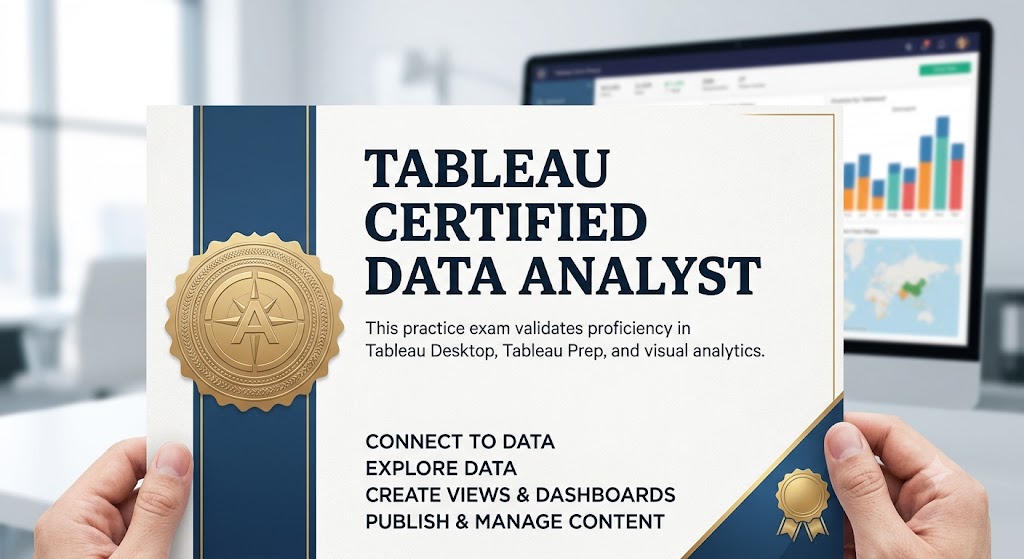
Additional Information
What the Course Entails and Exam Details
The Tableau Certified Data Analyst exam covers four critical domains that are essential for any modern analyst. These core skills are designed to ensure you are equipped for the full lifecycle of data analysis.
Domain 1: Connect to and Transform Data. This section is all about getting the right data in the right shape. You will learn to connect to diverse data sources, from basic spreadsheets to complex relational databases, and decide between live and extract connections. A major component involves utilizing Tableau Prep to perform data transformation, including cleaning, combining, and shaping data.
Domain 2: Explore and Analyze Data. This is where your analytical prowess is tested. You will learn to write sophisticated date, string, logical, and number functions. You'll master advanced calculation types, including aggregate, FIXED level of detail (LOD), and both quick and custom table calculations (e.g., Year-to-Date, running totals, and ranking). This domain also emphasizes the creation of filters and the use of parameters to introduce interactivity into your analysis.
Domain 3: Create Views and Dashboards. Your ability to create meaningful visualizations is key. This part of the course teaches you to design and refine high-impact charts, maps, and other visual formats. You will create integrated dashboards and stories that use grouping, binning, hierarchies, sorting, and advanced formatting to reveal deep trends, forecasts, and data distributions.
Domain 4: Publish and Manage Content. The final domain covers the crucial governance and sharing phase. It deals with understanding site roles and licenses, publishing content to Tableau Server or Tableau Cloud, and managing the published data. This includes scheduling extract refreshes and managing permissions, ensuring secure and scalable access to your work.
What to Expect in the Final Exam
The final exam is a comprehensive assessment of both your theoretical knowledge and your practical, hands-on skills. To pass, you must achieve a scaled score of 750 or higher. The exam has a time limit of 105 minutes for completion.
What makes this exam unique is its dual format. It includes:
Knowledge-Based Questions: These are composed of multiple-choice, multiple-selection, and active screen (build list, drag-and-drop, hot area) questions. You will be expected to rapidly and accurately answer 60 knowledge-based items.
Performance-Based Hands-On Lab: In this section, you will be given access to a real Tableau environment. You will be asked to complete 10-11 practical tasks, testing your real-world ability to use Tableau Desktop and Tableau Prep to answer business questions.
The exam is designed to be rigorous. It is proctored to maintain its high value.
How to Study and Exam Centers
We recommend a multi-faceted approach to preparing for this demanding certification. Successful candidates usually create a study plan that combines theory, practice, and hands-on application.
Follow the Learning Path: Begin with Tableau's suggested Analyst Learning Path and take expert-led classes such as 'Tableau Desktop I: Fundamentals'.
Review the Official Exam Guide: The exam guide provides a complete, granular list of every skill that will be assessed. Use it as your study checklist.
Use Trial Accounts and Tableau Public: You cannot pass without practical experience. Download Tableau Desktop, Tableau Prep, and use a Tableau Cloud trial. Practice making dashboards and calculations on your own data or data from Tableau Public.
Take Practice Exams: This is the best way to understand the exam format, manage your time, and identify your weaknesses. Utilize multiple practice tests to build your confidence.
Study for the Lab: For the hands-on section, you must be comfortable working in a live environment. Ensure you can connect to, clean, analyze, and build a visualization in Tableau Desktop/Prep without relying on help menus.
Once you are ready, you can register for the exam via Pearson VUE. The certification is widely accessible, offering two primary testing options:
Online-Proctored Exam: You can take the exam from the comfort of your home or office, provided you meet the proctoring requirements (a quiet, secure room, a webcam, and a stable internet connection).
In-Person Test Center: You can choose to take the exam at a Pearson VUE Authorized Test Center. These physical centers provide a standardized, distraction-free environment for testing.
Job Opportunities from the Course
Achieving this certification will significantly enhance your professional value and open doors to numerous high-paying career paths. Here is a list of job titles and roles where the Tableau Certified Data Analyst credential is highly sought after:
Data Analyst
Tableau Developer
Business Intelligence (BI) Analyst
Mid-Level Data Analyst
Senior Data Analyst
Analytics and Reporting Specialist
Dashboard Developer
Product Data Analyst
ERP Data Analytics Analyst
Lead Data Analyst
Data Analytics Manager
Senior Marketing Data Analyst
Frequently Asked Questions
Reviews
5.0
Based on 0 reviews
Leave a Review
No reviews yet. Be the first to review!