
T Level Digital Production, Design and Development Practice Exam
$69.00
- Buy to unlock unlimited access to all Quiz questions.
- After purchase you can print a PDF of the whole quiz at any point. The PDF will contain the questions and the correct answers.
About this Exam
The T Level in Digital Production, Design and Development is a rigorous, two-year technical qualification designed for students in England after their GCSEs. It offers an exciting alternative to A-Levels by combining classroom theory with a substantial industry placement. This qualification is specifically developed with employers to provide the essential knowledge and skills needed to enter the rapidly evolving digital sector. It is designed for ambitious individuals aiming for careers in software development, web design, or IT project management.
Ready to test your knowledge?
Buy Now to Access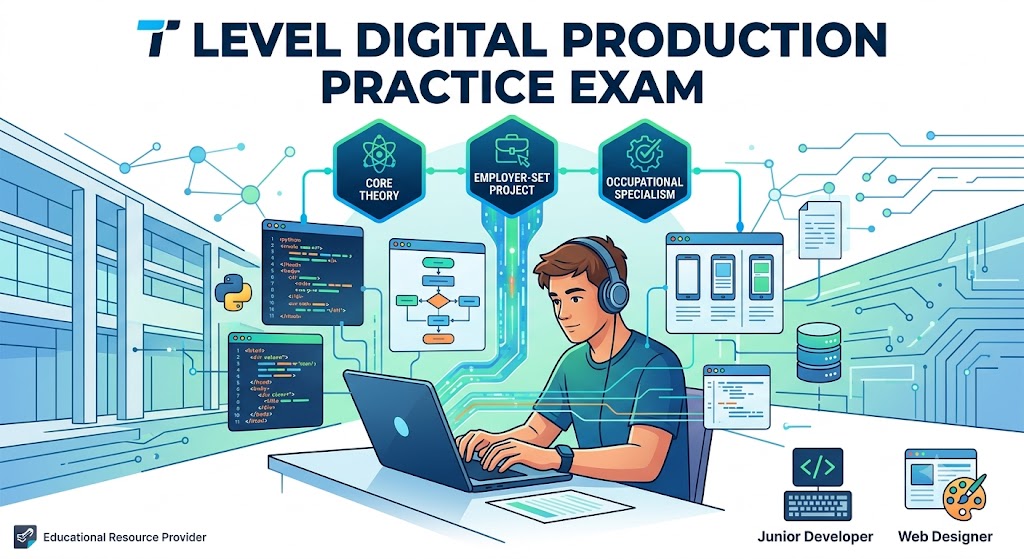
Additional Information
What the Course Entails and Exam Details
This comprehensive course covers a broad range of core digital and IT principles before specializing in digital production, design, and development. The core syllabus includes essential topics such as digital analysis, emerging technologies like AI and data science, internet security, and software development fundamentals.
Students then delve deeply into their specialism, mastering programming languages (often including Python or JavaScript), learning user experience (UX) and user interface (UI) design principles, and developing robust software testing methodologies. The course emphasizes practical application and includes an invaluable industry placement of at least 45 days, allowing students to gain real-world experience.
What to Expect in the Final Exam
The T Level is assessed through a combination of methods rather than a single final exam. Understanding this structure is crucial for preparation.
The assessment typically includes:
Core Component Assessments: These usually consist of two written examinations covering the underpinning theory of the digital industry.
Employer-Set Project (ESP): This is a substantial project where students apply their knowledge and skills to a real-world scenario set by industry employers. It tests problem-solving, project management, and communication skills.
Occupational Specialism Assessment: Students complete synoptic practical assignments or projects that demonstrate their competence in digital production, design, and development. This usually involves coding, designing user interfaces, and software testing.
Passing requires achieving at least a 'Pass' grade in both the core component and the occupational specialism, as well as completing the industry placement and achieving at least a Grade 4 (or Level 2 equivalent) in GCSE English and Maths.
How to Study and Exam Centers
Effective preparation requires a mixture of theoretical study and practical practice. Students should thoroughly review their course notes and utilize the official specification documents provided by their awarding body (such as City & Guilds or NCFE).
Access Past Papers: Practicing with past exam papers and exemplar Employer-Set Projects is the single best way to understand the assessment format and time constraints.
Use Practical Resources: Regularly practice coding on platforms like GitHub or Codecademy. Use design tools like Figma or Adobe XD to build a portfolio of UI/UX designs.
Review Class Materials: Consistently review notes and textbooks on software development lifecycles, database design, and cybersecurity principles.
Exam Centers: T Levels are studied and assessed in authorized schools and further education colleges across England. Assessments are administered internally by the institution or externally under strict exam conditions, rather than at independent commercial testing centers.
Job Opportunities from the Course
Completing the T Level in Digital Production, Design and Development opens doors to various exciting entry-level roles within the tech industry and provides a strong foundation for higher education or degree apprenticeships.
Career paths this qualification unlocks include:
Junior Software Developer
Web Developer
Software Tester
IT Support Technician
Junior UX/UI Designer
Junior Data Analyst
IT Project Support Officer
Frequently Asked Questions
Reviews
5.0
Based on 0 reviews
Leave a Review
No reviews yet. Be the first to review!