
T-Level Building Services Engineering Practice Exam
$69.00
- Buy to unlock unlimited access to all Quiz questions.
- After purchase you can print a PDF of the whole quiz at any point. The PDF will contain the questions and the correct answers.
About this Exam
The T-Level Building Services Engineering (BSE) for Construction is a groundbreaking, two-year technical qualification for 16-to-19-year-olds in England. Designed with leading employers, this Level 3 qualification is the equivalent of three A-Levels and is specifically designed to give you the precise knowledge, skills, and real-world experience that the industry is looking for. It is the perfect launchpad for ambitious students who want to combine theoretical learning with a substantial, high-quality industry placement. It primes you for a multitude of skilled roles within the sector or a seamless progression into a higher-level apprenticeship or degree.
Ready to test your knowledge?
Buy Now to Access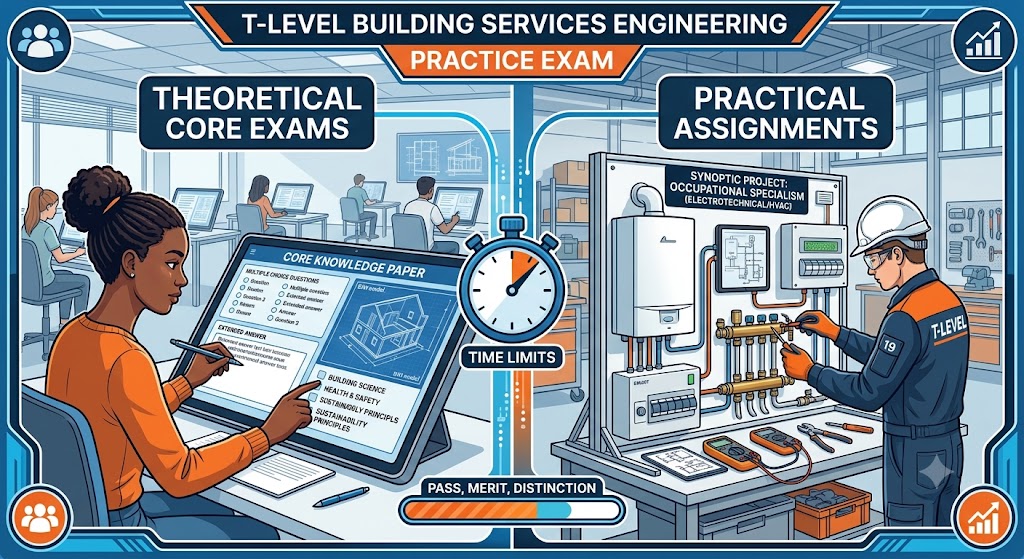
Additional Information
What the Course Entails and Exam Details
This comprehensive course splits its focus between two main components, ensuring you develop a versatile skill set. The technical qualification is comprised of a Core component and an Occupational Specialism, both of which you must successfully achieve.
The Core Component provides the foundation. You will cover 14 key knowledge areas, including Health and Safety in construction, scientific and design principles, building technology, sustainability, digital engineering techniques like BIM (Building Information Modeling), and the business principles that drive the industry.
The Occupational Specialism is where you deep-dive into your chosen field. Students must select from options such as:
Electrotechnical Engineering
Gas Engineering
Protection Systems Engineering
Refrigeration Engineering and Air Conditioning Engineering
Plumbing Engineering and Heating Engineering (combination)
Heating Engineering and Ventilation (combination)
The entire T-Level includes a technical qualification (which is where our practice exam focuses), a minimum of 315 hours of industry placement, and further development of English, Maths, and digital skills.
What to Expect in the Final Exam
To achieve your T-Level Building Services Engineering technical qualification, you will need to pass both the Core component and your selected Occupational Specialism. The overall T-Level grade is awarded as Pass, Merit, Distinction, or Distinction*, determined by a lookup table combining your results from both parts.
The Core component assessment is a three-part process, which is externally marked:
Core Paper 1: A written exam covering a selection of the 14 knowledge outcomes.
Core Paper 2: A second written exam, covering the remaining knowledge outcomes. Both papers typically include a mix of short, structured questions and extended response questions to test your depth of understanding.
Employer-Set Project (ESP): A separate project that simulates a real-world task, where you apply your knowledge to plan, design, and solve a complex problem set by industry professionals.
The Occupational Specialism is primarily assessed through a series of demanding, practical projects or synoptic assignments. You will need to demonstrate 'threshold competence'—meaning you can operate safely and effectively in your chosen skilled trade. These practical tests require you to plan, perform, and evaluate complex tasks, such as installing, commissioning, or maintaining building services systems to a professional standard.
How to Study and Exam Centers
Preparation is the key to confidence and success. An effective study plan includes:
Utilizing Official Resources: City & Guilds and Pearson provide comprehensive candidate guides, specification documents, and sample assessment materials that are invaluable.
Active Revision: Don't just read notes. Create flashcards, mind maps, and practice solving construction science problems and design scenarios.
Practical Practice: If possible, practice the hands-on skills required for your specialism, replicating test conditions.
Simulated Practice Exams: Using a dedicated T-Level Building Services Engineering Practice Exam is one of the single most effective techniques. Time yourself, complete both written and practical sample assessments, and use the marking guides to identify your strengths and weaknesses. It builds familiarity with the question formats and required depth of answer.
The final assessments are administered by the awarding bodies (City & Guilds and Pearson) and are taken at authorized test centers. These centers are your school, college, or training provider where you are studying for your T-Level. The centers are rigorously approved to ensure all assessment criteria are met for both written and practical examinations.
Job Opportunities from the Course
A T-Level is highly regarded by employers. Upon completion, you won't just have a qualification; you will have practical experience and industry-recognized competence, opening doors to a wide range of career paths. Here is a non-exhaustive list of the specific job opportunities this qualification can unlock:
Building Services Engineer
Electrician / Electrotechnical Engineer
Plumber
Heating and Ventilation Engineer
Refrigeration and Air Conditioning Engineer
Gas Service Technician
Engineering Maintenance Technician
Protection Systems Installer (e.g., fire, security)
Smart Meter Installer
Domestic Appliance Service Engineer
Engineering Construction Craftworker or Technician
BIM Technician / Digital Engineering Specialist
T-Level graduate in BSE can also progress to Higher-Level Apprenticeships or University degrees in specific engineering fields.
Frequently Asked Questions
Reviews
5.0
Based on 0 reviews
Leave a Review
No reviews yet. Be the first to review!