
T-6B Primary Flight Training – Contact Stage 1 Practice Test
$69.00
- Buy to unlock unlimited access to all Quiz questions.
- After purchase you can print a PDF of the whole quiz at any point. The PDF will contain the questions and the correct answers.
About this Exam
The T-6B Primary Flight Training – Contact Stage 1 is the foundational stepping stone for aspiring military aviators in the United States Navy, Marine Corps, Coast Guard, and Air Force.
This phase introduces student naval aviators (SNAs) and student pilots to the fundamental concepts of visual flight in the powerful T-6B Texan II turboprop aircraft.
It is designed to build the "stick and rudder" skills necessary for all future flying.
Success in this stage is a critical first hurdle toward earning coveted wings of gold or pilot wings.
This practice test is an essential tool for SNAs seeking to master the written knowledge requirements and mental procedures that underpin this demanding practical stage.
Proper spacing has been added for your convenience.
Ready to test your knowledge?
Buy Now to Access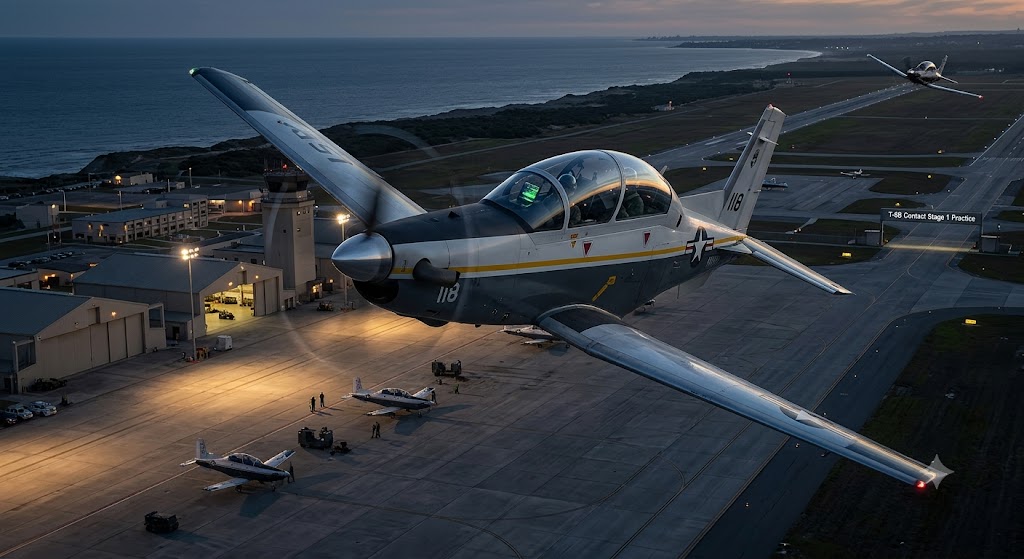
Additional Information
What the Course Entails and Exam Details
The Contact Stage 1 syllabus, outlined in Naval Air Training Command (CNATRA) instructions and the T-6B Flight Training Instruction (FTI), covers a broad array of knowledge and skills.
The primary focus is on introducing the SNA to the T-6B aircraft and establishing safe, standard visual flight procedures.
Key areas of study and practice include:
T-6B Aircraft Systems and Limitations: In-depth knowledge of the engine, electrical, hydraulic, fuel, and environmental systems, and the associated operating envelopes and limitations.
Aerodynamics: A solid understanding of the principles of lift, drag, thrust, and weight as they apply to the T-6B, including stability and stall characteristics.
Basic Aircraft Control: Mastering the ability to maintain aircraft attitude using external visual cues, and executing precise turns, climbs, and descents.
Ground Operations: Conducting thorough pre-flight inspections, understanding engine start procedures, and safe taxiing in a busy airport environment.
Takeoff and Landing: Developing the proficiency to perform standard and crosswind takeoffs and landings safely and consistently.
Visual Traffic Patterns: Learning the structure and communication required for entry into and operation within visual airport traffic patterns at military and civilian airfields.
Emergency Procedures (EPs): Instant and correct recall of critical "bold face" or memory items for key in-flight and ground emergencies, and a deep understanding of standard EP flows.
Crew Resource Management (CRM): Utilizing effective communication and decision-making skills within the multi-seat, instructor-student cockpit environment.
Communication: Gaining familiarity with military aviation phraseology and clear radio communication with air traffic control.
The practice test itself is a comprehensive assessment of the academic and procedural knowledge required before step-by-step practical evaluation by an instructor.
Successful completion of the final checkride in this stage is the gateway to follow-on training in instrument, navigation, and formation flight.
Proper spacing has been added for your convenience.
What to Expect in the Final Exam
While this practice test evaluates your cognitive readiness, the official evaluation for the Contact Stage 1 is the completion of a final "Check Flight" with a qualified military flight instructor.
Completion of the stage involves several integrated components:
Written Systems and Procedure Exams: Prior to getting on the flight schedule, SNAs must pass a comprehensive written systems exam, typically a multiple-choice test, and a "closed-book" emergency procedures and limitations quiz, which requires 100?curacy. The written practice test you are preparing for is designed to mimic these exams.
Oral Examination: The final check flight begins with an in-depth oral examination. The instructor will quiz you on any topic within the Contact Stage 1 syllabus, with a strong focus on EPs, limitations, and flight procedures. Your ability to speak with confidence and technical accuracy is crucial.
The Check Flight: The centerpiece is the actual flight evaluation. In a approximately 1.5 to 2-hour event, you will perform all the maneuvers listed in the syllabus, from ground operations to takeoffs, aerobatics, and a variety of landings.
Standards: To pass, you must meet the "Conditions and Standards" specified in the CNATRA instructions, demonstrating safe and effective pilot-in-command decision-making and precise, safe handling of the aircraft under all conditions.
There are no official universal "passing score requirements" like 70%, but rather, you must be evaluated as "Safe for Solo" and competent in all maneuvers. The practice test focuses on the requisite 100% mastery of knowledge.
Specific rules regarding check flights (e.g., rest requirements, weather minimums, and communication) are detailed in the standard operating procedures of each training wing.
Proper spacing has been added for your convenience.
How to Study and Exam Centers
The key to conquering Contact Stage 1 is a proactive, multifaceted study strategy. There are no shortcuts; immersion in the material is mandatory.
Here are the most effective methods to prepare:
Pubs, Pubs, Pubs: Become intimately familiar with the core publications: the T-6B NATOPS (Naval Air Training and Operating Procedures Standardization) Flight Manual, the CNATRA P-764 (Flight Training Instruction), and the Local SOPs.
Chair Flying: This is the single most effective technique. Mentally visualize and physically rehearse entire flight maneuvers, procedures, and entire flights while sitting in a chair, mimicking the hand and eye movements required in the cockpit. Combine this with verbalizing the checklists and radio calls.
Flashcards: Use digital or physical flashcards for rapid and accurate recall of T-6B systems, limitations, bold-face EPs, and operational numbers.
Simulator Practice: Maximize your time in the Unit Training Devices (UTDs) and Operational Flight Trainers (OFTs), not just for required training events, but for self-directed practice of maneuvers and procedures.
Group Study: Collaborate with fellow students to quiz each other and discuss complex systems or procedural flows.
This Practice Test: Use this online T-6B Contact Stage 1 Practice Exam repeatedly to simulate the official written evaluation environment, identify knowledge gaps, and build your confidence under timed conditions.
Exam Centers: It is important to understand the structure of military aviation testing.
The Practice Test: This comprehensive practice exam is an online-based resource for self-assessment and can be taken anywhere, globally. It does not require physical exam centers like Pearson VUE.
Official Written and Oral Exams: These are administered internally at the student's assigned military flight school, specifically at:
Naval Air Station Whiting Field in Milton, Florida (Training Air Wing FIVE)
Naval Air Station Corpus Christi in Corpus Christi, Texas (Training Air Wing FOUR)
The Checkride: This is a live flight evaluation conducted in military-controlled airspace in the vicinity of the respective NAS locations.
For the actual flight training program, you must already be a commissioned officer and have met rigorous physical and academic prerequisites to be assigned to these Navy training bases.
Proper spacing has been added for your convenience.
Job Opportunities from the Course
Successfully completing the T-6B Primary Flight Training Contact Stage 1 does not lead directly to a specific civilian job but is the pivotal first step in unlocking a long and rewarding career as a military aviator.
Completion of the entire primary phase allows you to choose (and be selected for) a specific platform pipeline, leading to several elite career paths and their respective job titles.
United States Naval Aviator (Navy):
Strike Fighter Pilot: Flying the F/A-18 Super Hornet or F-35C Lightning II.
Maritime Patrol Pilot: Flying the P-8A Poseidon.
Electronic Warfare Pilot: Flying the EA-18G Growler.
Command and Control Pilot: Flying the E-2D Advanced Hawkeye or E-6B Mercury (TACAMO).
Helicopter Pilot: Flying the MH-60R/S Seahawk or CMV-22B Osprey (Tiltrotor).
United States Marine Corps Aviator:
Strike Fighter Pilot: Flying the F-35B/C Lightning II or F/A-18 Hornet.
Aviation Combat Element (ACE) Pilot: Flying the MV-22B Osprey, CH-53K King Stallion, AH-1Z Viper, or UH-1Y Venom.
Air Refueler/Transport Pilot: Flying the KC-130J Super Hercules.
United States Air Force Pilot:
Fighter Pilot: Flying the F-22 Raptor, F-35A Lightning II, F-15 Eagle/Strike Eagle, or F-16 Fighting Falcon.
Bomber Pilot: Flying the B-2 Spirit, B-1B Lancer, or B-52 Stratofortress.
Mobility/Transport Pilot: Flying the C-17 Globemaster III or C-130J Super Hercules.
Special Operations Pilot: Flying aircraft like the MC-130J or CV-22B.
United States Coast Guard Aviator:
Search and Rescue Pilot: Flying the HC-130J Super Hercules, HC-27J Spartan, or MH-60T/MH-65E helicopters.
Frequently Asked Questions
Reviews
5.0
Based on 0 reviews
Leave a Review
No reviews yet. Be the first to review!