
T-6A BOLDFACE Emergency Procedures & Operating Limitations Practice Test
$69.00
- Buy to unlock unlimited access to all Quiz questions.
- After purchase you can print a PDF of the whole quiz at any point. The PDF will contain the questions and the correct answers.
About this Exam
The T-6A BOLDFACE and Operating Limitations exam is a critical milestone for student military pilots during their initial flight training.
This test evaluates your immediate, memory-based recall of essential emergency procedures (BOLDFACE) and your understanding of the safe operating envelope of the T-6A Texan II aircraft.
Mastering these fundamentals is non-negotiable for ensuring flight safety and successful progression in undergraduate pilot training.
Ready to test your knowledge?
Buy Now to Access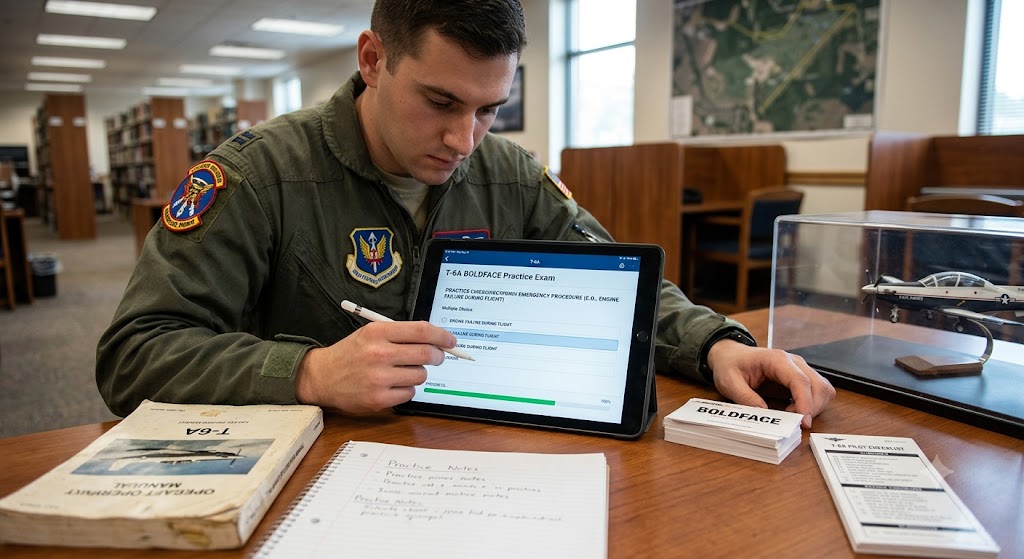
Additional Information
What the Course Entails and Exam Details
This comprehensive practice test covers the core knowledge areas required for safe T-6A operations.
You will be tested heavily on verbatim memorization of BOLDFACE emergency procedures, which include actions for situations such as engine failure, smoke/fire in the cockpit, and ejection.
Additionally, the course reviews and tests your knowledge of aircraft operating limitations, such as maximum airspeed (V-speeds), G-load limits, engine torque and temperature limits, and critical fuel system constraints.
What to Expect in the Final Exam
The final T-6A BOLDFACE and Operating Limitations exam is typically a written test administered in a controlled academic environment at your training squadron.
You can expect a rigorous format, often consisting of multiple-choice questions regarding aircraft limitations, alongside requirements to rewrite specific BOLDFACE procedures exactly from memory, with zero errors allowed.
A high passing score, often 90% or higher, is strictly enforced, and quick, accurate recall is essential under timed conditions.
How to Study and Exam Centers
Successful preparation requires consistent, disciplined study habits focused on rote memorization and practical application.
Effective strategies include daily verbatim rewriting of BOLDFACE items, using flashcards for operating limitations, and practicing recall with study partners.
You should also visualize executing these procedures while sitting in the aircraft or a simulator cockpit to build muscle memory.
As this is an internal military training requirement, the exam is administered directly at your assigned Undergraduate Pilot Training (UPT) base, typically within the squadron’s academic department; it is not taken at civilian testing centers.
Job Opportunities from the Course
Mastering T-6A procedures is a fundamental requirement for completing Undergraduate Pilot Training and earning your wings as a military aviator.
This qualification unlocks diverse and rewarding career paths across the armed forces.
Successful completion enables progression to flying advanced operational aircraft in various roles, including:
US Air Force Pilot (flying fighters, bombers, mobility aircraft, or special operations platforms)
US Navy Aviator (flying carrier-based jets, helicopters, or maritime patrol aircraft)
US Marine Corps Aviator (flying tiltrotor aircraft, helicopters, or fighter-attack jets)
Frequently Asked Questions
Reviews
5.0
Based on 0 reviews
Leave a Review
No reviews yet. Be the first to review!