
T-6 Ops Limits Practice Test
$69.00
- Buy to unlock unlimited access to all Quiz questions.
- After purchase you can print a PDF of the whole quiz at any point. The PDF will contain the questions and the correct answers.
About this Exam
The T-6 Operational Limits practice exam is an indispensable resource designed specifically for military and civilian pilots undergoing training or recurrent qualification on the T-6 Texan II aircraft. This assessment is tailored to evaluate and reinforce a pilot's precise knowledge of the aircraft’s critical systems, structural boundaries, and engine operating parameters. Mastering these limitations is fundamental to flight safety, optimal performance, and mission success. Whether you are a student pilot in initial training or an experienced aviator, this practice test provides the rigorous mental preparation necessary to confidently handle the T-6 within its designed capabilities and excel in official examinations.
Ready to test your knowledge?
Buy Now to Access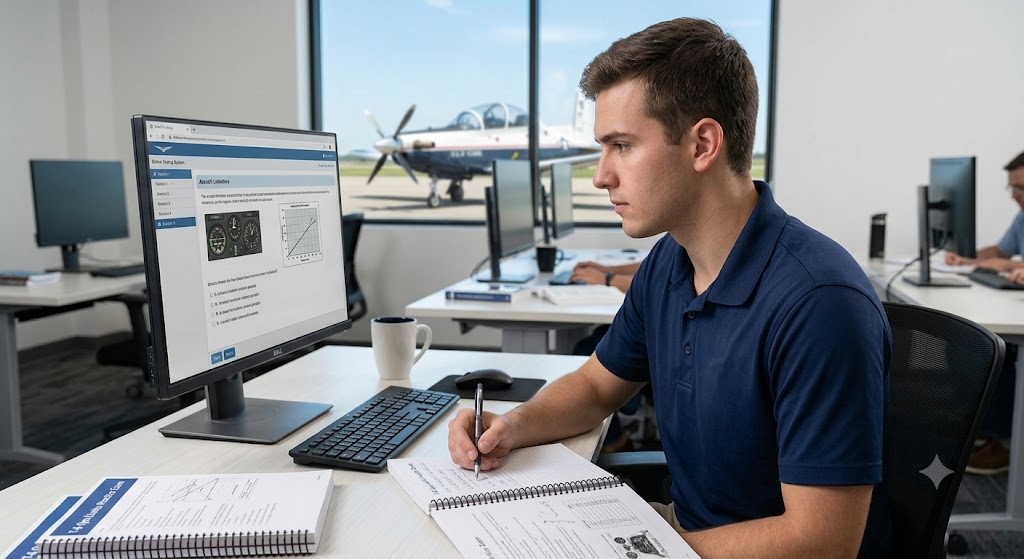
Additional Information
What the Course Entails and Exam Details
This practice exam comprehensively covers the essential operational limitations detailed in the T-6 flight manual and training directives. It encompasses vital subject areas, including:
Engine limitations (e.g., torque, ITT, N1/N2 RPM, fuel flow) for all flight phases.
Airspeed limitations (e.g., maximum operating, maneuvering, landing gear/flap extension speeds).
Structural limitations (e.g., maximum takeoff and landing weights, center of gravity limits).
System limitations (e.g., hydraulic, electrical, fuel, and environmental system constraints).
Flight characteristics and operational envelopes.
The focus is on ensuring you possess the quick, accurate recall and application skills required of a proficient T-6 pilot, mirroring the content and difficulty of the actual examination.
What to Expect in the Final Exam
The final T-6 Ops Limits examination typically adopts a multiple-choice or short-answer format, administered either via a computer-based testing system or in a traditional paper-based setting. Students can generally expect:
A significant number of knowledge-based questions, often ranging from 50 to 100 questions.
A strict passing score, typically 80% or higher, reflecting the safety-critical nature of the content.
Enforced time limits, generally between 60 and 120 minutes, requiring efficient recall and decision-making.
Closed-book conditions, necessitating thorough memorization and understanding of all relevant limitations without external aids.
Rigorous proctoring to maintain testing integrity.
How to Study and Exam Centers
Preparation for the T-6 Ops Limits exam should be multifaceted and persistent:
Study the Flight Manual: The T-6 Pilot’s Flight Manual (or equivalent official guidance) is your primary resource. Meticulously review and commit all limitation tables and descriptions to memory.
Utilize Practice Tests: Engage repeatedly with comprehensive practice exams like this one. This not only reinforces knowledge but also familiarizes you with the question types, time constraints, and exam pressure, effectively highlighting areas that require further study.
Flashcards and Spaced Repetition: Create digital or physical flashcards for each limitation, utilizing spaced repetition techniques to enhance long-term retention.
Study Groups: Collaborate with peers to discuss complex scenarios, clarify interpretations, and quiz each other.
Official Resources: Leverage study guides, online modules, and official knowledge bases provided by your training organization.
The official T-6 Ops Limits exam is typically administered at specific military training installations, authorized civilian flight schools, or designated aviation training centers, often following completed phases of instruction. Check with your training command, flight safety officer, or relevant aviation authority for the exact locations and scheduling procedures. Some organizations may also utilize secure online testing portals with remote proctoring.
Job Opportunities from the Course
Successfully demonstrating proficiency in T-6 Operational Limits through certification is a mandatory stepping stone for any pilot aspiring to operate this aircraft. While not a standalone "course" for job placement, it is a vital component of pilot training that directly leads to numerous career paths:
Military Pilot (Air Force, Navy, Marines, Coast Guard) across various aircraft types (fighters, bombers, transport, special ops, instructor, functional check pilot)
Civilian Flight Instructor (specifically for T-6 or similar high-performance aircraft)
Civilian Contract Pilot (for various organizations utilizing T-6 aircraft)
Aviation Safety Officer/Specialist
Operations Officer
Frequently Asked Questions
Reviews
5.0
Based on 0 reviews
Leave a Review
No reviews yet. Be the first to review!