
T-6 Formation Checkride Practice Test
$69.00
- Buy to unlock unlimited access to all Quiz questions.
- After purchase you can print a PDF of the whole quiz at any point. The PDF will contain the questions and the correct answers.
About this Exam
Mastering formation flying in the T-6 Texan II is a defining skill for every military aviator. The T-6 Formation Checkride is a rigorous practical evaluation that assesses a student pilot's ability to safely and effectively operate an aircraft in close proximity to another. This exam is not just about stick-and-rudder skills; it tests discipline, situational awareness, communication, and dynamic decision-making under pressure. It is a critical milestone designed for military pilot candidates in undergraduate pilot training (UPT), marking their transition into advanced multi-aircraft operations.
Ready to test your knowledge?
Buy Now to Access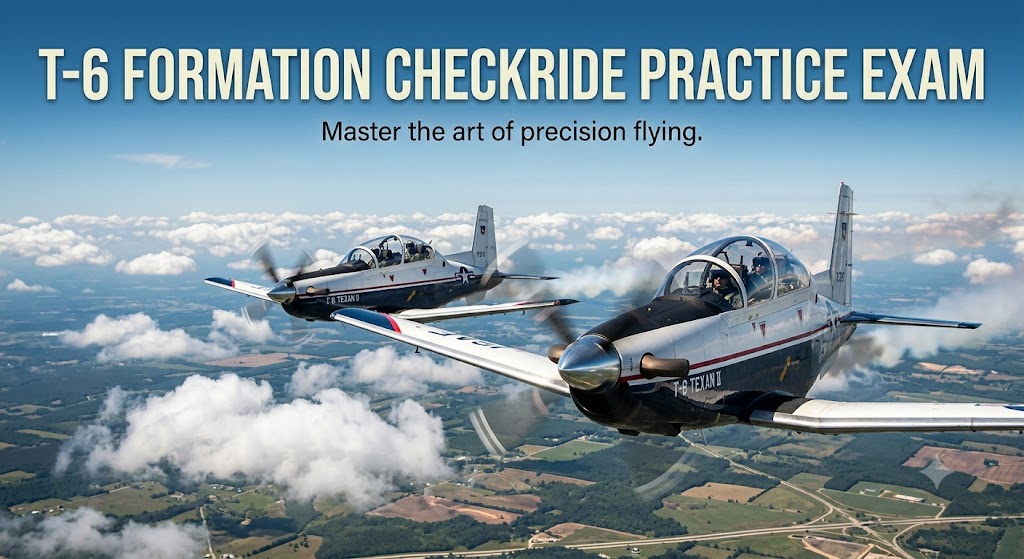
Additional Information
What the Course Entails and Exam Details
This comprehensive course, often spanning several weeks within the UPT syllabus, provides the foundational knowledge and hands-on training required for safe formation flight. The training focuses on both the roles of Lead and Wingman. Core topics and skills covered include:
Lead Responsibilities: Mission planning, briefing, managing the formation, communication, and ensuring safety of flight.
Wingman Responsibilities: Maintaining proper station keeping (the defined distance and position relative to Lead), visual scanning, and smooth, responsive control inputs.
Dynamic Maneuvering: Executing turns, climbs, descents, and speed changes while in formation.
Rejoins: Executing safe, efficient procedures to rejoin a formation from a separated position.
Formation Break: Safely and orderly breaking the formation for individual aircraft maneuvering or landing patterns.
Lost Wingman Procedures: Critical safety maneuvers to execute if visual contact with Lead is lost.
Administrative Procedures: Communication discipline, radio calls, flight discipline, and ground operations.
What to Expect in the Final Exam
The T-6 Formation Checkride is a practical flight evaluation conducted by a qualified military evaluator pilot. It is not a written exam. The evaluation typically consists of several distinct phases:
The Briefing: A thorough pre-flight briefing where the applicant is evaluated on their knowledge of the mission, procedures, weather, and safety considerations. The evaluator may ask detailed questions to test depth of understanding.
The Flight: The actual dynamic evaluation in the air. This includes startup, taxi, takeoff (often in formation), transitioning to the area, executing required maneuvers (such as rejoins, station keeping exercises, and dynamic turns), and pattern entries. The evaluator will observe and score performance based on defined standards, such as those found in the Practical Test Standards (PTS) or equivalent military directives.
The Debriefing: A detailed post-flight analysis where the evaluator provides feedback, highlights strengths, and critiques areas needing improvement. This is a crucial learning opportunity.
Passing Score: Meeting defined performance standards without critical safety or procedural errors. Evaluators look for proficiency, smooth aircraft control, good judgement, and consistent adherence to regulations.
Time Limits: The checkride is typically a standard sortie duration, including briefing and debriefing.
Specific Rules: Strict flight discipline and unwavering adherence to safety procedures are non-negotiable. Any compromise on safety can result in an immediate failure.
How to Study and Exam Centers
Preparation for the T-6 Formation Checkride requires a multi-faceted approach. There is no better way to prepare than by consistently practicing these skills throughout your training sorties. Actionable study strategies include:
Chair Flying: Mental rehearsal is incredibly effective. Visualize every step of the checkride, from the briefing to the debriefing, mentally practicing control inputs and communications for both Lead and Wingman roles.
Review Official Manuals: Thoroughly study the T-6 Texan II flight manuals (Dash-1), Air Education and Training Command (AETC) instructions, and the specific formation training guides.
Utilize Simulations: While not a perfect substitute for the real aircraft, modern flight simulators can help reinforce procedures, flows, and communication discipline.
Practice Sorties: Fly every practice sortie with checkride intensity. Treat every engagement with your instructor or peers as an evaluation.
Detailed Feedback: Pay close attention to the feedback provided after every flight. Identify weaknesses and actively work to improve them.
Study Groups: Collaborate with fellow pilot candidates to review procedures, practice briefings, and quiz each other on technical knowledge.
Physical and Mental Fitness: Maintain peak physical and mental condition. Fatigue can degrade situational awareness and reaction time.
Exam Centers: This is a military evaluation. The T-6 Formation Checkride is administered at the pilot candidate's assigned undergraduate pilot training (UPT) base, such as Vance, Laughlin, Columbus, or Sheppard Air Force Base, or a corresponding Naval/Marine Corps air station. The "center" is the actual flight training wing where you are stationed.
Job Opportunities from the Course
Successfully passing the T-6 Formation Checkride is not just a certification in itself; it is a vital step in the military pilot training pipeline. It unlocks advanced training phases and leads directly to earning wings and assignment to operational military aircraft. Achieving proficiency in formation flight opens doors to numerous career paths within military aviation, including:
Military Aviator: Earning the prestigious title and wings of a commissioned officer in the Air Force, Navy, or Marine Corps.
Fighter Pilot: The foundation for complex air combat maneuvering (ACM) and tactical employment of multi-role fighters (e.g., F-16, F-15, F-22, F-35, F/A-18).
Mobility/Transport Pilot: Formation skills are essential for aerial refueling, heavy-lift logistics, and specialized airlift missions (e.g., C-17, C-130, KC-135, KC-46).
Bomber Pilot: Executing strategic and conventional bombing missions in aircraft like the B-1, B-2, and B-52.
Reconnaissance/Special Operations Pilot: Operating advanced surveillance and specialized mission platforms (e.g., U-2, MC-130, CV-22).
Instructor Pilot: Training the next generation of military aviators after gaining operational experience.
Frequently Asked Questions
Reviews
5.0
Based on 0 reviews
Leave a Review
No reviews yet. Be the first to review!