
SWLCAT Book 3-2 Practice Test
$69.00
- Buy to unlock unlimited access to all Quiz questions.
- After purchase you can print a PDF of the whole quiz at any point. The PDF will contain the questions and the correct answers.
About this Exam
The SWLCAT (Southwestern Line Constructors Joint Apprenticeship and Training Program) provides crucial training for outside electrical workers across several US states. Book 3-2 represents a vital intermediate-to-advanced module within the multi-year apprenticeship sequence. It is designed for indentured apprentices who have demonstrated proficiency in the fundamental aspects of the trade and are progressing towards Journeyman status. Mastery of this book signifies a significant step in the specialized skills required for line construction, substation work, and related external electrical systems. The entire SWLCAT program, in collaboration with the IBEW and NECA, ensures the development of highly skilled, safety-conscious, and industry-ready craftsmen.
Ready to test your knowledge?
Buy Now to Access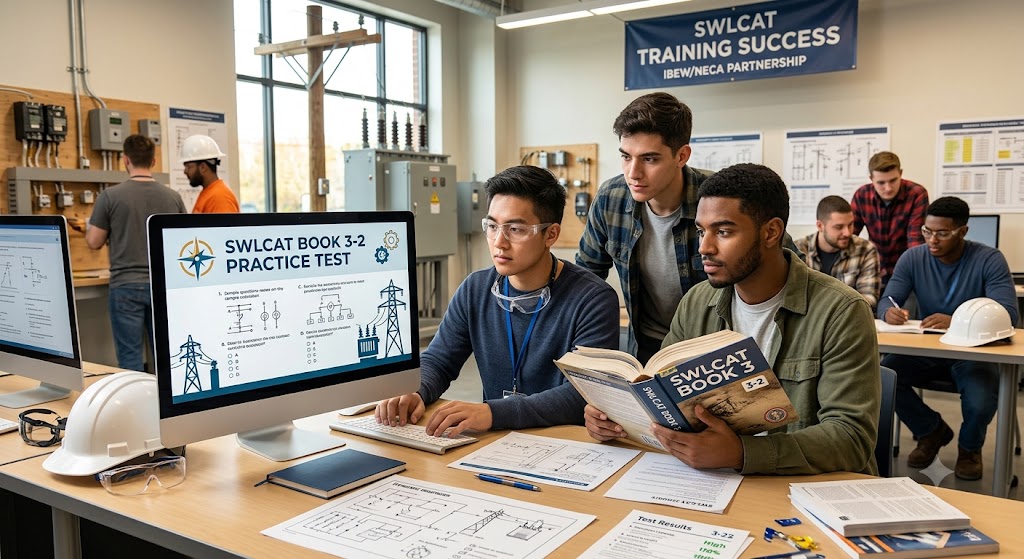
Additional Information
What the Course Entails and Exam Details
The SWLCAT Book 3-2 course builds upon earlier foundational knowledge, delving into complex and safety-critical aspects of the trade. While the specific syllabus may be updated by the JATC (Joint Apprenticeship and Training Committee) and the Electrical Training Alliance, representative topics for this module generally include:
Advanced Line Construction Techniques: Mastery of intricate pole setting, tensioning methods, and the installation and repair of various overhead and underground line configurations.
Safety Protocols and Regulatory Compliance: Rigorous reinforcement of safety standards, including specialized procedures for energized work, hazardous environments, and OSHA compliance specific to outside construction.
Equipment Operation and Maintenance: In-depth training on the safe and efficient operation of specialized utility vehicles, climbing gear, and construction machinery.
Complex Problem-Solving and Troubleshooting: Developing critical thinking skills to identify, assess, and resolve complex issues in electrical systems and construction scenarios.
Leadership and Teamwork: Preparing apprentices for advanced roles by focusing on leadership within a crew, effective communication, and collaborative work practices.
The related instruction involves both classroom and hands-on training, designed to blend theoretical understanding with practical application. All indentured apprentices are required to complete this module to progress in their training.
What to Expect in the Final Exam
The SWLCAT Book 3-2 Final Exam is a rigorous assessment, ensuring that apprentices possess the depth of knowledge and skills required to safely and effectively perform advanced tasks. Candidates should expect the following components:
Mixed Format: A comprehensive exam typically combining multiple-choice questions for theoretical and regulatory knowledge with complex scenario-based and problem-solving questions. Some components may involve a practical, hands-on evaluation in a controlled environment.
Passing Score: The pass mark is competitive and reflective of the high standards of the SWLCAT program, often in the range of 70-80%, though exact requirements should be confirmed with the official program guidelines. A high degree of accuracy and safety compliance is paramount.
Time Limit: A specified time limit, often around 2-3 hours for the written/theory portion, designed to assess quick and accurate thinking. Practical components will have separate, realistic timeframes.
Rules & Proctoring: The exam is strictly proctored, either at designated SWLCAT centers, local union halls, or through authorized secure online testing platforms, where applicable. No unauthorized materials are permitted, and all guidelines must be strictly followed. Identification verification is required.
Successful completion is essential for advancement to the next book in the series and continued progress towards becoming a Journeyman.
How to Study and Exam Centers
Preparation for the SWLCAT Book 3-2 exam must be comprehensive and start early. Here are effective study strategies:
Utilize Official SWLCAT Resources: Thoroughly review the official SWLCAT study guides, textbooks, course materials, and guidelines provided for Book 3-2. This is your primary resource.
Engage with Instructors and Mentors: Actively participate in all training sessions and seek clarification from instructors and journeymen on complex topics and practical application.
Practice with Real-World Scenarios: Apply knowledge to on-the-job training. Think critically about the 'why' behind each safety rule and construction technique.
Take Mock and Practice Tests: Leverage available practice resources and sample questions, including this practice test, to familiarize yourself with the exam format and time management, and identify areas needing improvement.
Form Study Groups: Collaborating with fellow apprentices can provide new perspectives, clarify difficult concepts, and provide support.
Regular Review: Consistently dedicate time each week to review material, don't wait until the last minute.
Regarding Exam Centers: Testing for SWLCAT modules is typically administered and scheduled through the program itself. Apprentices will receive specific details regarding exam dates, times, and designated centers, which are usually specific SWLCAT training locations, affiliated union halls, or partners within the covered states (Arizona, Kansas, New Mexico, Oklahoma, and Texas). For the most accurate and up-to-date information on exam registration and center locations, apprentices must consult the official SWLCAT website, their JATC, or program coordinators directly. Registration and scheduling are not typically done through public proctoring services like Pearson VUE.
Job Opportunities from the Course
Successfully completing the SWLCAT program and passing the intermediate assessments like Book 3-2 sets you on a definitive path to a well-paying and rewarding career in the outside electrical construction industry. Graduates from the full apprenticeship and journeymen find employment as:
Outside Lineman
Journeyman Lineman
Substation Technician
Traffic Signal Technician
Apprentice or Journeyman Operator
Line or Substation Crew Leader
Outside Construction Safety Coordinator
Service Technician for Outside Electrical Systems
Utility Line Supervisor
Security and Telecommunications Outside Plant Installer
A journeyman credential from this program is highly recognized across the industry and ensures consistent, universally accepted training standards.
Frequently Asked Questions
Reviews
5.0
Based on 0 reviews
Leave a Review
No reviews yet. Be the first to review!