
SWLCAT Book 1-1 Practice Test
$69.00
- Buy to unlock unlimited access to all Quiz questions.
- After purchase you can print a PDF of the whole quiz at any point. The PDF will contain the questions and the correct answers.
About this Exam
The SWLCAT Book 1-1 is a pivotal step in the Southwest Line Constructors Joint Apprenticeship and Training Program (SWLCAT).
It is designed for individuals who have been accepted into the apprenticeship and are beginning their journey toward becoming a Journeyman Outside Lineman or Substation Technician.
This specific module, Book 1-1, is part of the first-year curriculum and serves as the primary academic foundation for new apprentices.
Passing this practice test ensures you have mastered the fundamental safety principles, tool handling techniques, and core organizational knowledge required to proceed to the next phase of your career.
Ready to test your knowledge?
Buy Now to Access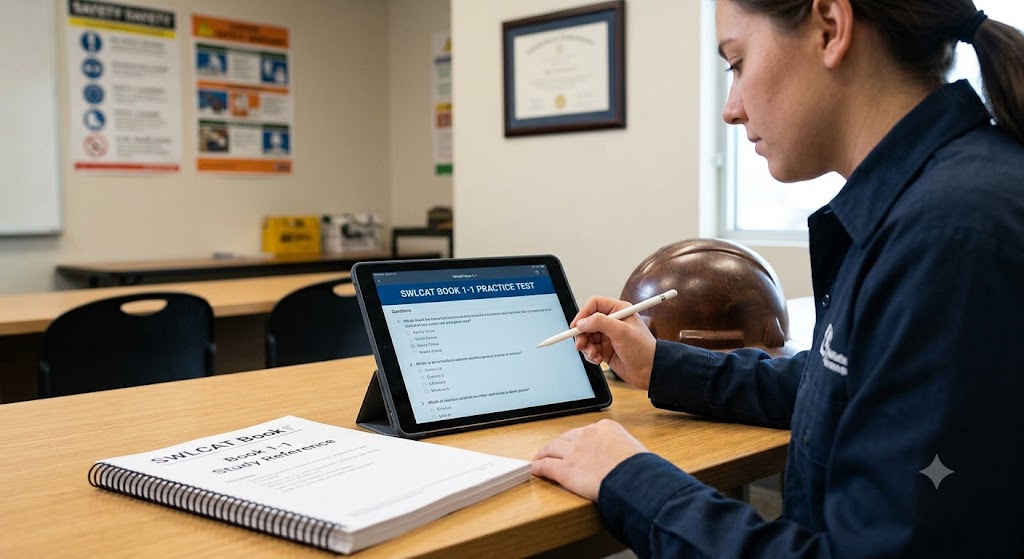
Additional Information
What the Course Entails and Exam Details
The SWLCAT Book 1-1 curriculum covers the fundamental knowledge necessary for safety and productivity on a job site. It ensures that every apprentice understands their responsibilities, the risks involved in electrical construction, and the structure of the program they have joined.
The main syllabus areas covered include:
Apprenticeship and Responsibilities: Understanding the expectations of an IBEW/NECA apprentice, the history and goals of the Southwestern Line Constructors program, and your individual responsibilities to your instructors and fellow workers.
Safety Awareness and Hazard Identification: Recognizing hazards on the job, the principles of safety culture, and an Introduction to OSHA standards relevant to electrical construction.
Safety Practices: Specifically covering energized versus non-energized parts, minimum approach distances, and the crucial inspection, use, and care of Climbing Equipment and Fall Protection.
Tool Identification and Use: Mastering the identification, proper application, and maintenance of essential hand tools used in the trade.
Applied Mathematics (Optional but related): Many first-year reviews also include basic math fundamentals such as working with whole numbers, fractions, decimals, and percentages, which are essential for trade calculations.
What to Expect in the Final Exam
The SWLCAT Book 1-1 exam is an objective assessment of your academic preparedness during the apprenticeship. While exact specifications may vary slightly by training center, the standard format includes:
Exam Format: A structured exam primarily consisting of Multiple-Choice Questions. The questions are designed to test your knowledge retention from the specific information sheets and text references assigned in the curriculum.
Passing Score: The program maintains high standards for safety and knowledge. You should expect a passing score threshold of around 75% or 80%, though you must confirm the exact requirement with your specific JATC director.
Time Limit: The exam is timed to ensure you have internalized the material rather than having to look it up. You will need to be well-prepared to answer all questions accurately within the allocated time.
Specific Rules: This is typically a closed-book exam. In the program's view, "A student should NOT have the reference open when answering lesson questions" on tests. Cheating, sharing answers, or referencing material will lead to severe disciplinary action, potentially including termination from the program.
How to Study and Exam Centers
Preparation for the Book 1-1 test must be structured and diligent. Do not treat this as a last-minute study session; it is the culmination of weeks of required reading.
Here are actionable study strategies:
Active Reading: You must read and thoroughly understand every information sheet associated with the 1-1 lessons. For example, memorize the details from information sheets 1-1-1 through 1-1-12.
Study the Reference Material: In addition to handouts, you must read the relevant chapters in key textbooks like the Guidebook for Lineman and Cableman, the Safety Handbook, and DC Theory.
Utilize Practice Tests: The best way to prepare is by taking simulated practice tests. These familiarize you with the wording of the multiple-choice questions and help you identify areas where you need further review.
Review Lessons: Come to class prepared. The Southwestern program relies heavily on class discussion to reinforce key points and trouble spots. If you prepare beforehand, you can actively participate in these crucial learning sessions.
You will typically take the Book 1-1 exam at the official Southwestern Line Constructors Joint Apprenticeship and Training Committee (JATC) testing facility or an authorized regional training center where you are attending class. Because this is an apprentice-only program monitored by the US Department of Labor and IBEW/NECA, the exam is proctored in person, and you must follow the schedule provided by your program director.
Job Opportunities from the Course
While Book 1-1 is an initial module, successfully completing it, alongside the remainder of your apprenticeship, is the mandatory path to becoming a qualified journeyman. Passing this foundation unlocks the subsequent steps toward a lucrative and respected career.
Specific career paths and job opportunities include:
Journeyman Outside Lineman: Building, repairing, and maintaining overhead and underground electric power lines.
Substation Technician: Installing, testing, maintaining, and repairing all equipment inside electrical substations.
Overhead Line Crew Member/Lead: Leading crews in challenging, hazardous, and vital public service work.
Maintenance Lineman: Specializing in the maintenance and optimization of the electric grid.
Construction Foreman: Advancing to supervisory roles within electrical contracting companies.
Safety Coordinator: Using your deep knowledge of trade safety standards to supervise other crews.
Good luck in your SWLCAT Book 1-1 preparation! Take your training seriously—your safety and your career depend on it.
Frequently Asked Questions
Reviews
5.0
Based on 0 reviews
Leave a Review
No reviews yet. Be the first to review!