
Swift River ER Practice Exam
$69.00
- Buy to unlock unlimited access to all Quiz questions.
- After purchase you can print a PDF of the whole quiz at any point. The PDF will contain the questions and the correct answers.
About this Exam
The Swift River ER Practice Exam is a crucial diagnostic and preparation tool designed specifically for healthcare professionals and students aspiring to excel in high-pressure emergency room settings. This comprehensive practice experience aims to simulate the complex scenarios and critical decision-making processes inherent in emergency medicine. It is a powerful resource for nurses, paramedics, medical students, and other clinicians looking to validate their knowledge, sharpen their triage skills, and build confidence before facing official certification exams or entering a live ER environment. This practice exam is not just about recall; it emphasizes the practical application of critical thinking in dynamic and often chaotic situations.
Ready to test your knowledge?
Buy Now to Access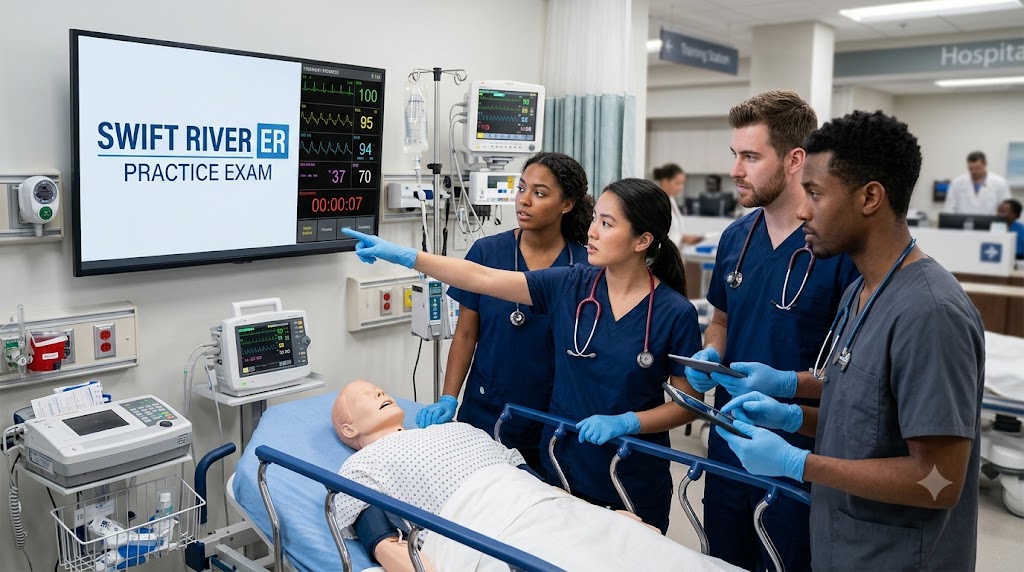
Additional Information
What the Course Entails and Exam Details
The preparation for this practice exam, and the underlying knowledge it assesses, covers a broad spectrum of critical ER competencies. Students and professionals can expect a rigorous review and application of:
Triage Principles and Procedures: Mastering the rapid assessment and prioritization of patients based on the severity of their condition.
Acute Care and Trauma Management: Identifying and managing time-sensitive emergencies, including cardiac events, stroke, respiratory distress, and significant physical trauma.
Medical Conditions and Disease Processes: Understanding the presentation and immediate treatment of various acute medical emergencies (e.g., sepsis, diabetic ketoacidosis, pediatric emergencies).
Critical Thinking and Decision Making: Developing the ability to quickly synthesize information, make sound clinical judgments, and initiate appropriate interventions under pressure.
Communication and Teamwork: Simulating real-world ER communication, emphasizing clear, concise interaction and effective collaboration within a medical team.
Ethical and Legal Considerations: Applying professional ethics and relevant healthcare laws to difficult situations in the ER.
The preparation isn't a passive course; it involves interacting with realistic patient simulations, reviewing core medical guidelines, and engaging with challenging practice questions that mirror the complexity and speed of an actual emergency room.
What to Expect in the Final Exam
The Swift River ER Practice Exam is designed to provide a authentic test experience, preparing you for the rigor of official evaluation. While it is a practice tool and not a final certification exam in itself, it typically features:
Format: A comprehensive set of multiple-choice questions and interactive, simulated patient case scenarios. These scenarios require you to assess dynamic information, make real-time decisions, and select the best course of action.
Focus: Strong emphasis on critical thinking, prioritization, and the direct application of emergency medical knowledge.
Passing Score: As a practice exam, its primary function is diagnostic. While specific programs or institutions utilizing this tool might set internal passing scores for progress tracking, its main value lies in providing feedback and identifying areas where additional study is needed. Aim for the highest proficiency possible to maximize your readiness.
Time Limits: To simulate the real pressure of a certification exam, the practice exam is typically timed, requiring you to manage your time effectively across different sections and scenarios.
Rules: Treat this practice as a formal evaluation. Adhere to all standard test integrity guidelines, focusing solely on your knowledge and critical thinking, to get a true measure of your preparedness. No external aids are permitted during the timed session.
How to Study and Exam Centers
Maximizing your performance on the Swift River ER Practice Exam—and consequently on any subsequent official exams—requires a strategic study plan:
Comprehensive Review: Thoroughly study core emergency nursing/medicine textbooks, guidelines, and procedures. Focus on triage protocols, advanced life support algorithms, common ER conditions, and trauma management.
Active Practice with Simulations: Engage fully with all available simulations. Practice repeated decision-making across a variety of scenarios to improve your speed, accuracy, and confidence. Analyze why specific choices are correct and others are not.
Analyze Practice Questions: Deeply review all practice questions. Don't just check the correct answer; understand the rationale behind all options to reinforce your knowledge. Pay attention to both technical correctness and time management.
Simulate Test Conditions: Take timed practice exams under quiet, focused conditions to build stamina and manage test anxiety.
Seek Feedback and Collaboration: Discuss challenging scenarios with peers or instructors. Understanding different perspectives can broaden your clinical reasoning.
Where to Take the Practice Exam: The Swift River ER Practice Exam is primarily a digital resource and is typically accessed online through a dedicated platform provided by Swift River or an authorized educational institution. This allows for convenient, on-demand practice from any location with internet access.
For official certification exams that this practice tool supports (e.g., specific nursing or EMS certifications), those are generally taken at official physical testing centers, such as authorized schools or established testing organizations (e.g., Pearson VUE). Consult the specific certification board's guidelines for exact locations and scheduling.
Job Opportunities from the Course
While the practice exam itself is a stepping stone, the advanced skills and confidence it cultivates significantly enhance employability and open diverse career paths within emergency care and related fields. Individuals who demonstrate proficiency in ER competencies may find opportunities as:
Registered Nurse (Emergency Room/Department)
Emergency Department Nurse Practitioner
Paramedic
Emergency Medical Technician (EMT)
Critical Care Nurse
Trauma Nurse
Physician Assistant (Emergency Medicine)
Hospitalist Nurse Practitioner/PA
Nurse Educator (Emergency/Critical Care)
Medical Scribe (in Emergency Settings)
Frequently Asked Questions
Reviews
5.0
Based on 0 reviews
Leave a Review
No reviews yet. Be the first to review!