
Success! In Clinical Laboratory Science – Microbiology Practice Test
$69.00
- Buy to unlock unlimited access to all Quiz questions.
- After purchase you can print a PDF of the whole quiz at any point. The PDF will contain the questions and the correct answers.
About this Exam
The [Success! In Clinical Laboratory Science – Microbiology Practice Test] is an invaluable preparation tool for students and laboratory professionals aiming to achieve certification in Clinical Laboratory Science, specifically in the subdiscipline of microbiology. This comprehensive review resource is designed to help individuals preparing for national certification exams, such as the American Society for Clinical Pathology (ASCP) Board of Certification (BOC) for Medical Laboratory Scientist (MLS) or Technologist in Microbiology (M) credentials. It provides a robust and focused review of the essential concepts, practices, and troubleshooting skills required in a modern clinical microbiology laboratory. Whether you are a current student nearing graduation, a recent graduate, or a laboratory professional seeking to specialize and solidify your knowledge, this practice test offers a critical assessment to ensure you are exam-ready and prepared to contribute to patient care through accurate diagnostic testing.
Ready to test your knowledge?
Buy Now to Access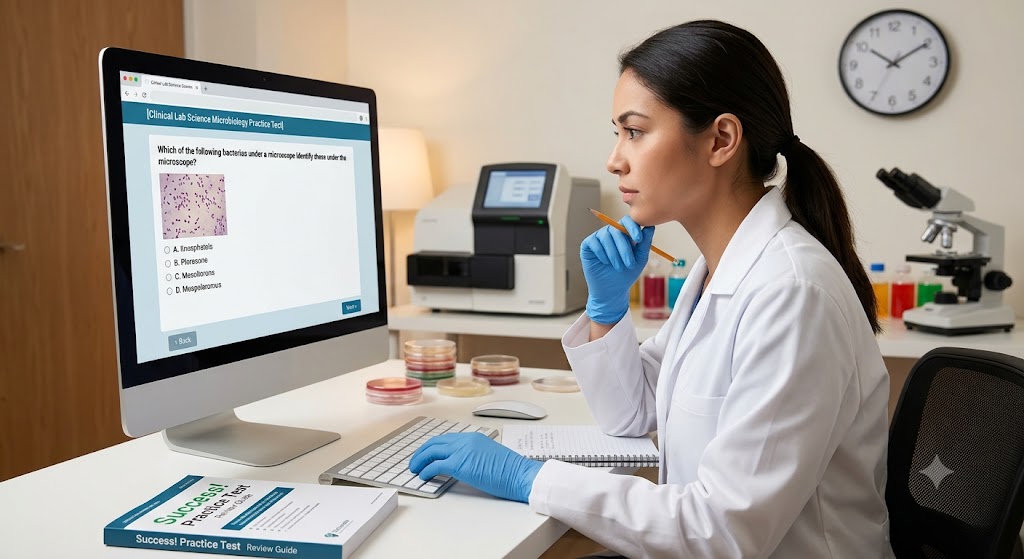
Additional Information
What the Course Entails and Exam Details
Utilizing this resource offers a structured review of the entire spectrum of clinical microbiology. It entails self-assessment through a vast array of practice questions that mirror the style and difficulty of the actual certification exams. The core curriculum covers key areas, including:
Bacteriology: Identification of clinically significant bacteria, their characteristics, and pathogenic mechanisms.
Virology, Mycology, and Parasitology: Methods for identifying and understanding the lifecycle and clinical impact of viruses, fungi, and parasites.
Laboratory Essentials: Specimen collection, transport, processing, staining techniques (e.g., Gram stain, Acid-fast stain), and cultural methods.
Microbial Identification: Modern techniques, including the use of matrix-assisted laser desorption/ionization time-of-flight (MALDI-TOF) mass spectrometry.
Antimicrobial Susceptibility Testing: Testing methodologies, detecting resistance mechanisms (like extended-spectrum beta-lactamases and carbapenemases), and interpreting results for appropriate therapy.
Laboratory Safety and Quality Assurance: Standard precautions, sterilization, disinfection, and maintaining rigorous quality control standards.
Molecular Diagnostics: Expanding content on molecular biology techniques used for the rapid identification of pathogens.
What to Expect in the Final Exam
It is crucial to understand that the [Success! In Clinical Laboratory Science – Microbiology Practice Test] is a simulated experience designed to prepare you for the official final certification exam, such as the ASCP BOC MLS or M exam. Here is what you can expect in the actual final exam that this resource helps you prepare for:
Format: The actual certification exam is typically a computer-adaptive test (CAT). This means that the computer selects questions based on your performance on previous questions, making the test tailored to your ability level. Questions are almost entirely multiple-choice.
Time Limit: For the full ASCP BOC MLS exam, you can generally expect a time limit of approximately 2 hours and 30 minutes for about 100 questions. Microbiology-specific exams (M) may differ slightly but follow a similar structured approach.
Passing Score: For the ASCP BOC exams, the passing score is not a simple percentage. Instead, scores are reported on a scaled range from 0 to 999, with a score of 400 required to pass.
Rules and Practicalities: The final exam is taken under strict proctored conditions. You are usually not allowed to bring personal items, and no external materials or aids are permitted during the test.
How to Study and Exam Centers
Successfully passing your final microbiology certification exam requires a dedicated and multifaceted approach. Here are actionable strategies, utilizing the [Success!] practice test as a cornerstone of your study plan:
Diagnostic Pre-Test: Begin by taking a selection of practice questions across all categories. Analyze your results to create a personal heat map of your strengths and weaknesses. Focus your early study efforts on the areas where you underperformed.
In-Depth Content Review: Do not just guess. The "Success!" guide is known for its concise summaries and rationales for every question. Read the rationales for both correct and incorrect answers to understand the clinical reasoning behind each response.
Simulate the Real Thing: Create a timed environment when taking full sets of practice questions. This will help you build stamina, improve your pacing, and become comfortable with the pressure of a timed exam.
Utilize Peer Groups: Form study groups with peers preparing for the same exam. Discussing complex case studies and teaching concepts to others is an excellent way to reinforce your own learning.
Schedule the Actual Exam: For the final, official certification, you must apply to the relevant credentialing board (e.g., the ASCP BOC). Once approved, you will schedule your exam at an authorized testing center. The ASCP, for instance, administers its exams through Pearson VUE, which has a vast network of secure testing centers globally.
Job Opportunities from the Course
By leveraging this preparation tool to earn your certification, you unlock numerous career paths within the field of medical and laboratory science. Successful certification as a Medical Laboratory Scientist or Technologist in Microbiology opens doors to a wide range of job opportunities in diverse sectors:
Medical Laboratory Scientist (MLS) / Medical Technologist (MT): Performing complex analysis in all areas of the laboratory, including microbiology, to aid in the diagnosis and treatment of disease.
Microbiology Technologist / Clinical Microbiologist: Specializing in the identification of pathogens and determination of antibiotic sensitivities in a clinical setting.
Public Health Microbiologist: Working in government laboratories to track infectious disease outbreaks, monitor public health, and ensure food and water safety.
Veterinary Microbiologist: Diagnosing and treating microbial diseases in animals.
Research Associate / Laboratory Manager: Conducting research, managing laboratory operations, and overseeing quality control in academic, pharmaceutical, or biotechnology laboratories.
Technical Service Representative: Providing technical support and expertise for laboratory equipment and diagnostic test manufacturers.
Infection Control Practitioner: Collaborating with healthcare teams to prevent and control the spread of healthcare-associated infections.
Quality Control / Quality Assurance Microbiologist: Ensuring compliance with regulatory standards in the manufacturing of pharmaceutical, food, or cosmetic products.
Frequently Asked Questions
Reviews
5.0
Based on 0 reviews
Leave a Review
No reviews yet. Be the first to review!