
StudentRDH Local Anesthesia Practice Exam
$69.00
- Buy to unlock unlimited access to all Quiz questions.
- After purchase you can print a PDF of the whole quiz at any point. The PDF will contain the questions and the correct answers.
About this Exam
The StudentRDH Local Anesthesia Practice Exam is a essential study tool for dental hygiene students preparing for their state or regional board exams on administering local anesthesia. This comprehensive practice test simulates the format and content complexity of the actual licensure exam. It is designed specifically for dental hygiene students and recent graduates who need to demonstrate proficiency in pain management concepts, anatomical considerations, pharmacology, and safe injection techniques required for their scope of practice.
Ready to test your knowledge?
Buy Now to Access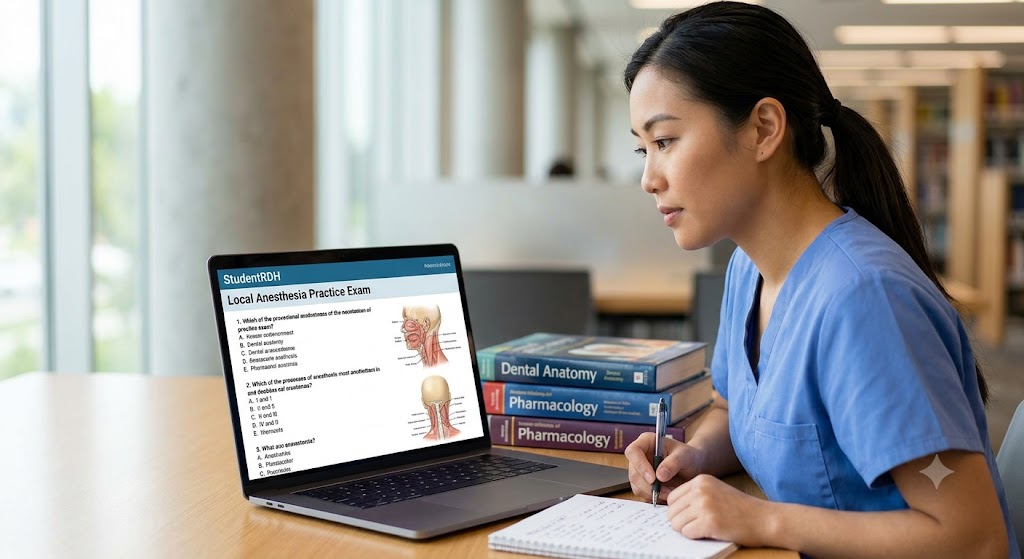
Additional Information
What the Course Entails and Exam Details
The focus of this practice exam covers the full spectrum of local anesthesia knowledge required for dental hygienists. The core topics included in the preparation materials and reflected in the practice questions usually cover:
Neurophysiology: How local anesthetics work on nerve cells to block pain signals.
Pharmacology of Local Anesthetics & Vasoconstrictors: Mechanism of action, metabolism, contraindications, and appropriate drug selection.
Head and Neck Anatomy: Precise knowledge of the nerves, blood vessels, and bony landmarks relevant to common dental injections.
Patient Assessment and Risk Management: Reviewing medical history, identifying potential complications, and determining maximum recommended dosages (MRD).
Armamentarium: Knowledge of syringes, needles, and anesthetic cartridges.
Injection Techniques: Reviewing protocols for maxillary and mandibular injections, such as the Inferior Alveolar (IA) block, infiltration, and PSA block.
Complications: Recognizing and managing local and systemic complications, including allergic reactions and toxicity.
What to Expect in the Final Exam
The official board exam you are preparing for generally consists of a written, multiple-choice format. The StudentRDH Local Anesthesia Practice Exam mirrors this structure, providing realistic practice questions that range from direct knowledge recall to complex clinical scenario applications.
Format: Multiple-choice questions, often featuring case studies and diagrams.
Passing Score: While practice exam passing scores vary, actual board exams typically require a score of 75% or higher to pass.
Time Limit: Expect the practice exam and the actual board exam to be timed, adding a realistic element of time management pressure.
How to Study and Exam Centers
Effective preparation is key to success. Here’s how to utilize this practice exam best:
Take the Exam Early and Often: Take an initial assessment to identify weak areas, then study those topics specifically and retake the exam to track progress.
Focus on Rationales: StudentRDH practice exams often include detailed rationales for correct and incorrect answers. Understanding why an answer is right or wrong is crucial for long-term retention.
Study Pharmacology and Anatomy Heavily: These are high-yield areas. Utilize anatomical charts and pharmacology flashcards alongside the practice test.
Simulate Exam Conditions: Take at least one full-length practice test in a quiet environment, timed, without notes.
The StudentRDH Local Anesthesia Practice Exam is taken online through the StudentRDH platform or mobile app, providing flexibility and convenience.
Please note: The actual licensure exam (e.g., WREB, CDCA-WREB-CITA, CRDTS) is typically scheduled through the respective regional testing agency or state board and administered at designated computer-based testing centers, such as Pearson VUE, or sometimes at authorized dental schools.
Job Opportunities from the Course
Successfully passing your dental hygiene board exams, including the local anesthesia component, is the final hurdle to obtaining your Registered Dental Hygienist (RDH) license. This certification is a prerequisite for nearly all clinical roles. Career paths unlocked by this achievement include:
Registered Dental Hygienist (RDH)
Clinical Dental Hygienist in private practice
Public Health Dental Hygienist (often in community clinics or schools)
Special Needs Dental Hygienist
Pediatric Dental Hygienist
Periodontal Dental Hygienist
Frequently Asked Questions
Reviews
5.0
Based on 0 reviews
Leave a Review
No reviews yet. Be the first to review!