
Student Development (SDV) ABLE Practice Exam
$69.00
- Buy to unlock unlimited access to all Quiz questions.
- After purchase you can print a PDF of the whole quiz at any point. The PDF will contain the questions and the correct answers.
About this Exam
The Student Development (SDV) ABLE Practice Exam is a comprehensive preparatory tool designed for students seeking to earn college credit through the Assessment by Local Examination (ABLE) pathway. This pathway is specifically tailored for experienced students who have already accumulated significant academic credits and possess a strong grade point average (GPA). It allows these students to demonstrate their existing mastery of essential college success skills without having to enroll in a formal one- or two-credit Student Development (SDV) course, such as SDV 100. Successfully challenging the SDV requirement through ABLE can save students time and money, accelerating their progress toward graduation and unlocking further academic opportunities.
Ready to test your knowledge?
Buy Now to Access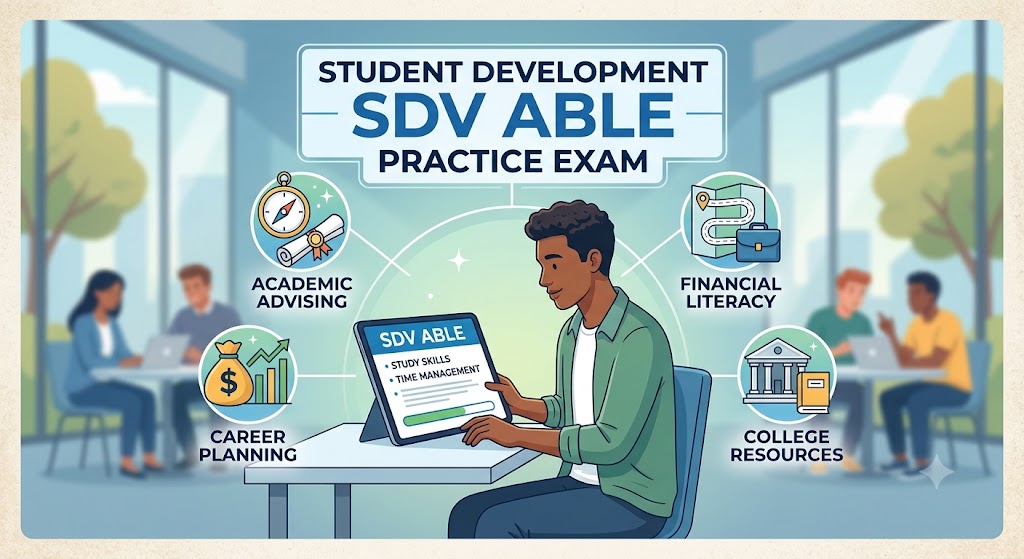
Additional Information
What the Course Entails and Exam Details
This examination is not associated with a specific instructor-led course; instead, it is a self-driven challenge that requires a candidate to prove competence in the core curriculum of a standard college success course. The comprehensive nature of the exam ensures that students are proficient in the foundational soft skills necessary for academic longevity and career readiness. The primary knowledge areas covered within the examination syllabus include:
Academic Advising and Planning: Understanding degree requirements, interpreting academic catalogs, and setting long-term educational goals.
Study Skills and Learning Strategies: Effective test-taking techniques, note-taking methods, and cognitive strategies for improved retention.
Time and Stress Management: Prioritization, organizational systems, and techniques for maintaining mental well-being in an academic environment.
Financial Literacy: Budgeting, understanding financial aid, debt management, and the basics of credit.
Career Exploration: Self-assessment methods, resume writing, and identifying potential career paths linked to academic majors.
College Resources: Familiarity with institutional support systems such as libraries, counseling services, and disability support services.
What to Expect in the Final Exam
It is crucial for students to understand that the ABLE exam is typically a one-time opportunity; if a student does not pass, they will usually be required to take the actual SDV course for credit. The exam format is standardized across institutions utilizing this model:
Question Format: The test consists exclusively of objective questions, primarily multiple-choice and true/false items.
Number of Questions: The exam typically contains 50 questions covering the diverse topic areas outlined above.
Time Limit: Students are allowed exactly 90 minutes to complete the exam once it is launched.
Passing Requirement: Institutions set a strict passing threshold, often requiring a minimum score of 75% to 76% to receive the credit-by-exam.
Prerequisites for Taking the Exam: Students generally must have completed a minimum number of college credits (e.g., 30+) and maintained a minimum cumulative GPA (e.g., 2.0+) to be eligible for this challenge.
How to Study and Exam Centers
The key to success in a self-driven ABLE exam is dedicated and structured preparation.
Recommended Study Strategies:
Review Standard SDV Materials: Since the ABLE exam tests the same outcomes as the SDV 100 course, reviewing open educational resources (OER) and standard textbooks dedicated to "College Success Skills" is highly effective. Focus heavily on time management matrices and academic planning.
Utilize the College Catalog: Thoroughly review your institution’s current catalog, paying close attention to graduation requirements, student code of conduct, and academic policies.
Focus on Weak Areas: For many students, the financial literacy or academic advising sections are the most challenging. Prioritize these during your study time.
Take the Practice Exam: Treat practice questions with the same rigor as the final test, adhering to the 90-minute time limit to build endurance.
Testing Center Information:
Because this is a Local Examination, the ABLE exam is administered primarily at authorized physical testing centers located on the campuses of the specific community college where the student is enrolled. The exam is typically delivered digitally via the institution's Learning Management System (such as Canvas) but requires strict proctoring by official college staff. Online or remote proctoring options may be available depending on the specific institution’s policies, but the exam is rarely offered through third-party vendors like Pearson VUE. Students must schedule their examination session in advance with their college testing center.
Job Opportunities from the Course
Earning the SDV credit via the ABLE exam does not provide a professional license or technical certification. However, it directly demonstrates to potential employers and university transfer boards that you possess highly developed foundational skills, resilience, and the self-discipline required for successful professional transition and long-term retention. These are essential transferable "soft skills" that enhance your employability across numerous sectors.
Direct Benefits to Career Pathing:
Proof of Competence: Demonstrates to future employers that you have mastered critical workforce readiness skills, such as complex problem-solving, active listening, and professionalism.
Transferability: A confirmed passing score on the ABLE exam ensures that the SDV requirement is met, removing barriers to degree completion and enabling transfer to four-year institutions.
Skill Application: The financial literacy and stress management techniques honed during preparation are directly applicable to managing professional life and career advancement.
Frequently Asked Questions
Reviews
5.0
Based on 0 reviews
Leave a Review
No reviews yet. Be the first to review!