
STEPP Marking Classified Information Practice Exam
$69.00
- Buy to unlock unlimited access to all Quiz questions.
- After purchase you can print a PDF of the whole quiz at any point. The PDF will contain the questions and the correct answers.
About this Exam
The STEPP Marking Classified Information Practice Exam is an essential preparatory tool for professionals working with, or aspiring to work with, sensitive national security information. The official exam, administered by the Defense Counterintelligence and Security Agency (DCSA) through its Security Training, Education, and Professionalization Portal (STEPP), validates an individual's ability to correctly identify and apply security classification markings to a variety of documents and materials. This practice exam simulates the official assessment, allowing military personnel, Department of Defense (DoD) employees, federal civilians, and approved defense contractors to test their knowledge and build confidence before taking the final, graded course exam required for official certification. Mastering this skill is non-negotiable for safeguarding the nation’s secrets and maintaining a career within the national security sector.
Ready to test your knowledge?
Buy Now to Access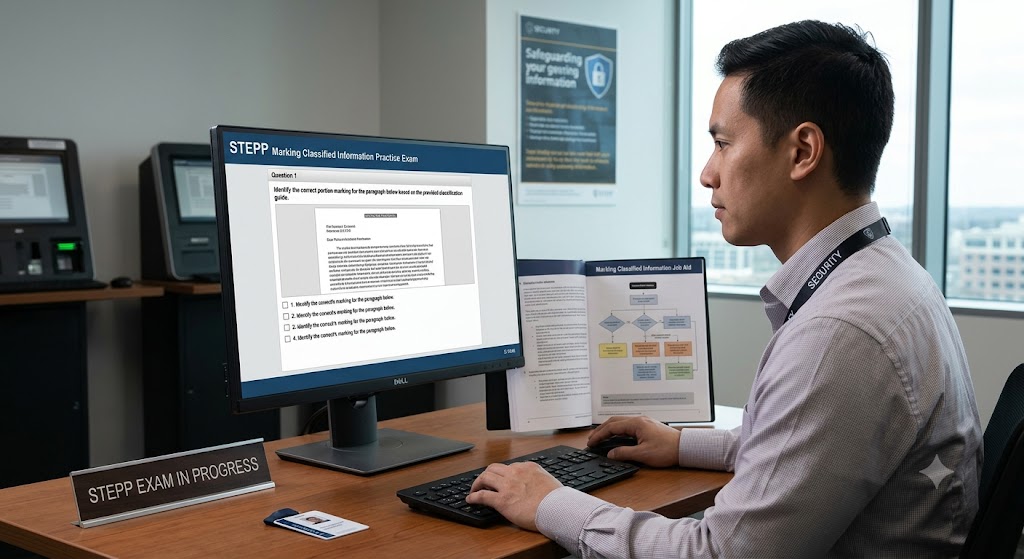
Additional Information
What the Course Entails and Exam Details
The comprehensive training that this practice exam supports covers the complete lifecycle and proper execution of classification management as mandated by executive orders and DoD policy. The practice exam will test your understanding and application of knowledge across several core modules. You can expect questions related to:
The purpose and types of classification levels: Top Secret, Secret, and Confidential.
The difference between original and derivative classification authority and responsibilities.
The required components of a classification marking, including portion markings, banner lines, and classification blocks.
Procedures for marking specific categories of materials, such as electronic data, emails, and legacy documents.
Recognizing and applying control and dissemination markings, including Controlled Unclassified Information (CUI), Restricted Data (RD), and Not Releasable to Foreign Nationals (NOFORN).
Process and syntax for downgrading and declassification instructions.
What to Expect in the Final Exam
The final certification exam for the Marking Classified Information course on STEPP is a rigorous assessment designed to ensure no errors are made in a critical real-world environment. While formats can vary slightly by specific curriculum, students should prepare for a multiple-choice or scenario-based examination. The exam will present documents or data fragments and require you to determine the correct markings based on provided classification guidance. A high passing score, typically 75% or higher, is required to receive a certificate of completion. You can generally expect a time limit to complete the exam, often around 60 to 90 minutes. The exam is proctored or administered securely through the STEPP online portal, and you must maintain integrity and follow all rules, as any unauthorized assistance is strictly prohibited.
How to Study and Exam Centers
Effective preparation is key to success on the STEPP Marking Classified Information Exam. First and foremost, take the practice exam multiple times. It is your best tool for identifying knowledge gaps and understanding the types of scenario-based questions you will encounter. We highly recommend reviewing the foundational source documents, especially the relevant volumes of DoD Manual 5200.01, which provide the authoritative guidance on classification management. DCSA CDSE (Center for Development of Security Excellence) also offers excellent, free “Job Aids” and "Security Shorts" videos that break down complex marking requirements into manageable concepts. Create flashcards for key acronyms, portion markings, and declassification instructions. To take the official, final exam, you will use your authorized STEPP account through the DCSA online portal. If you are a government employee or contractor, your Facility Security Officer (FSO) or agency security manager will facilitate your access to this secure learning management system.
Job Opportunities from the Course
A formal certification in Marking Classified Information through STEPP, validated by your success on the exam, is a significant differentiator that directly enables and unlocks various high-security career paths within the U.S. federal government and the defense industry. This credential proves your competency in one of the most critical aspects of information security. Some of the job opportunities it unlocks or enhances include:
Security Specialist
Information Security Manager
Facility Security Officer (FSO)
Intelligence Analyst
Program Manager with Security Responsibilities
Government Contractor (various technical and administrative roles requiring access)
Military Security Officer
Frequently Asked Questions
Reviews
5.0
Based on 0 reviews
Leave a Review
No reviews yet. Be the first to review!