
STCW Fire Safety Practice Test
$69.00
- Buy to unlock unlimited access to all Quiz questions.
- After purchase you can print a PDF of the whole quiz at any point. The PDF will contain the questions and the correct answers.
About this Exam
The STCW Basic Firefighting course is a cornerstone of maritime safety training, mandatory for virtually all seafarers operating on commercial vessels worldwide. Mandated by the International Maritime Organization (IMO) under the STCW (Standards of Training, Certification, and Watchkeeping) Convention, this certification ensures that crew members possess the essential knowledge and practical skills to respond effectively to fire emergencies at sea. It is designed for everyone from entry-level deckhands and stewards to experienced officers, as fire is one of the most serious hazards encountered on a ship.
Ready to test your knowledge?
Buy Now to Access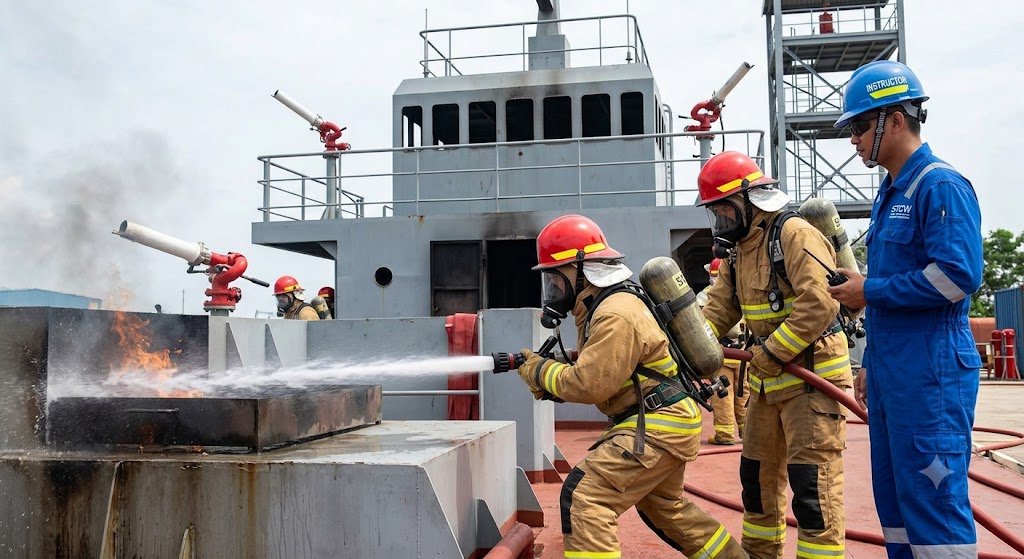
Additional Information
What the Course Entails and Exam Details
The STCW Fire Safety course blends theoretical learning with intensive practical training. The syllabus is rigorous and covers critical topics to ensure comprehensive preparation. Key areas include understanding the chemistry of fire (the fire triangle), classifications of fires (Class A through F/K), and the specific firefighting agents used for each. Participants learn about fire prevention strategies, shipboard fire organization, and the various types of fixed and portable fire-detecting and extinguishing systems found on vessels. A major component of the training involves the proper use of personal protective equipment, specifically Self-Contained Breathing Apparatus (SCBA), and safely navigating smoke-filled environments.
What to Expect in the Final Exam
The assessment for the STCW Basic Firefighting certificate usually consists of two parts: a theoretical examination and a practical evaluation.
Theoretical Exam: This component generally takes the form of a multiple-choice test. Candidates must demonstrate their understanding of fire theory, prevention, and emergency procedures. The passing score is typically around 70% or higher, and there is often a time limit (e.g., 45-60 minutes) to complete the exam.
Practical Evaluation: This is a crucial part of the certification. Candidates are assessed on their ability to correctly use firefighting equipment, including hoses, nozzles, and various fire extinguishers. A significant segment involves a smoke enclosure exercise, where students must don SCBA gear and work as a team to navigate a dark, smoke-filled structure, sometimes involving dummy rescue operations. Instructors look for competence in equipment handling, teamwork, and adherence to safety protocols. You must pass both the theoretical and practical sections to receive your certification.
How to Study and Exam Centers
How to Study: Success in the STCW Fire Safety exam requires a combination of rote learning and hands-on familiarity.
Review Course Materials: Thoroughly study the manual provided by your training provider.
Take Practice Tests: Utilizing online STCW Fire Safety practice exams is one of the most effective ways to prepare for the multiple-choice section. These help you become familiar with the phrasing of questions and identify gaps in your knowledge.
Focus on the Practical: Pay close attention during the practical training sessions. Don't hesitate to ask instructors for clarification on equipment use or procedures. Familiarize yourself with donning SCBA gear quickly and correctly.
Understand the 'Why': Don't just memorize facts; understand the principles of fire dynamics and why certain procedures are followed.
Exam Centers: The STCW Fire Safety exam is not taken at general centers like Pearson VUE. Instead, it must be completed at a dedicated maritime training provider (MTP) that is approved by the national maritime administration (e.g., the US Coast Guard in the USA, or the MCA in the UK). These authorized schools have the necessary specialized facilities, such as smoke complexes and fire training grounds, to conduct the required practical assessments safely and realistically. You will typically take the written exam at the same facility where you complete your practical training week.
Job Opportunities from the Course
The STCW Basic Firefighting certification is an absolute prerequisite for nearly all professional roles at sea. It is typically taken as part of the five-day STCW Basic Safety Training (BST) week. Obtaining this qualification unlocks numerous career paths, including:
Deck Cadet
Engine Cadet
Ordinary Seaman (OS)
Able Seaman (AB)
Marine Engineer
Steward/Stewardess (on yachts and cruise ships)
Cook
Cruise Ship Staff
Offshore Oil & Gas Worker
Superyacht Crew
Frequently Asked Questions
Reviews
5.0
Based on 0 reviews
Leave a Review
No reviews yet. Be the first to review!