
SSI Deep Diver Practice Exam
$69.00
- Buy to unlock unlimited access to all Quiz questions.
- After purchase you can print a PDF of the whole quiz at any point. The PDF will contain the questions and the correct answers.
About this Exam
The SSI Deep Diver Specialty is the definitive course for divers looking to safely expand their horizons and explore deeper underwater environments.
Designed for certified Open Water Divers (or equivalent), this intermediate program equips you with the knowledge, skills, and contingency plans necessary to conduct recreational dives to depths of up to 40 meters (130 feet).
It is not just about the number on your dive computer; this certification is a crucial step towards intermediate and advanced diving and a prerequisite for many exciting technical diving programs, unlocking a world of vertical walls, large pelagics, and untouched wrecks.
Ready to test your knowledge?
Buy Now to Access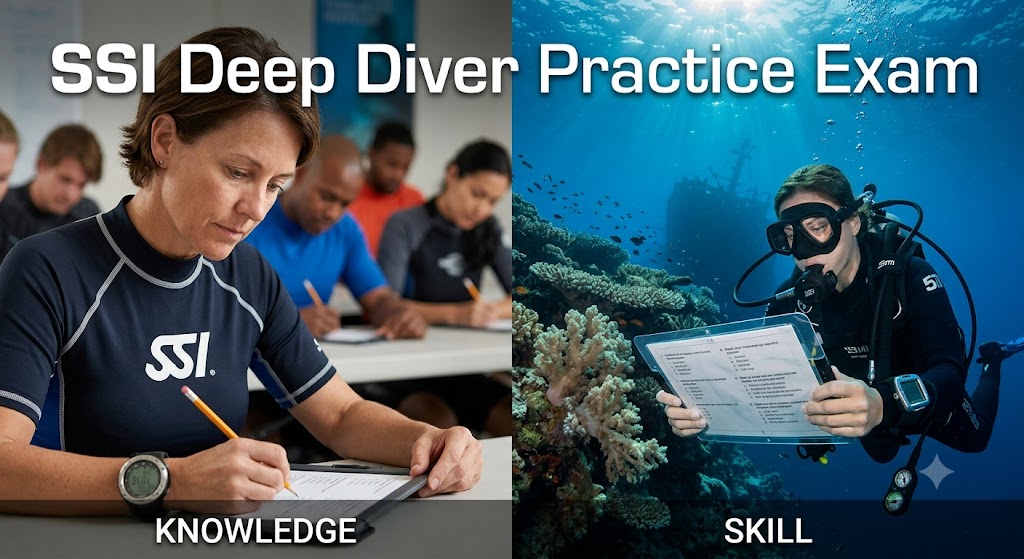
Additional Information
What the Course Entails and Exam Details
The SSI Deep Diver course covers a range of essential topics through a combination of academic sessions (typically 5 digital learning modules) and a minimum of three open water dives, with a maximum depth of 40 meters.
Key topics covered include:
The definition and planning of deep dives.
Specialized deep diving equipment, including redundant air sources and high-performance delivery systems.
The physics and physiology of deep diving, including the behavior of gases at depth.
Managing the unique risks and challenges, such as nitrogen narcosis, decompression sickness, and oxygen toxicity.
Gas management and consumption calculations to ensure a safe and successful dive.
Emergency procedures, contingency planning, and accident management.
The exam itself is integrated into your MySSI digital learning platform, serving as a comprehensive knowledge review to ensure your theoretical understanding is solid before your in-water training.
What to Expect in the Final Exam
While the primary assessment of your deep diving competency occurs during your in-water skill application and open water dives, the final exam on the SSI Digital Learning platform is a formal check of your knowledge.
You can expect the following:
A digital exam format, often featuring multiple-choice and true/false questions.
A minimum passing score, typically 80% or 90%, depending on the specific region or dive center, to advance.
The exam will cover all key theoretical concepts discussed in your manual, from physics to specialized gear.
It is designed to be a validation of your knowledge and should be completed individually.
Upon passing the written (digital) and practical assessments, and successfully executing your planning and dives, you will receive your international SSI Deep Diver digital certification.
How to Study and Exam Centers
Preparation for the written portion of the exam should be focused and organized.
Here are some effective study strategies:
Complete all Digital Learning Modules: This is your primary source. Work through the MySSI deep diving material thoroughly.
Utilize the Review Questions: Pay close attention to the quick reviews and tests at the end of each section in the app. They are directly related to the final exam content.
Create a Study Plan: Break down the manual into manageable sections and review them over multiple days to aid retention.
Focus on Key Concepts: Understand the practical application of concepts like gas consumption and nitrogen narcosis management, not just the definitions.
Discuss with Your Instructor: Clarify any confusing points or real-world scenarios with your SSI Instructor during your review sessions.
For the theory exam, your "exam center" is the MySSI online portal or app, allowing you to complete it at your own pace from anywhere.
However, to complete the mandatory in-water training and open water dives, you must register with and visit an authorized SSI Training Center. These centers are located worldwide, ensuring you can find professional training wherever you are, from cozumel to Cairns.
Job Opportunities from the Course
A Deep Diver certification opens a wide array of career paths within the diving industry and related fields.
It is often the foundational step for these exciting roles:
Divemaster / Dive Guide: Assisting instructors and leading certified divers on complex or deep dive sites.
Marine Conservation Diver: Participating in scientific research, coral reef restoration, and species monitoring, which frequently occurs at greater depths.
Public Safety Diver: A crucial qualification for search, rescue, and recovery operations for emergency services and law enforcement.
Underwater Photographer / Videographer: Capturing professional content on wrecks and large marine life, often requiring deep diving skills for the best shots.
Equipment Technician & Gear Specialist: While not always required, deep diving experience is valuable for understanding the performance of specialized equipment like high-performance regulators and dive computers.
Aquarium & Tank Diver: Maintaining and conducting presentations in large exhibits, some of which require deep-water skills for large-scale operations.
Scientific Diver: Conducting research for universities, research institutions, and environmental consultancies, which often extends past 18 meters.
Dive Travel Consultant: Specializing in liveaboard and advanced dive trip bookings, where deep diving knowledge is essential to advise clients.
Dive Resort Operations Staff: Deep diving certification is highly valuable for varied roles on liveaboards and at remote resorts.
Frequently Asked Questions
Reviews
5.0
Based on 0 reviews
Leave a Review
No reviews yet. Be the first to review!