
Ssat Practice Test & Exam Prep
$69.00
- Buy to unlock unlimited access to all Quiz questions.
- After purchase you can print a PDF of the whole quiz at any point. The PDF will contain the questions and the correct answers.
About this Exam
The Secondary School Admission Test (SSAT) is a standardized entrance exam used by independent and private schools worldwide, primarily in the United States and Canada, to assess the academic abilities of students seeking admission in grades 5 through 12. It serves as a common benchmark, allowing admission officers to compare the skills of students from diverse educational backgrounds. The SSAT is designed to evaluate core verbal, mathematical, and reading comprehension skills, providing schools with valuable insights into a student's potential for academic success in their rigorous environments.
Ready to test your knowledge?
Buy Now to Access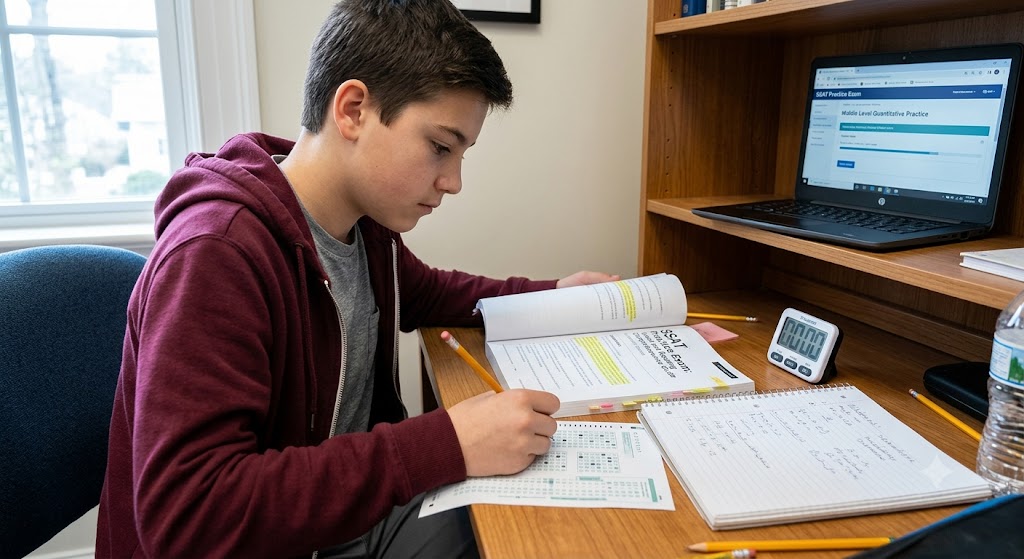
Additional Information
What the Course Entails and Exam Details
Preparing for the SSAT requires a focused approach, and comprehensive "courses" or study programs essentially focus on mastering the key sections covered in the exam. These topics include:
Verbal: This section measures vocabulary strength and logical reasoning through synonyms and analogies.
Quantitative (Math): The quantitative section assesses proficiency in arithmetic, elementary algebra, and geometry concepts, appropriate for the student's current grade level. It focuses on problem-solving and applying mathematical reasoning.
Reading Comprehension: Students must read and analyze passages from various sources, answering questions that test their ability to grasp main ideas, make inferences, and understand the meaning of words in context.
Writing Sample: While not included in the official score sent to schools, the essay or creative writing prompt provides admission committees with a valuable example of the student's writing ability and thought processes under timed conditions.
What to Expect in the Final Exam
The SSAT is a strictly timed, standardized test administered either on paper at designated test centers or, for Middle and Upper levels, on a computer via the SSAT at Home option. Here’s a breakdown of what to expect:
Format: The exam predominantly consists of multiple-choice questions, with five answer choices (A, B, C, D, E) for each. The writing section requires an open-ended essay response to a prompt.
Scoring: SSAT scoring is slightly unique. Students receive a raw score based on correct answers, but a small deduction (1/4 point) is taken for incorrect answers to discourage random guessing. Unanswered questions do not affect the score. This raw score is then converted into a scaled score, which varies by the level of the test (Elementary, Middle, or Upper), and finally, a percentile rank comparing the student to a norm group of test-takers from the same grade and gender.
Time Limit: The total testing time is approximately 2 hours and 5 minutes, including scheduled breaks.
Rules: Strict protocols must be followed during the test administration. Calculators, rulers, and reference materials are not permitted. Standard test-taking items like specific pencils are allowed, and for the computer-based test, specific system requirements must be met.
How to Study and Exam Centers
Effective preparation is key to achieving a strong score on the SSAT. Here are proven study strategies and information on test administration:
How to Study:
Take Official Practice Tests: Start by taking an official SSAT practice exam under timed conditions. This provides a baseline score and helps identify strengths and weaknesses.
Target Weak Areas: Analyze practice test results and dedicate focused study time to reviewing concepts in weaker sections, whether it’s specific math topics, vocabulary building, or reading strategies.
Use Quality Study Materials: Invest in reputable SSAT prep books and online resources that offer practice questions, explanations, and strategies.
Practice Regularly: Consistent, scheduled practice is more effective than cramming. Dedicate focused time each day or week to SSAT preparation.
Simulate Test Conditions: Practice taking full-length practice tests under the same timed conditions as the actual exam to build endurance and improve time management.
Exam Centers:
The SSAT is administered by the Enrollment Management Association (EMA). Students can take the test in several ways:
Standard Paper-and-Pencil Administration: Offered on specific dates throughout the testing year (typically fall through spring) at numerous participating independent schools and designated test centers worldwide.
SSAT at Home (Middle and Upper Levels): This computer-based option allows students in grades 5-11 to take the SSAT securely from their own homes, remotely proctored by live supervisors. This option offers more flexibility in scheduling.
Registration for all versions of the SSAT must be completed in advance through the official SSAT website (ssat.org).
Academic Opportunities and Future Pathways
A strong performance on the SSAT doesn't directly unlock job titles, as the test is for high school admission. However, it opens doors to significant academic opportunities that pave the way for successful future careers. Excelling on the SSAT and securing admission to competitive independent schools often leads to:
Admission to highly regarded, academically rigorous private secondary schools.
Access to advanced and challenging curricula, including Advanced Placement (AP) or International Baccalaureate (IB) programs.
More comprehensive support for college applications, including dedicated college counseling services.
Opportunities for specialized programs in STEM, the arts, athletics, or leadership development.
A strong academic foundation and network that facilitates entry into selective colleges and universities.
Frequently Asked Questions
Reviews
5.0
Based on 0 reviews
Leave a Review
No reviews yet. Be the first to review!