
SQA National 5 Drama Practice Exam
$69.00
- Buy to unlock unlimited access to all Quiz questions.
- After purchase you can print a PDF of the whole quiz at any point. The PDF will contain the questions and the correct answers.
About this Exam
The SQA National 5 Drama qualification is an engaging, introductory course designed for secondary school students in Scotland who have a passion for the performing arts. This course serves as a critical stepping stone for those interested in exploring the world of theater, acting, and production. It provides a balanced foundation in both the practical skills required for performance and the analytical understanding needed to evaluate dramatic work.
Ready to test your knowledge?
Buy Now to Access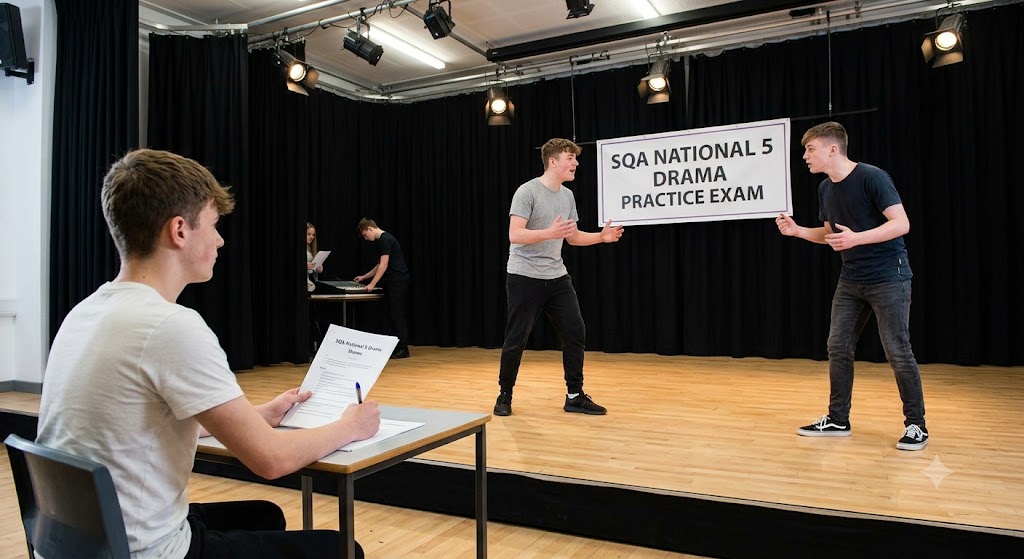
Additional Information
What the Course Entails and Exam Details
The SQA National 5 Drama course is structured around two main components that develop a holistic understanding of theater:
Drama Skills: Students learn the fundamental techniques of acting, characterization, and devised performance. This involves exploring voice, movement, and emotional expression to create compelling characters. They also learn how to respond to stimuli, work collaboratively in groups, and structure dramatic narratives.
Production Skills: This component focuses on the technical aspects of theater. Students gain hands-on experience in at least two production areas, such as lighting, sound, set design, costume design, or makeup and hair. They learn how to use these technical elements to enhance the artistic vision of a performance.
What to Expect in the Final Exam
The final assessment for SQA National 5 Drama is comprised of two distinct parts that evaluate both practical application and theoretical knowledge:
Part 1: Performance/Design Practical Examination: This is a significant component where students are assessed on their ability to apply the skills learned in either acting or production roles. For actors, this involves preparing and presenting two contrasting extracts from published plays. For production students, it means designing and demonstrating their chosen skills (e.g., setting up lighting cues or presenting a complete costume plot) for a live performance context. This practical exam is typically assessed internally by the center and externally verified by SQA examiners.
Part 2: Question Paper: The written exam is a structured paper that tests candidates' understanding of dramatic theory, analysis of performance, and ability to respond to a textual extract. It often includes short-answer questions, character analysis based on a provided scene, and a longer essay-style question requiring students to analyze a live performance they have viewed or reflect on their own practical work experience. Students must demonstrate their knowledge of theatrical terminology, production concepts, and the relationship between text and performance. Passing scores are subject to yearly standard-setting but generally require achieving a minimum percentage across both components.
How to Study and Exam Centers
Preparation for the SQA National 5 Drama exam requires a blend of practical rehearsal and theoretical review. Students should:
Practical Preparation: Dedicate consistent time to rehearsing acting pieces, focusing on character development, projection, and interaction. For production students, this means mastering the technical equipment and creating detailed design plans and cue sheets. Seeking feedback from teachers and peers is crucial.
Theoretical Study: Thoroughly review all course notes, vocabulary lists, and analyzing dramatic structures. Practicing past papers is essential to understand the layout of the question paper and the types of responses examiners expect. Students should also gain experience analyzing live or recorded theater performances.
Exam Centers: The SQA National 5 Drama exams are not taken at independent test centers like Pearson VUE. Instead, they are administered directly within the students' registered secondary schools or other authorized SQA centers across Scotland. The school coordinates both the practical performance dates and the scheduling of the written question paper.
Job Opportunities from the Course
Successfully completing the SQA National 5 Drama course can be the first step towards a wide array of exciting careers in the creative industries. While further education and training (such as Higher Drama, NC, or HND/Degree level courses) are typically required for professional roles, this qualification unlocks foundational paths in:
Actor
Stage Manager
Director
Lighting Designer
Sound Designer
Set Designer
Costume Designer
Makeup Artist (for TV/Film/Theater)
Drama Teacher (requires further academic qualification)
Creative Director
Theater Education Officer
Arts Administrator
TV/Film Production Assistant
Scriptwriter
Frequently Asked Questions
Reviews
5.0
Based on 0 reviews
Leave a Review
No reviews yet. Be the first to review!