
SQA Higher Computing Science Practice Exam
$69.00
- Buy to unlock unlimited access to all Quiz questions.
- After purchase you can print a PDF of the whole quiz at any point. The PDF will contain the questions and the correct answers.
About this Exam
Welcome to your essential resource for the SQA Higher Computing Science Practice Exam. This qualification is a pivotal step for students in Scotland (typically S5 or S6) who are looking to deepen their understanding of how the digital world is built and managed. It is designed for those with an interest in problem-solving through computational thinking, data analysis, and software creation. By achieving this qualification, students demonstrate a level of analytical and critical expertise that is highly valued by both further education institutions and employers in the expanding technology sector. This practice exam environment is the perfect space to hone your skills before the final test.
Ready to test your knowledge?
Buy Now to Access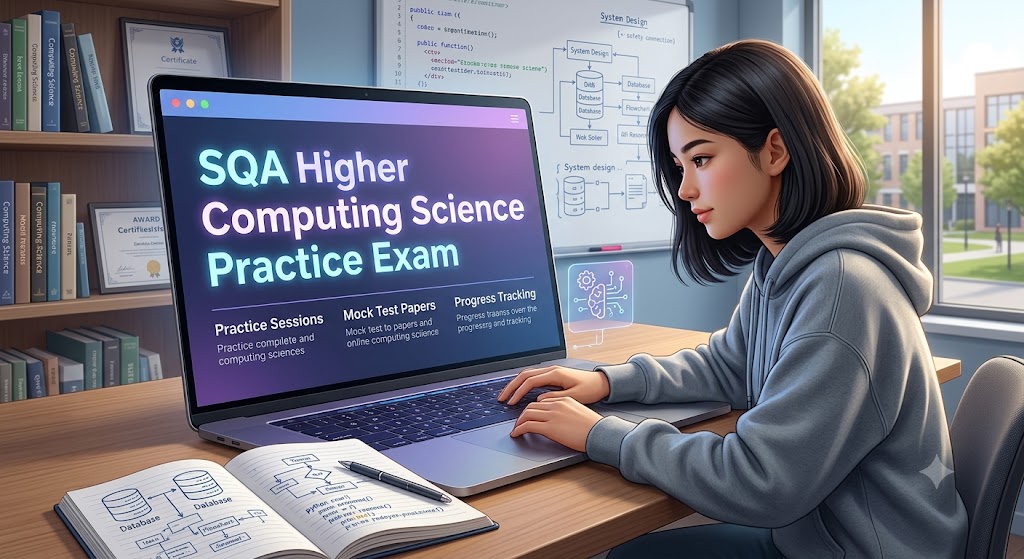
Additional Information
What the Course Entails and Exam Details
The Higher Computing Science course covers four primary areas of study, providing a comprehensive foundation in the field. Students will explore: Software Design and Development (creating applications using high-level programming languages); Database Design and Development (structuring, organizing, and querying complex data sets); Web Design and Development (building dynamic, interactive websites); and Computer Systems (understanding the internal architecture and security of modern technology).
The SQA assessment for Higher Computing Science currently has two components:
Coursework Assignment (50 marks): An internal, practical task completed earlier in the academic year.
Question Paper (110 marks): The final external examination, which is what this practice exam simulates.
What to Expect in the Final Exam
The final Question Paper is a rigorous, written exam lasting 2 hours and 30 minutes, with a total of 110 marks available. It is divided into two sections. Section 1 (80 marks) focuses on computer systems and software development, requiring you to apply your knowledge to short and extended-response questions. Section 2 (30 marks) covers database and web development, testing your ability to design and implement solutions in these crucial areas. To succeed, you will need to demonstrate deep knowledge of theoretical concepts and the practical application of coding principles (including pseudocode), SQL, HTML, CSS, and Javascript. A pass typically requires achieving a score above roughly 50%, though the exact boundary varies annually based on paper difficulty.
How to Study and Exam Centers
The most effective way to prepare is through consistent, active revision. Use SQA past papers (available from 2015 onward) and their corresponding marking instructions as your primary tool; this helps you understand the exam format and exactly how marks are awarded. Supplement this by revisiting core concepts in your notes, using approved revision guides (such as Leckie or Bright Red), and practicing your coding skills on platforms like Python or Repl.it. For SQL and web design, practical implementation is key—build small projects to solidify your learning. Remember to review your understanding of theory from the Computer Systems unit, including security and low-level architecture.
The final external exam is organized directly by your school, college, or authorized SQA center. These are typically local secondary schools across Scotland, but other accredited educational institutions may also serve as centers. Check with your Computing Science department for your specific exam schedule and location.
Job Opportunities from the Course
Successfully achieving the Higher Computing Science qualification is a significant step toward a career in Scotland’s booming technology sector. It provides the essential entry requirement for many university degree courses in computer science, software engineering, and data science. The critical thinking, logical analysis, and practical coding skills you develop are highly sought after in the professional world.
Career paths that this qualification unlocks (often requiring further specialized study) include:
Software Developer
Web Developer / Front-end Engineer
Data Analyst
Database Administrator
Systems Analyst
Cybersecurity Specialist
Game Developer
IT Consultant
Computer Scientist
Frequently Asked Questions
Reviews
5.0
Based on 0 reviews
Leave a Review
No reviews yet. Be the first to review!