
SPCB Applicator Practice Exam
$69.00
- Buy to unlock unlimited access to all Quiz questions.
- After purchase you can print a PDF of the whole quiz at any point. The PDF will contain the questions and the correct answers.
About this Exam
The Structural Pest Control Board (SPCB) Applicator certification is the vital entry-level step for anyone aiming to build a career in the professional pest control industry. This license is specifically designed for individuals who will be hired by a registered pest control company to apply pesticides and rodenticides to control structural pests. It is a foundational credential, validating that you possess the essential knowledge required to perform these duties safely, effectively, and in compliance with state regulations. Whether you are new to the field or looking to formalize your role within a company, earning this license is your first major milestone.
Ready to test your knowledge?
Buy Now to Access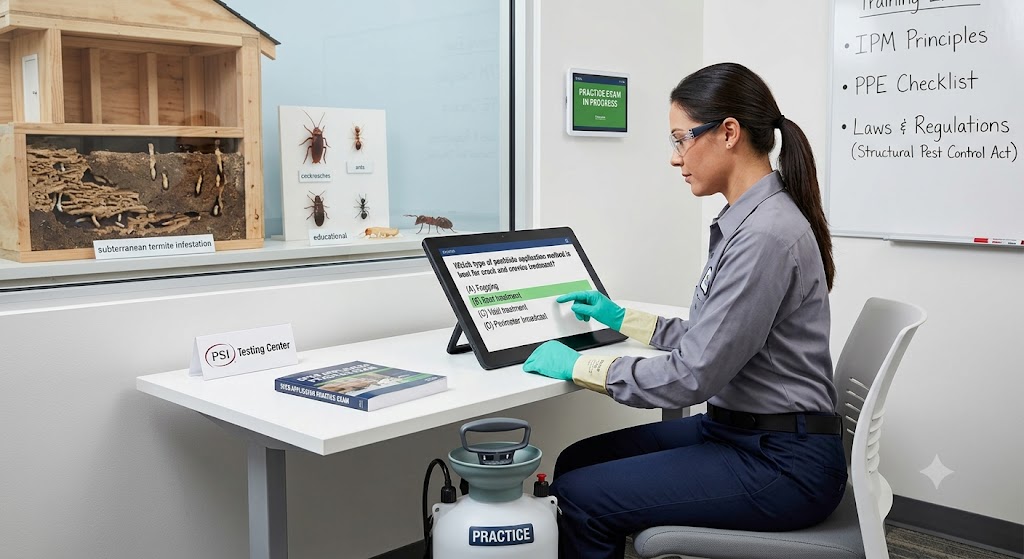
Additional Information
What the Course Entails and Exam Details
This course and the corresponding exam provide a comprehensive overview of structural pest management. Candidates are expected to master a wide range of subjects that are critical for both passing the exam and performing the job. The core topics covered include:
Pesticide Safety: Understanding product labels, Personal Protective Equipment (PPE), and emergency procedures.
Laws & Regulations: Familiarity with state-specific structural pest control acts and regulations governing application.
Pest Identification and Biology: Recognizing common structural pests, including wood-destroying organisms (Branch 3), common household pests (Branch 2), and their life cycles.
Integrated Pest Management (IPM): Employing non-chemical and chemical methods in a balanced, sustainable strategy.
Pesticide Formulations and Equipment: Identifying different chemical formulations and their proper application methods, including duster and sprayer operation and calibration calculations.
Environmental Hazards: Mitigating the impact of pesticide use on non-target organisms, groundwater, and air quality.
What to Expect in the Final Exam
The SPCB Applicator exam is a computer-based, proctored test. You will need to bring valid, government-issued photo identification. You can generally expect immediate results upon completion. The exam details are:
Format: Multiple-choice questions.
Time Limit: Typically 1 to 2 hours, though exact times can vary by testing vendor (e.g., 90 minutes is common).
Passing Score: A passing grade is typically 70% or higher.
Rules: The exam is closed-book. No external study materials, programmable calculators, or mobile devices are permitted in the testing area.
Retakes: If you do not pass, there is usually a mandatory waiting period (e.g., 15 to 30 days) and a re-examination fee.
How to Study and Exam Centers
Preparing for this exam requires a strategic combination of official study materials and practice. Here are actionable steps to succeed:
Study the Candidate Handbook: The SPCB or its testing vendor provides a Candidate Handbook that is your single most important resource. It outlines the full content specifications of the exam.
Use SPCB Suggested Materials: The board often provides a list of recommended reading materials or study guides tailored to the applicator content.
Practice, Practice, Practice: Utilize a practice exam, like this one, to simulate the test environment. Look for resources that offer diverse, scenario-based multiple-choice questions to build confidence and reinforce knowledge. Pay attention to the "why" behind correct and incorrect answers.
Formulate a Study Plan: Break the syllabus into manageable sections and allocate study time to each. Don't cram; consistent review is key.
Exam Centers: The final exam is typically administered through third-party testing vendors with locations nationwide, such as PSI Exams. You will need to schedule your appointment in advance through their online portal or by phone. Some states may also have authorized physical testing centers at specific government or educational institutions.
Job Opportunities from the Course
Earning your SPCB Applicator license is the key to unlocking several career paths within the essential and growing pest management industry. This certification is usually a prerequisite to hold one of the following positions:
Structural Pest Control Applicator (Branch 2 or 3)
Pest Control Technician
Termite Control Technician / Applicator
Route Manager
Exterminator (Residential or Commercial)
Initial Sales/Technician roles that require applying pesticide while training to become a Field Representative
Frequently Asked Questions
Reviews
5.0
Based on 0 reviews
Leave a Review
No reviews yet. Be the first to review!