
SOCRA CCRP Practice Exam
$69.00
- Buy to unlock unlimited access to all Quiz questions.
- After purchase you can print a PDF of the whole quiz at any point. The PDF will contain the questions and the correct answers.
About this Exam
The Society of Clinical Research Associates (SOCRA) Certified Clinical Research Professional (CCRP) certification is a globally recognized and highly respected credential in the clinical research industry.
It is designed for dedicated professionals who manage, monitor, and coordinate clinical trials, aiming to validate their expertise in ethical and regulatory standards.
Whether you are a clinical research coordinator, a research assistant, or a clinical trial monitor, this certification proves your comprehensive understanding of the complex frameworks that protect patient safety and ensure data integrity.
Earning the CCRP designation not only elevates your professional credibility but also demonstrates your unwavering commitment to excellence in the clinical research field.
Ready to test your knowledge?
Buy Now to Access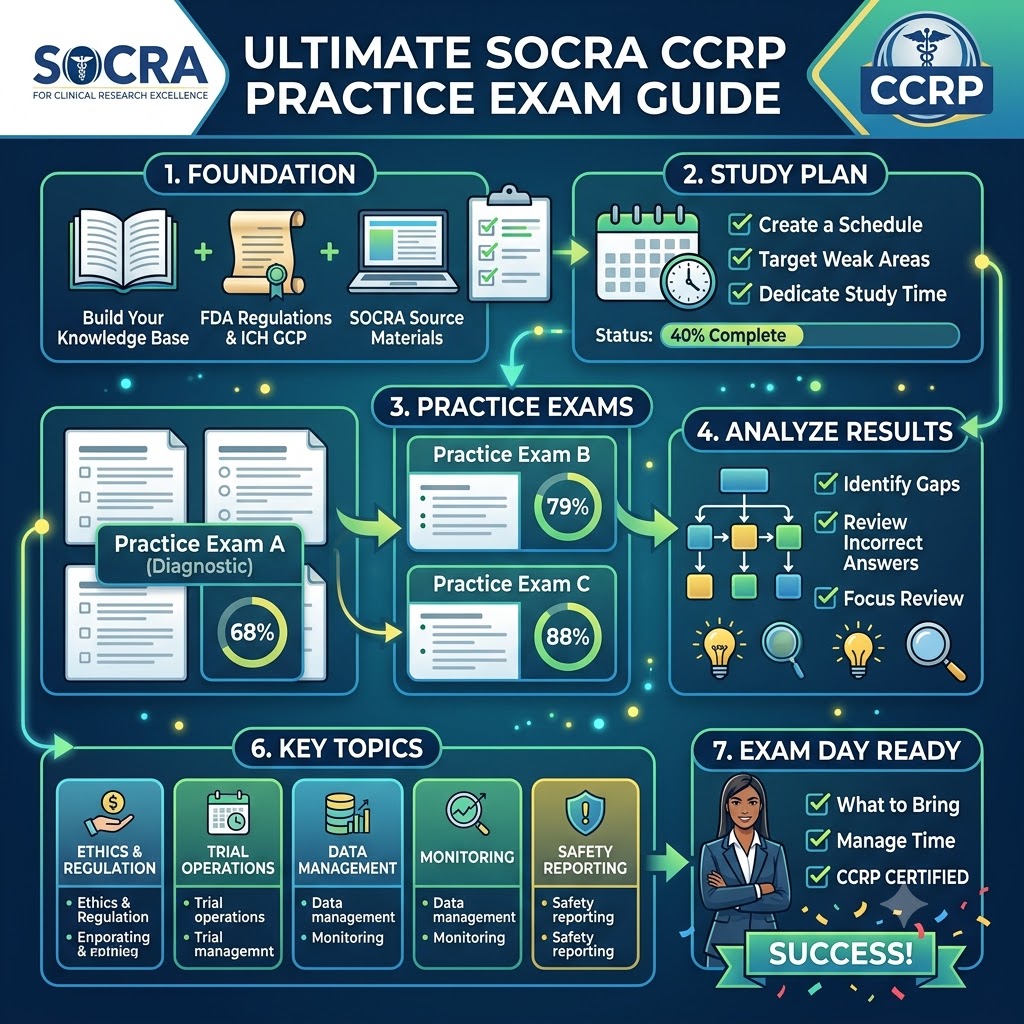
Additional Information
What the Course Entails and Exam Details
Preparing for the CCRP exam requires a deep dive into the entire lifecycle of a clinical trial.
The core syllabus is strategically divided into three main operational phases: Research Study Start-Up, Research Study Implementation, and Research Study Closure.
You will master essential topics such as Good Clinical Practice (ICH-GCP) guidelines, FDA regulations (including 21 CFR parts 50, 56, 312, and 812), and fundamental ethical frameworks like the Belmont Report and the Declaration of Helsinki.
The curriculum also extensively covers critical operational skills, including informed consent processes, safety reporting, adverse event management, protocol adherence, and institutional review board (IRB) responsibilities.
By engaging with these subjects, you develop a robust, practical understanding of how to seamlessly navigate sponsor, investigator, and regulatory obligations.
What to Expect in the Final Exam
The SOCRA CCRP final exam is a rigorous assessment designed to test both your factual knowledge and your ability to apply it to real-world scenarios.
The test consists of 130 multiple-choice questions, of which 100 are scored and 30 are unscored pre-test items used to evaluate future exam forms.
Candidates are given a generous time limit of 4 hours to complete the examination, allowing ample time to carefully read and analyze situational questions.
To achieve a passing score, candidates typically need to answer approximately 71 of the 100 scored questions correctly, though the exact threshold is determined via a scaled scoring system that varies slightly by exam form.
You must strictly adhere to testing regulations, which include non-disclosure of exam materials and presenting valid, government-issued identification prior to testing.
How to Study and Exam Centers
Success on the CCRP exam stems from a highly structured, strategic study plan that incorporates active recall and scenario-based thinking.
Start by thoroughly reviewing the official SOCRA Candidate Handbook and focusing heavily on primary source documents like the ICH E6(R2) GCP guidelines and federal regulations.
Taking a SOCRA CCRP practice exam is one of the most effective ways to familiarize yourself with the question formats, identify your knowledge gaps, and build test-day confidence.
When you are ready to test, you will find that the logistics are incredibly flexible and accommodating.
SOCRA has fully transitioned to Computer-Based Testing (CBT), allowing you to schedule your exam year-round at any authorized Prometric testing center globally.
If you prefer testing from the comfort of your own home, you can also opt for remote at-home testing via the ProProctor system, provided your testing environment meets strict technical and security requirements.
Job Opportunities from the Course
Achieving the CCRP certification unlocks a wealth of dynamic career paths and leadership opportunities within pharmaceuticals, biotechnology, academic medical centers, and Contract Research Organizations (CROs).
Professionals holding this credential frequently step into the role of a Clinical Research Coordinator (CRC), where they manage daily trial activities and patient interactions.
Another prominent path is becoming a Clinical Research Associate (CRA), a role focused on monitoring multiple trial sites to ensure absolute regulatory compliance and data accuracy.
You will also be highly qualified for advanced positions such as a Clinical Trial Manager (CTM) or a Clinical Project Manager, where you will oversee the strategic execution of massive global studies.
Additionally, this certification paves the way for specialized roles like Regulatory Affairs Specialist, Clinical Research Auditor, and Site Director, giving you incredible mobility to shape your long-term career in clinical research.
Frequently Asked Questions
Reviews
5.0
Based on 0 reviews
Leave a Review
No reviews yet. Be the first to review!